


추부길 whytimespen1@gmail.com
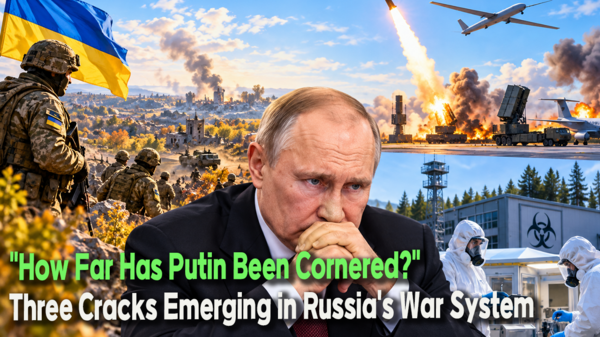
[The First Crack - The Frontline Built Over 21 Months Begins to Waver]
For Russian President Vladimir Putin, the autumn of the war’s fifth year feels far from ordinary. In northern Donbas, long-accumulated Russian territorial gains are wavering under Ukraine’s "Operation Vivaldi," while Iskander missile operational sites and military airfields inside Russia proper are now exposed to Ukrainian long-range strikes.
It is under these precise circumstances that Ukrainian President Volodymyr Zelenskyy claimed, citing intercepted intelligence, that Putin has removed constraints on airstrikes and issued orders effectively signaling that "now there are no rules." Meanwhile, in Siberia, the death of a plague research facility employee from an unexplained pneumonia has prompted the U.S. government to monitor the situation closely. With three simultaneous cracks surfacing across the frontlines, the rear guard, and Russia's internal control system, just how far has Putin been backed into a corner?
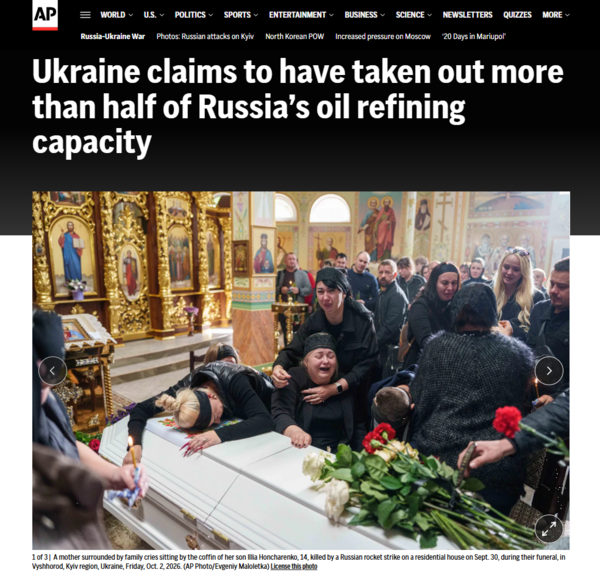
AP News reported on the 6th: "What hurts Putin most right now is not how many square kilometers he lost in Ukraine, but that the impact of the war itself has begun to penetrate deep into Russian territory." It added: "Ukraine's Ministry of Defence claimed that its long-range strikes have incapacitated 51% of Russia's total oil refining capacity, with targets including refining facilities in Moscow, Yaroslavl, Ust-Luga, Perm, Saratov, and Syzran."
AP continued: "The war is no longer being fought exclusively on Ukrainian soil; it is reversing inward toward Russia's energy, economy, and its very capacity to wage war." The problem for Putin is that while the Russian rear is coming under attack, uncomfortable developments continue to unfold on the Donbas front as well.
In a recent battlefield assessment released on the 5th analyzing combat footage and official statements from both sides, independent news website Meduza noted: "Ukraine's 'Operation Vivaldi' in the Lyman direction is yielding tangible results." What Meduza particularly highlighted was the discrepancy between Russian claims and actual frontline reality.
Meduza evaluated: "While Russian forces claim to have surrounded large Ukrainian formations, Ukrainian troops are actually continuing operations to push Russian forces back from their first line of defense—and that operation itself is progressing successfully." It emphasized: "Crucially, the territorial gains Russia incrementally built up over more than 21 months in this area have been significantly shaken by months of Ukrainian counteroffensives."
This trend becomes even clearer when examining the numbers. In its battle assessment published on October 1, the Institute for the Study of War (ISW) analyzed: "While Russian forces seized 175.54 km² of Ukrainian territory in September, they lost control over 293.59 km², recording a net loss of 118.05 km²." Even more severe are the human casualties. According to the General Staff of the Ukrainian Armed Forces, Russian casualties in September alone reached 46,320. This marks the highest monthly loss of 2026 and the third consecutive month exceeding 40,000. The ISW offered an even more blunt assessment: "Russian forces likely gained virtually no territory in September despite suffering over 46,000 casualties." This implies that the return on investment for the personnel-heavy war of attrition Russia has relied on for years is falling off a cliff.
The strategic significance of Operation Vivaldi is equally critical. According to open-source data confirmed by ISW, Operation Vivaldi has liberated at least 147 km². However, its location is what matters most. In pressing toward Lyman, Russian forces aimed to achieve a broad encirclement of Ukraine’s so-called "fortress belt"—including Sloviansk and Kramatorsk—from the east and south over the long term. But as the Lyman salient wavered, this overarching plan hit a snag. ISW noted that even Russian military bloggers have begun expressing concern that Operation Vivaldi could disrupt Russian advances east of Sloviansk. Ultimately, Vivaldi shook far more than just 147 km² of land; it fractured the broader blueprint Putin had drawn for the northern Donbas front.
[The Second Crack - Russian Air Bases 500 km Behind the Frontline Struck]
The issue extends beyond attacks on Russian energy infrastructure. The Security Service of Ukraine (SBU) announced on the 4th: "Drones operated by the Alpha Special Operations Center struck Khanskaya Military Airfield in the Republic of Adygea in southern Russia—approximately 500 km behind Ukrainian lines." The SBU stated that the drone strike hit Su-35 multirole fighters, Su-34 fighter-bombers, and an ammunition depot.
The Kyiv Independent noted: "The Su-34 serves as the primary delivery platform for guided glide bombs used by Russian forces against Ukrainian positions and cities, while the Su-35 remains a core fighter of the Russian Air Force." It highlighted: "What warrants close attention here is the strike location. It indicates that Ukraine is no longer merely attempting to shoot down Russian jets in the sky, but is actively hunting and striking them at their launch bases 500 km away from the frontlines."
Amid these developments, an absurd incident occurred within Russia's rear air defense network. On October 1, a Russian Mi-8 helicopter crashed in Voronezh Oblast, killing three crew members. The issue lies in the cause of the crash. Both Russian and Ukrainian military channels reported that a Russian Su-35 fighter jet, while attempting to intercept a large-scale Ukrainian drone attack, mistook the Mi-8 for a Ukrainian drone and shot it down.
If true, the implications are substantial. It demonstrates that Ukrainian drones—even without directly destroying Russian aircraft—are straining Russian air defenses to the extreme, placing a severe burden on friend-or-foe identification and command-and-control operations.
[The Third Crack - And Then Came "Now There Are No Rules"]
It was against this backdrop that Zelenskyy made his revelation. In a recent interview with foreign media, drawing on Ukrainian intelligence and intercepted Kremlin communications, Zelenskyy claimed: "Putin has approved new guidelines lifting previous restrictions on air strikes and expanding target sets to include civilian infrastructure." The phrase allegedly uttered during this process was: "Now there are no rules."
In an interview with Reuters on the 3rd, Zelenskyy reiterated: "Putin has approved a so-called 'new doctrine' expanding strikes against civilian targets," adding, "Ukraine will respond by continuing to strike Russian oil refineries." While the Kremlin denied deliberately targeting civilian facilities like schools and hospitals, Russian airstrikes hit civilian areas again just one day later.
Reuters reported on the 5th: "Russian airstrikes hit residential areas in Kharkiv, Ukraine's second-largest city, killing 6 people and injuring 59," noting that children were among the wounded. On the same day, Russian drones ignited a fire in an apartment building in Zaporizhzhia, while Russian strikes in Sloviansk also resulted in civilian fatalities.
[An Unexpected Event Erupts in Siberia]
Meanwhile, an unexpected crisis of a completely different nature erupted inside Russia. Reuters reported: "Dariya Shipilova, a 28-year-old researcher at a plague research facility in Irkutsk, Siberia, died from an 'unexplained pneumonia.'" Local media reports raised the possibility of a laboratory accident involving plague pathogens, leading authorities to place approximately 200 people under quarantine or medical observation. While Shipilova’s actual infection with plague remains unconfirmed officially, confusion surrounding initial disclosures by Russian authorities has led the U.S. government to monitor the situation closely.
On the 5th, U.S. President Donald Trump addressed the issue directly. Speaking to reporters at the White House, Trump characterized the developments in Russia as a serious matter and expressed readiness to provide U.S. assistance if necessary. Ultimately, what is vital now is not panic, but transparent disclosure and accurate determination of the cause. Nevertheless, for a Russia funneling vast national resources into the war effort, the sudden emergence of an unexpected health concern under international scrutiny represents yet another burden.
[Why Times Insight]
Defining Putin's situation simply as "Russia is losing the war" would be premature. However, while Putin has committed immense human lives and capital without ending the war at his desired pace, the costs of war are rapidly bleeding into Russian territory itself.
The First Crack is the Frontline: In Lyman, Russia’s long-built gains have wavered, threatening to derail future operational plans toward Sloviansk.
The Second Crack is the Rear: Ukraine claims to have knocked out 51% of Russia's oil refining capacity, while military airfields 500 km behind the frontlines are coming under attack.
The Third Crack is Putin's Warfare Method: The alleged "Now there are no rules" directive emerged under these conditions, accompanied by Russian declarations to intensify airstrikes against Ukraine. If true, this signals desperation rather than confidence. Unable to achieve a decisive breakthrough on the ground, Putin may be shifting the conflict's center of gravity—attempting to break the Ukrainian public's resolve by bombarding cities and power grids, while generating new refugee pressures to destabilize Europe internally.
Naturally, the suspected plague incident in Siberia is not directly linked to these three military cracks. However, for a state directing all resources toward war, the emergence of an unforeseen public health issue—prompting a public response from the U.S. President—adds another layer of strain on the Kremlin.
Ultimately, the key question is not how desperate Putin has become, but what a cornered Putin will do next. Will he mobilize more troops? Will he expand winter bombardment campaigns against Ukrainian cities and energy grids? Will he escalate nuclear signaling once again? Or will he scale back his war aims and pivot toward negotiations?
Putin's options are narrowing by the day. Paradoxically, the coming months may prove even more dangerous. The most perilous moment for Putin is not when he is confident of victory, but when he realizes the tools to achieve his goals are slipping away one by one.

- TAG