


추부길 whytimespen1@gmail.com
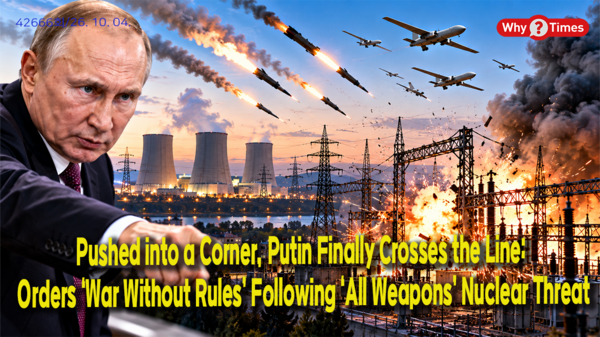
[“We Will Use All Weapons”… The Dangerous Card Pulled by Putin]
Russian President Vladimir Putin’s war rhetoric and offensive tactics are simultaneously escalating toward a perilous threshold. To NATO on his western flank, he warned that "all types of weapons" could be deployed if Kaliningrad comes under attack. Inside Ukraine, claims have emerged that Putin instructed his military command to lift previous restrictions on airstrikes. Compounding these developments are reports of a massive winter offensive targeting nuclear-connected power grids and the national electrical infrastructure. As the war drags on, whether Russia attempts to achieve on the political front what it failed to gain on the battlefield—through nuclear deterrence and civilian pressure—has surfaced as the single largest variable this winter.
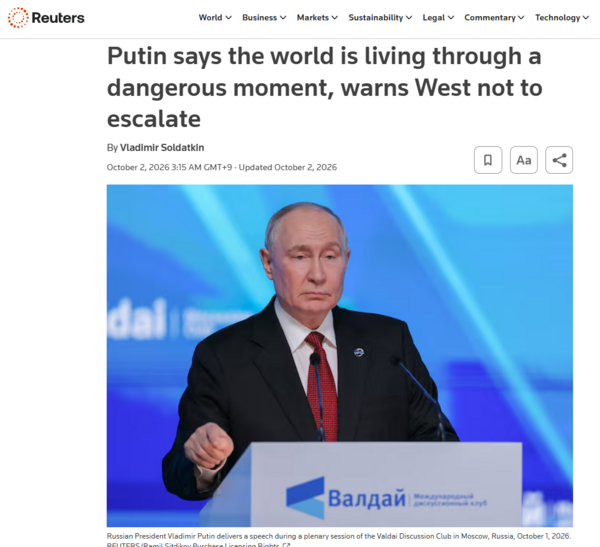
Reuters reported on October 3 that "Putin has once again cast the shadow of nuclear weapons over Europe," noting that "during the annual meeting of the Valdai Discussion Club in Moscow on October 1, Putin signaled that if Russia's exclave of Kaliningrad were attacked, 'if a direct assault on the Russian Federation occurs, the issue of deploying and using all types of weapons in our state’s arsenal will immediately be put on the agenda.'" While avoiding the explicit term "nuclear weapons," news outlets including AP and Reuters reported the remarks within the context of an implicit nuclear threat.
According to Reuters, Putin did not stop there. He flexed Russia’s destructive capacity by adding, "Russia is fully aware that France and the United Kingdom are nuclear-armed states." While stopping short of an explicit declaration to "use nuclear weapons in Kaliningrad," his reliance on the phrase "all types of weapons" serves to pressure Europe into factoring nuclear escalation into any calculus of direct military confrontation with Russia.
Kaliningrad is no ordinary Russian territory. Separated from the Russian mainland, sandwiched between NATO members Poland and Lithuania, and overlooking the Baltic Sea, it stands as a heavily fortified strategic outpost. Consequently, a direct military clash between Russia and NATO in this enclave risks escalating into an uncontained NATO-Russia confrontation far exceeding the scope of the Ukraine war. It is precisely over this territory that the Russian president publicly invoked "all weapons."
Nevertheless, Putin claimed that Russia harbors no intent to attack Europe first. NATO similarly countered that it operates strictly as a defensive alliance and poses no threat to Kaliningrad. In this context, Putin’s nuclear threat can be viewed as a posture of bluster intended to intimidate NATO.
[The Day After Nuclear Warnings… Putin Appears at Large-Scale Military Drill]
What drew even greater scrutiny was the sequence of events that followed immediately after. On October 2, the day after his Valdai address, Putin traveled to the Chelyabinsk region in the Ural Mountains to personally observe the final stage of the 'Center-2026' strategic military exercise. According to AP, the overarching exercise mobilized approximately 47,000 personnel, drawing forces not only from Belarus, Kyrgyzstan, and Tajikistan, but also from China, Mongolia, and Pakistan. The final phase involved roughly 6,000 troops and was attended by observer delegations from 55 nations.
Naturally, this exercise was not hastily assembled merely to validate the previous day’s nuclear rhetoric. However, the spectacle of Putin personally inspecting weaponry at a major military exercise immediately after hinting at nuclear deployment generated a powerful display of force. In swift succession, verbal warnings of "all weapons" were paired with an explicit demonstration of conventional military capability.
[Ukraine Declares, “Now There Are No Rules”]
An even more alarming account emerged from Ukraine. In an interview with the Financial Times (FT), President Volodymyr Zelenskyy asserted, based on intercepted internal communications secured by Ukrainian intelligence, that "Putin instructed his military leadership to scrap existing restrictions on airstrikes." The phrasing conveyed by Zelenskyy was stark: "Now there are no rules."
According to Zelenskyy, this directive was issued in September, following which Russian strikes against Kyiv and other cities intensified sharply, hitting civilian infrastructure including schools, hospitals, and data centers. The FT detailed Zelenskyy’s explanation that Ukrainian intelligence intercepted communications among Kremlin officials to confirm the directive.
[Why Now?… Achieving in Winter What Was Unattained on the Battlefield]
According to the FT report, Zelenskyy framed this escalation against the backdrop of a prolonged war of attrition. Unable to secure its desired breakthrough on the frontlines, Russia is attempting to break Ukraine's national resolve by pounding rear cities and civilian infrastructure. The FT cited Zelenskyy's assessment that with frontlines largely stalled, Russia is doubling down on heavy bombardment and civilian coercion.
Thus, the next battlefield targeted by Putin is 'winter.' While capturing a single frontline town demands massive troop and equipment casualties, disrupting electricity, heating, water, and transportation simultaneously impacts civilian life across entire regions. This is why Ukrainian authorities view Russia’s winter campaign not as simple strikes on power stations, but as a strategic assault aimed at eroding the nation's capacity to resist.
[Targeting 'Switchyards' Instead of Reactors]
A Russian winter offensive strategy reported by The Times on October 3 highlights this exact tactic. According to the report, strategic Russian documents obtained by Ukraine outline a scheme to deploy up to 1,000 missiles, drones, and glide bombs this winter to paralyze Ukraine’s energy grid. Major metropolitan centers including Kyiv, Kharkiv, and Odesa are listed as primary targets.
The most critical concern centers on Ukraine's three operational nuclear power plants. The core objective outlined in the documented strategy is to strike adjacent electrical switchyards and grid infrastructure connecting the plants to the national network, thereby forcing the shutdown of nuclear generation.
The risks associated with such strikes are severe. Switchyards serve as vital conduits that distribute electricity generated by nuclear plants nationwide while supplying the external power necessary for safe reactor cooling and operation. According to the document cited by The Times, Russia aims to eliminate up to 15 GW of generation capacity—a figure roughly equivalent to Ukraine’s current total power output. This strategy goes far beyond knocking out individual power stations; it aims to collapse the entire national grid.
[What Putin Seeks Is Not Just 'Blackouts,' But 'Coercion']
When power fails, the impact extends far beyond lighting. Heating, water supply, sewage treatment, communications, transport, and commercial operations suffer cascading disruptions. Subjecting millions of civilians to these conditions in sub-zero temperatures creates social strain entirely distinct from frontline combat. This supports Ukrainian assessments that Russian energy strikes target the broader societal capacity to sustain the war effort.
According to the FT, Ukrainian officials argue that Russia aims to isolate major population centers like Kyiv, Kharkiv, Odesa, and Lviv, potentially triggering a fresh wave of outward civilian migration. Should that occur, Russian energy strikes would double as a tool to test internal Ukrainian resilience while pressuring European nations sensitive to refugee burdens.
[Ukraine Is Striking Back at Putin’s Winter]
Ukraine is not enduring this assault passively. Over recent months, Ukrainian forces have sustained long-range strikes against Russian oil refineries and energy infrastructure. In his Valdai address, Putin himself acknowledged that Ukrainian attacks on Russian refining capacity have inflicted a degree of economic impact. As Russia targets Ukrainian electricity and heating, Ukraine is countering by hitting the oil and refining base underpinning Russia's war economy, driving an asymmetric energy war.
Consequently, this winter’s outcome will not be determined solely by missile tallies. It will depend on the degree of pressure Russia can inflict on Ukrainian society balanced against Ukraine's ability to intercept strikes while imposing costs on energy and military logistics in Russia's rear.
[Why Times Insight | Threatened Out of Strength, or Driven to Danger by Frustration?]
Viewed in isolation, each of Putin’s recent moves projects an image of a 'strong Russia.' He issues warnings of "all weapons" if Kaliningrad is touched, and personally oversees massive military exercises the following day. Airstrikes in Ukraine are intensifying, accompanied by intelligence reports of planned winter strikes against nuclear grid connections.
However, these developments can also be interpreted from an inverse perspective. Why must Russia invoke the specter of nuclear weapons at this stage? Why is greater weight being placed on disrupting civilian heating, electricity, and municipal services than on achieving decisive victories on the frontline? The fact that Russia is escalating its coercive tools while failing to secure its primary political objectives is a critical factor to consider.
This behavior suggests that a leader fearful of strategic failure may be escalating reckless rhetoric—disregarding the basic laws of war and raising nuclear options—driven by an imperative to shift the momentum at all costs.
Therefore, this winter is not merely a defense of electrical infrastructure. It represents a coercive test where Russia challenges the Ukrainian public on how long they can endure darkness and cold, while Ukraine relies on air defenses and long-range precision strikes to dismantle that calculus.
Ultimately, the most critical takeaway from Putin’s current trajectory lies not in speculating over his internal mindset, but in measuring how high the threshold of threat is rising. It is a war that casts a nuclear shadow over NATO while weaponizing winter and power grids against Ukraine. Rather than demonstrating a stronger Russia, these actions signal that the methods of this war have become vastly more dangerous.

- TAG