


추부길 whytimespen1@gmail.com
[The White House Room Accessible Only to Peng Liyuan]
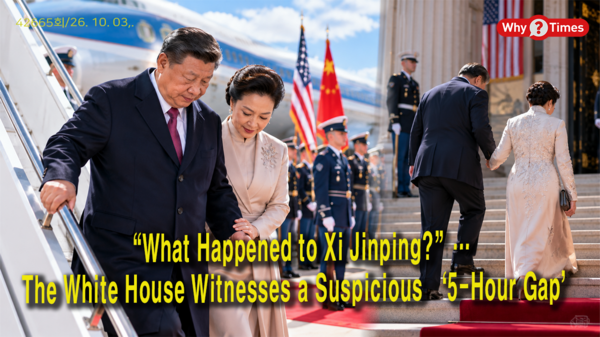
Behind the extravagant state protocol lay another unscheduled itinerary. A month before Chinese President Xi Jinping’s visit to Washington, Beijing requested additional rest periods from the White House, culminating in a dedicated rest space in the West Wing reserved solely for President Xi. A planned working lunch with President Trump was canceled, creating an approximate 5-hour gap in a schedule lasting less than two days. This unprecedented arrangement, revealed by The Wall Street Journal (WSJ), extends beyond mere health rumors, thrusting the issue of political succession back into focus for a Chinese system where power is concentrated in a 73-year-old leader without a clear successor.
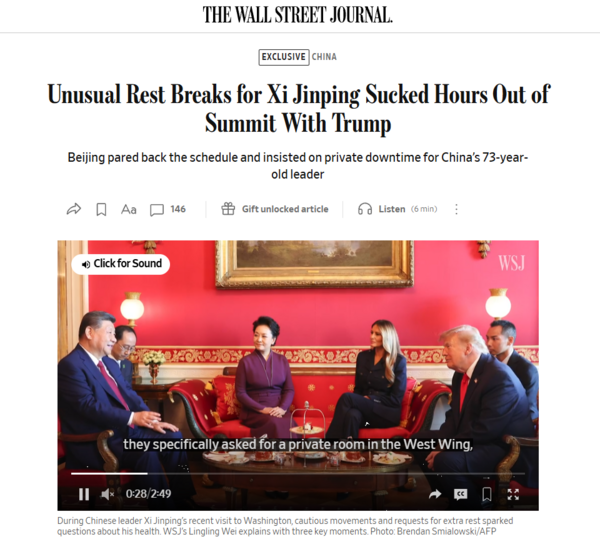
WSJ reported on October 2, citing sources familiar with the preparations for Xi Jinping’s U.S. visit, that "the Chinese side made unusual requests to the U.S. for President Xi’s rest. Most notable was the request to set up a dedicated rest area for Xi in the West Wing of the White House."
WSJ further detailed that "into this space—referred to by American officials as a 'hold room'—only his wife, Madam Peng Liyuan, was permitted entry. No other Chinese delegates, including Xi’s chief of staff, Politburo Standing Committee member Cai Qi, were allowed, and the reason for restricting access strictly to Peng remains unconfirmed."
According to WSJ, what stands out even more is that these schedule adjustments were not made abruptly upon arrival in Washington. As early as August—a month prior to the trip—a Chinese advance team declined the working lunch scheduled for September 24 between President Trump and President Xi. Chinese representatives communicated to U.S. staff that President Xi desired more rest time during his stay in Washington. Consequently, an approximate 5-hour gap was carved out of a state visit lasting under two days. This sharply contrasts with President Trump’s visit to Beijing in May, when both leaders shared a working lunch inside Zhongnanhai.
[A Summit That Started at Noon and Wrapped Up Early Afternoon]
The actual duration of head-of-state diplomacy was remarkably brief. The bilateral summit held at the White House on September 24 began around noon and concluded early in the afternoon. President Xi then left the White House, returning only in the evening for the state dinner. While both nations agreed on tariff reductions, extending the trade truce, and launching dialogues on artificial intelligence, fundamental conflicts regarding Taiwan, Iran, and high-tech sectors remained unresolved.
Dennis Wilder, a professor at Georgetown University who served as Senior Director for East Asian Affairs on the NSC during the George W. Bush administration and helped coordinate three state visits, noted that "such a brief summit itinerary itself is highly unusual." He told WSJ that despite preparing for visits by Japanese Prime Minister Junichiro Koizumi, Australian Prime Minister John Howard, and Chinese President Hu Jintao, he had never experienced a setup requiring a separate dedicated rest room.
Schedules on the first and last days were equally revealing. The Chinese side scheduled no separate evening events for Xi on the day of his arrival at Joint Base Andrews. On the final day, September 25, a scheduled visit to the National Archives lasted roughly 10 minutes—a stay far shorter than what U.S. organizers had originally anticipated.
[“How Long Can He Stand, and How Far Can He Walk?”]
The public protocol was undeniably lavish. A 21-gun salute echoed across the grounds as U.S. fighter jets and stealth bombers flew overhead. The American host even presented a large bald eagle sculpture as a gift. Yet, according to WSJ, behind the scenes, the Chinese delegation was meticulously managing an entirely different set of concerns: factoring in how long President Xi could remain standing, how far he could walk, and when he needed to pause and rest.
While these logistics do not definitively confirm a specific illness, the core takeaway of WSJ's report remains the same: canceling a scheduled working lunch a month in advance, demanding a separate hold room, and leaving a 5-hour gap in the itinerary represent a significant departure from historical state visit protocols.
[‘Cautious Movements’ Caught on Camera]
In unedited footage, President Xi’s movements drew close scrutiny. While descending the stairs of his aircraft at Joint Base Andrews, Xi held the handrail with one hand while holding Peng Liyuan’s hand with the other. Two days later, while ascending the stairs at the National Archives alongside President and Mrs. Trump, the Chinese couple again held hands. WSJ observed of the moment that "Xi appeared to be receiving physical support from his spouse, rather than merely holding hands." This aspect was further highlighted by how Chinese state media handled the footage, omitting such scenes from prime-time broadcasts.
[Questions Raised Prior to Washington]
These concerns did not originate solely in Washington. During the BRICS Summit held in India in September, President Xi was absent from the gala dinner attended by other heads of state. At the time, WSJ reported that Xi skipped the dinner due to feeling unwell. With his Washington itinerary now confirmed to have been scaled back to secure rest periods, international curiosity regarding his physical condition has amplified.
[‘Physical Limitations’ vs. ‘Incapacity’]
Experts specializing in Chinese elite politics emphasize this key distinction. According to WSJ, analysts have observed no signs of cognitive decline during President Xi’s recent public appearances. Minxin Pei, a professor at Claremont McKenna College, explained that "a leader being unable to discharge duties due to a severe illness is entirely different from being physically uncomfortable while remaining mentally capable."
Under the latter scenario, the Chinese Communist Party (CCP) has no pressing reason to select a successor, and major policy trajectories are unlikely to shift dramatically. Thus, what can be objectively confirmed at this stage is that Beijing meticulously tailored the Washington schedule to accommodate President Xi’s physical strain. His exact medical condition and its underlying cause remain unverified publicly.
[Why Is the World Watching Xi Jinping's Health?]
The primary concern is not merely Xi's personal health, but the overarching power structure he has constructed. Xi holds all three top positions in China: General Secretary of the CCP, President of the PRC, and Chairman of the Central Military Commission. While holding the most concentrated power since Mao Zedong, he has not publicly designated a successor. WSJ underscored that China lacks an institutionalized procedure to simultaneously transfer all three core leadership roles to a successor.
This explains why the CCP manages top leaders' health as ultra-sensitive information: health issues at the top can spark internal power struggles and political instability. The significance of this report lies not in diagnosing a specific medical condition, but in revealing how physical constraints on the supreme leader forced tangible adjustments to a high-profile U.S. state visit.
[And 23 Days Later, the 5th Plenum Convenes]
The timing is noteworthy. The CCP will hold the 5th Plenary Session of the 20th Central Committee in Beijing from October 26 to 29. The main agenda item announced by the Politburo is advancing "full and rigorous governance over the Party" (quanmian conggan zhidang), focusing on Party discipline, political control, and centralized leadership.
Succession is not on the official agenda for the 5th Plenum. However, given the heightened international focus on the supreme leader’s physical state, Xi’s public appearances, meeting chairing style, and leadership signals will be scrutinized far more closely. Chinese authorities have already signaled that the session will reinforce the Central Committee's centralized authority and strict internal discipline.
[Why Times Insight]
The most critical question emerging from the WSJ report is not "What illness does Xi Jinping have?" Rather, it is the fact that Beijing altered core schedules of a major state visit to accommodate the supreme leader's physical limitations. This reveals a structural vulnerability in China's political system. If Xi faces physical limits but retains full cognitive and policy-making capacity, there is no immediate indication that China's governance will fracture. However, should an unexpected constraint affect the supreme leader's ability to govern, the mechanism and personnel for transferring power remain opaque—especially without a publicly anointed successor.
Therefore, far more critical than the "5-hour gap" in Washington is the potential power vacuum that exists after top leadership. While there is no evidence that succession will be addressed at the 5th Plenum, monitoring the intensity of Xi’s public engagements, his meeting leadership, and shifts in senior personnel will offer vital insights into China's political landscape.
Ultimately, the WSJ report points to a question beyond Xi as an individual: In a system where power is concentrated in a 73-year-old leader with no clear heir, are the institutions and figures prepared to guide China should significant operational constraints arise at the very top? The 5-hour gap witnessed in Washington has reopened that fundamental question.
- TAG