


추부길 whytimespen1@gmail.com
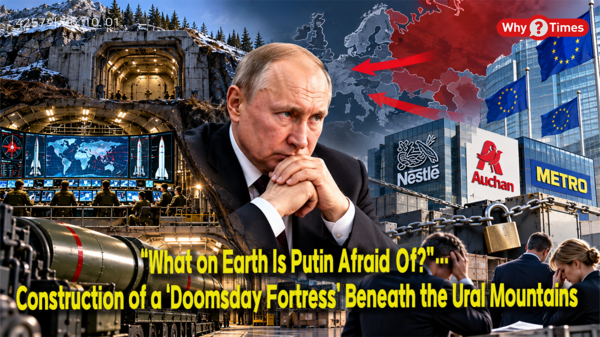
[A 'Doomsday Fortress' Uncovered Deep Beneath the Ural Mountains]
It has come to light that Russia has been extensively modernizing a Cold War–era nuclear command installation buried deep within the Ural Mountains. The site is widely known as a facility designed to maintain retaliatory capabilities even in the worst-case scenario where Moscow’s central command structure is obliterated in a nuclear exchange. Almost simultaneously, Russia has seized management control of Russian assets belonging to European corporations—such as Nestlé, Auchan, and Metro—transferring them to temporary state administration. An underground fortress designed to endure a post-nuclear environment and an economic policy that uses foreign enterprises as leverage may appear to be unrelated events. Yet together, they provide two striking snapshots of just how extreme a scenario Russia is preparing for.
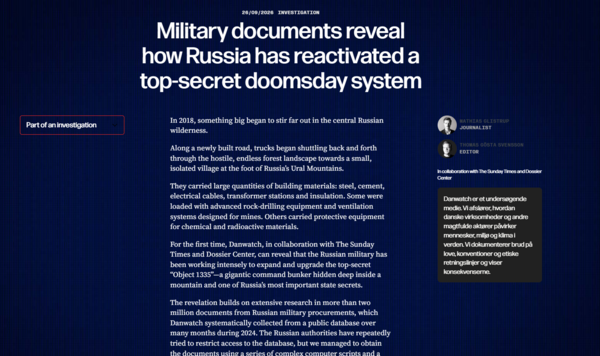
On September 26, the Danish investigative news outlet Danwatch, in collaboration with the UK’s Sunday Times and the independent Russian investigative collective Dossier Center, published findings based on an analysis of over two million Russian military procurement documents. Danwatch reported, “It has been revealed that Russia has been heavily expanding and modernizing a top-secret nuclear command facility constructed during the Cold War era.” The outlet noted that “since 2018, the Russian Ministry of Defense has funneled thousands of procurement shipments directly into 'Object 1335', located inside Mount Kosvinsky Kamen in Sverdlovsk Oblast.”
Danwatch continued, “This top-secret nuclear facility is situated deep within the Ural Mountains, approximately 1,300 kilometers east of Moscow, and operates under the codename 'Grot' (Cave).” It added, “While it has been recognized since the Cold War as one of the central command installations for Russia's strategic nuclear forces, it is unprecedented for details of its internal architecture and the recent scale of construction to be laid bare.”
[22,000 Tons of Steel and 56,500 Tons of Cement… Far Beyond Simple Maintenance]
The sheer scale of the project is staggering. Procurement records verified by the investigative team list at least 22,000 tons of steel, over 56,500 tons of cement, and more than 600 kilometers of electrical cabling. Heavy machinery for bedrock excavation, along with large-scale ventilation systems and power substations, were deployed to the site. Crucially, the procurement list included specialized air purification equipment capable of filtering out radioactive particles, chemical agents, and biological toxins, as well as blast-proofing and seismic reinforcement systems. This indicates a project operating on a magnitude entirely distinct from routine repairs of an aging military facility.
Satellite imagery confirms massive rock excavations on the mountain alongside newly constructed access roads. The investigative team concluded that Russia has been excavating deeper into the mountain's interior to expand the existing complex and fortify its protective envelope.
[300 Meters Under Solid Granite… Built to Survive Even a Direct Nuclear Strike]
Object 1335 commands particular attention because it is no ordinary military command bunker. The complex is reportedly situated beneath more than 300 meters of solid granite—a structural layout engineered to ensure that internal command mechanisms remain fully operational even under intense external bombardment. Recently disclosed records reference at least 24 underground chambers, with the distance between access portals spanning approximately 2.5 kilometers.
The objective is unambiguous. According to The Insider, the purpose is to preserve the capability to issue launch orders to surviving strategic nuclear assets even under a apocalyptic scenario where Russia’s political and military leadership is incapacitated and conventional communications networks are destroyed. It is within this context that the Cold War Soviet nuclear command apparatus known as 'Perimeter'—frequently referred to in the West as the 'Dead Hand'—re-enters the conversation.
[Has the 'Dead Hand' Been Resurrected?]
A critical distinction must be drawn here. Some media reports characterized these ongoing construction works as Russia reactivating the 'Dead Hand' system. Based on public records, Stanford University nuclear expert Jeffrey Lewis raised the possibility that Russia may once again be actively utilizing the system.
However, Pavel Podvig, an expert on Russian strategic nuclear forces, offered a different interpretation. He explained to The Insider that using the term 'reactivated' is inaccurate because the system was never deactivated in the first place. More importantly, he cautioned against defining Perimeter as a fictional 'doomsday machine' that launches nuclear missiles automatically without human intervention. Instead, its core function is closer to an emergency backup command and communications system designed to transmit launch directives to surviving nuclear forces should the highest chain of command and public communications networks be destroyed.
[Why Is Putin Upgrading This Facility Now?]
This brings us to a crucial question: why is Russia funneling vast resources into such a facility at this juncture? The modernization effort itself commenced in 2018. Therefore, framing the project as a sudden shelter built out of panic by a cornered Putin during the war in Ukraine does not align with the factual timeline. Nevertheless, the fact that construction persisted throughout the war in Ukraine—alongside Russia’s broader efforts to modernize its strategic forces and emphasize its nuclear deterrent—warrants close examination.
This demonstrates that, in its military planning, the Kremlin continues to treat extreme contingencies—such as a decapitation strike on Russia’s nuclear command structure and the destruction of standard communications—as realistic threats requiring active preparation. And it is precisely at this point that military posture subtly overlaps with Russia's recent economic maneuvers.
[Targeting European Firms: “Let Them Be Scared”]
A single remark from a senior Russian government official, reported by Reuters on September 29, symbolically encapsulates Moscow’s current posture toward Europe: “Let them be scared.”
Throughout September, Russia systematically transferred the Russian assets of Swiss food giant Nestlé, German wholesaler Metro AG, and French retailer Auchan into temporary state management. Consequently, foreign shareholders lost the right to directly manage their Russian subsidiaries. What stands out even more is that Russian government officials made little effort to conceal the political motive behind these actions.
Speaking to Reuters, the official remarked that “it is time to take asymmetric measures,” adding that “when Europe decides on sanctions, it should be made to think about Russia’s counter-response.” When asked if Italian bank UniCredit or Austria’s Raiffeisen Bank could be next, the official answered directly: “Let them be scared.”
[135 Foreign Entities Targeted Since the Start of the War]
This measure is by no means an isolated incident. Citing TASS statistics, Reuters reported that since the outbreak of the war in Ukraine, Russia has applied temporary management orders to 135 foreign-linked entities. Prominent European corporations such as Danone and Carlsberg are among those targeted. Furthermore, the number of Association of European Businesses (AEB) members operating within Russia dropped from roughly 400 to 330 in the span of a single year.
An intriguing aspect of this wave of seizures is that European companies, rather than American firms, have been at the center of recent actions. Reuters noted that major U.S. corporations have not yet been subjected to similar state-takeover measures. Russian authorities cite the European Union’s deep involvement in the Ukraine conflict as the rationale. In effect, Russia is wielding the assets and management rights of foreign corporations as a instrument of state leverage to counter Western sanctions.
[Hyundai Motor Ultimately Fails to Reclaim Its Russian Plant]
The case of South Korea's Hyundai Motor Company offers another instructive perspective. Hyundai did not lose its plant to a Russian temporary management decree; rather, it suspended operations and eventually sold its business after production became untenable due to the war, sanctions, and supply chain disruptions. While Hyundai secured a buyback option when selling its St. Petersburg facility to a local entity, that option expired unexercised on January 31, 2026.
Hyundai’s audit reports officially confirmed this development. According to Reuters, the facility is currently being operated by AGR, which produces vehicles under the 'Solaris' brand. Thus, rather than an example of direct state asset confiscation, Hyundai’s case serves as a prime illustration of the staggering costs global corporations have incurred while exiting the Russian market following the outbreak of war.
[Why Times Insight | Why Is Putin’s Russia Preparing for the 'Worst-Case Scenario'?]
Object 1335 and the state control over European corporate assets are events of fundamentally different natures. One is a hardened military installation designed for nuclear warfare; the other is an economic countermeasure. Yet a common thread runs through both: a Russian state operating under the explicit assumption of worst-case scenarios.
In the Ural Mountains, Russia is fortifying underground installations to ensure nuclear retaliatory commands can be issued even after the state's command hierarchy is destroyed. On the surface, it is squeezing the assets and management rights of foreign businesses to use as leverage against further Western sanctions. Russian officials no longer bother to hide these intentions, openly declaring, “Let them be scared.”
It would be premature to jump to conclusions and label this as definitive proof of Putin’s personal terror or psychological state. However, it clearly confirms that Russia’s governance model is shifting toward heightened military readiness and economic coercion amid a prolonged war of attrition.
Using the property rights of foreign businesses as bargaining chips in state-to-state conflicts carries substantial long-term costs. While this tactic may exert immediate pressure on Europe today, investors will inevitably ask the same question when asked to return to Russia after the war ends: “If another conflict erupts, will our assets become political bargaining chips once again?”
Therefore, the most critical takeaway regarding Object 1335 is not the sensationalized trope of a 'secret hideout for Putin.' It is the reality that Russia has devoted immense resources over several years to fortify a system engineered to survive the ultimate nightmare scenario: the complete destruction of its national command authority in a nuclear war.
Similarly, what matters most in the phrase “Let them be scared” is not the isolated fate of companies like Nestlé or Auchan. It is the posture of a Russia retreating 300 meters beneath solid granite militarily while converting foreign property rights into geopolitical pressure points economically.
What we are witnessing today may not be a set of clues to diagnose Putin’s personal psyche, but rather a vivid demonstration of how far Putin's regime is willing to go in preparing for the most extreme scenarios as it braces for a protracted confrontation.
- TAG