


추부길 whytimespen1@gmail.com
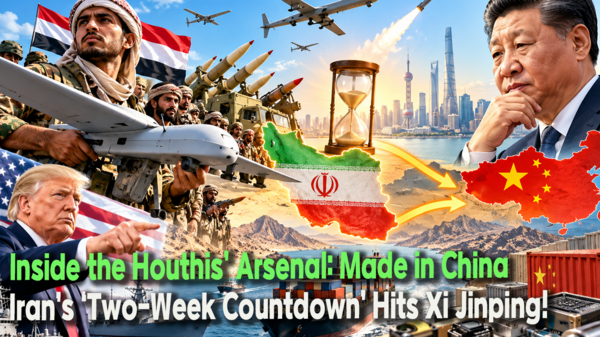
[350,000-Strong Houthi Force Threatens Israel with Drones Capable of 2,500 km Range]
The perimeter of U.S. pressure surrounding the Middle East conflict has begun shifting beyond Iran and toward China. Tracing the supply chain of drones and missiles used by Yemen’s Houthis—which threw the Red Sea into turmoil within just a few weeks—reveals that alongside Iranian technology, the role of Chinese dual-use components has expanded significantly. Simultaneously, the U.S. Department of the Treasury placed on its sanctions list a Beijing-based individual who coordinated the procurement of weapons and dual-use parts for Iran’s Ministry of Defense and Armed Forces Logistics (MODAFL). What makes the situation even more critical is that the time left for Iran to hold out is rapidly dwindling. As Iran’s crisis deepens, China—the largest buyer of Iranian crude—finds itself under simultaneous pressure across three fronts: energy security, Middle East diplomacy, and relations with the United States.
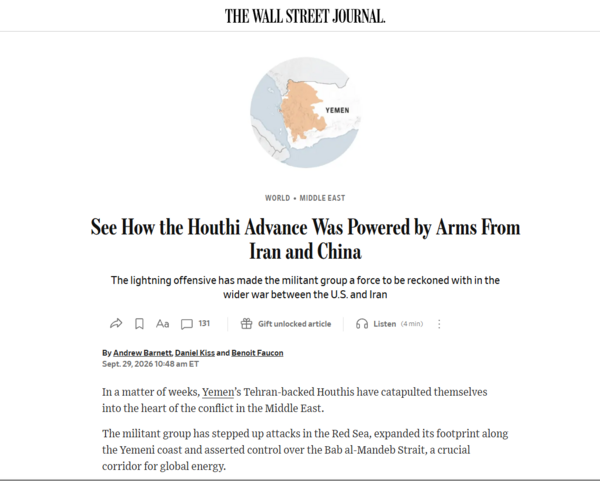
On the 29th (local time), The Wall Street Journal (WSJ) reported that “the map of the Houthis’ recent territorial expansion is startling.” It added, “Supported by Iran, the Houthis seized several islands in the Red Sea and strategic strongholds in western Yemen within a matter of weeks, even taking the port city of Mocha, rapidly emerging as a central variable in the Middle East war. Their troop strength is estimated at around 350,000.”
The WSJ continued: “The offensive was far from improvised. Starting in mid-August, the Houthis moved weapons and thousands of troops into the area surrounding Mocha to squeeze their opponent’s supply lines. They also leveraged access to the Yemeni telecommunications network to conduct information warfare, tracking enemy movements and intimidating rival factions.” The report noted, “The Houthis are no longer just rebels in a Yemeni civil war; they have transformed into a military force capable of threatening the Bab-el-Mandeb Strait and Red Sea shipping lanes—chokepoints for global energy transport.”
[It Was Iran That Transformed a 'Guerrilla Force' Into a Missile Military]
The roots of Houthi military power lie in Iran. According to the WSJ, the Quds Force of the Islamic Revolutionary Guard Corps (IRGC) began sending Iranian-designed missile and drone components to Yemen around 2015, providing assembly technology and training. Consequently, a local armed group once fighting with light rifles and machine guns gained a missile and drone arsenal capable of striking Saudi oil facilities, threatening Red Sea vessels, and hitting targets as far away as Israel.
A prime example is the Waid kamikaze drone, built upon the Iranian Shahed series. Some long-range drones operated by the Houthis are assessed to have a strike range of up to approximately 2,500 km. Combined with the Samad drone series and cruise missiles, Saudi Arabia, the UAE, and Israel all fall within their targeting radius. Integrating anti-ship ballistic missiles, naval mines, armed speedboats, and unmanned surface vessels (USVs), the Houthis built an asymmetric capability to threaten the Red Sea without maintaining a regular navy.
[Yet, 'Made in China' Items Begin Pouring Out of Houthi Weaponry]
Here lies the crux of the WSJ report. The WSJ stated that “while Iran remains the primary sponsor behind the Houthis’ military capability, dual-use components originating from China have rapidly accounted for a growing share in the Houthis’ recent self-production and modification of drones and missiles.”
Synthesizing UN reports and weapons expert analyses, the WSJ highlighted that “between 2021 and 2025, the proportion of Houthi-related military items seized that originated from China reached 35%, up from roughly 5% previously.” Furthermore, “about 65% of Houthi drone suppliers targeted by U.S. sanctions were found to operate out of China.”
The WSJ pointed out that “what China-based firms are supplying includes products usable in both military and civilian sectors, such as drone components and communications equipment.” It added, “For this reason, there is insufficient evidence to conclude that the Chinese government directly ordered the arming of the Houthis. However, repeated investigations demonstrate that China-based companies and commercial supply chains serve as vital sources for the dual-use items necessary for Houthi weapons production.”
[And On the Same Day, the U.S. Targeted Beijing’s 'Iranian Arms Pipeline']
An even more noteworthy event unfolded on the exact same day. On the 29th, the U.S. Treasury Department’s Office of Foreign Assets Control (OFAC) levied new sanctions on ten individuals and entities that procured weapons and components for Iran’s MODAFL as part of 'Operation Economic Outcast'. The MODAFL oversees weapons research, production, and acquisition for the Iranian military, as well as its ballistic missile and unmanned aerial vehicle (UAV) development programs.
Among those sanctioned, the most prominent figure is Seyed Asghar Alizadeh Tabatabaei. The U.S. Treasury Department stated that “he represented MODAFL in Beijing, coordinating the procurement of completed weapons systems and dual-use parts within China on behalf of Iran.”
[“In Two Weeks, Nothing Left”: Bessent’s Countdown]
At this precise moment, Key U.S. officials (such as Treasury Secretary nominee / official Bessent) presented a concrete two-week deadline toward Iran. Appearing on Fox News on the 27th, Bessent stated, “There are currently only about 15 million barrels of Iranian crude oil heading toward their final destinations.” He added, “Once that volume is delivered to China, Iran will have ‘nothing left to exchange.’ That point in time is likely two weeks away.”
This represents the core of the U.S.-driven 'Operation Economic Outcast'. The strategy aims not merely to choke off Iran's crude oil exports, but to trace its overseas financial, shipping, and weapons-procurement networks, isolating Iran completely from the international economic grid. Announcing the sanctions on the 29th, the U.S. Treasury Department affirmed, “We will continue to identify, expose, and isolate the enablers that sustain the Iranian regime.”
Interestingly, Bessent mentioned in the same interview that China has significantly curtailed its assistance to Iran. If true, this suggests the U.S. may be adopting a strategy of precision-striking Iranian procurement agents and affiliated firms within China while leaving room for Beijing to cut off such transactions, rather than seeking a head-on collision with the entire Chinese government. However, whether sanctions will eventually expand to include major Chinese state-owned refineries, banks, and enterprises remains unconfirmed.
[Iran’s Last Card, the 'Strait of Hormuz', Is Also Weakening]
This dynamic explains why Iran is moving back toward the negotiating table. The problem for Tehran, however, is that the strategic value of its Strait of Hormuz card is diminishing. According to the WSJ, crude oil exports from the Gulf region have recovered to roughly 80% of pre-war levels, as Saudi Arabia utilizes its East-West Pipeline and the UAE leverages bypass routes to Fujairah. In other words, according to Washington’s calculations, while Iran becomes unable to sell its crude over time, oil from other Gulf producers is returning to the market. The longer Iran stalls, the more disadvantaged Tehran becomes compared to the U.S.
[Yet, If Iran Collapses, One Country Faces the Greatest Dilemma]
Should Iran collapse, the country put in the most precarious situation is China. Beijing has long served as the primary buyer of Iranian crude oil. The fact that Bessent set a “two-week” deadline regarding the final shipment of oil bound for China highlights that the economic link between Iran and China sits directly in the crosshairs of the U.S. pressure strategy.
China’s first burden is energy. If supplies of cheap Iranian crude are cut off further, Chinese refiners will have to seek alternative sources, such as Russia. This will increase China’s crude procurement costs and strain its supply chain management.
The second factor is diplomacy in the Middle East. Having mediated the normalization of relations between Saudi Arabia and Iran, China has sought to project the image of a 'Middle Eastern mediator' that prioritizes non-interference and economic cooperation over military intervention. However, if data continues to reveal a rising share of Chinese dual-use parts inside Houthi weapons that threaten Red Sea shipping and energy flows, Beijing will find itself in an embarrassing position.
The third and most sensitive issue is how far U.S. sanction lines extend into China. Currently, the U.S. targets Iran’s defense representative in Beijing and procurement networks operating across mainland China and Hong Kong. Should the next phase encompass major Chinese state-owned oil companies or financial institutions, the scale of the problem changes fundamentally. Maintaining strategic ties with Iran escalates the risk of U.S. sanctions; yielding to U.S. demands and cutting off transactions weakens the long-cultivated relationship with Tehran.
[Why Times Insight: Tehran’s ‘Two-Week Countdown’—The Clock Starts Ticking in Beijing]
The place deserving the closest attention in this crisis may not be Tehran, but Beijing. Iran played a decisive role in building today’s Houthi military capabilities by supplying missile and drone technology. Yet as the Houthis expanded their self-armament, the footprint of Chinese dual-use components and China-based suppliers grew exponentially. Concurrently, U.S. tracking of MODAFL’s overseas procurement networks uncovered and sanctioned an individual procuring finished weapon systems and dual-use parts right out of Beijing. Though operating through distinct networks, 'China' emerges repeatedly as the common denominator in the U.S. tracking system.
If the 'two-week' horizon outlined by the U.S. materializes, the situation will grow even more intricate. Once Iran’s final crude shipments to China are exhausted and new exports remain blocked, Tehran’s foreign exchange revenues will plunge further. Simultaneously, China must secure alternative sources to replace discounted Iranian crude. The U.S. economic warfare against Iran is effectively aiming at the very energy artery connecting Iran and China.
An even heavier burden for China, however, lies elsewhere. The WSJ recently reported that “the flow of dual-use electronic components and drone/missile-related materials from China to Iran is emerging as a new friction point in U.S.-China relations.” While China denies providing military support in violation of international law, concerns persist within the U.S. that China-based enterprises and supply chains are being used to sustain Iranian military power.
The key variable to watch is whether the U.S. sanctions network stops at intermediate brokers and Iranian procurement agents within China, or escalates to target major Chinese refiners, financial institutions, and state-owned enterprises.
If it moves into the latter stage, the fundamental nature of the conflict surrounding Iran could transform. The U.S. 'Operation Economic Outcast' would evolve from isolating Iran to pressuring the third-country supply and financial networks that underpin it. At that moment, Xi Jinping’s options will narrow significantly. Embracing Iran continuously will drive up the cost of confrontation with the United States; giving in to U.S. pressure and severing supply chains risks destabilizing the strategic partnership China painstakingly built with Iran.
Thus, the 'two-week' timeline is not meant for Iran alone. The second hand of the countdown that started in Tehran has now begun ticking in Beijing as well.
- TAG