


추부길 whytimespen1@gmail.com
[‘No Tolls Allowed’ in One Line… Xi Jinping’s Check on Iran]
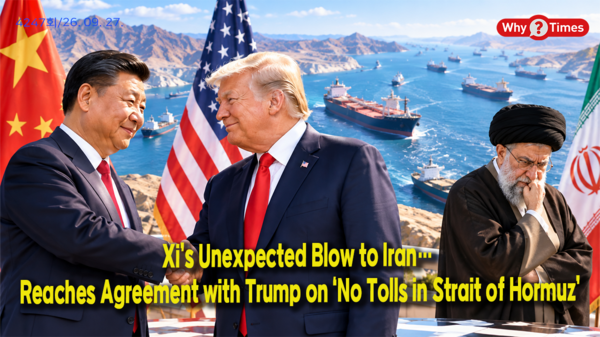
Chinese President Xi Jinping threw an unexpected check at the Hormuz strategy of its ally, Iran, as he agreed with President Donald Trump on the principle of "no transit fees on international waterways" during the US-China summit. Considering that the Iranian Foreign Minister had visited Beijing just a week prior to consult on the war and the Hormuz issue, this comes as a particularly painful moment for Tehran. However, this does not mean China has fully joined Washington's pressure campaign against Iran. While the US side claimed that China gave assurances it "would not support Iran," the Iranian side asserted that Beijing delivered a message stating it "would not restrict bilateral relations due to US pressure". Ultimately, the true test of US-China relations following this summit is likely to be China's actual actions regarding Iran rather than Xi's words.
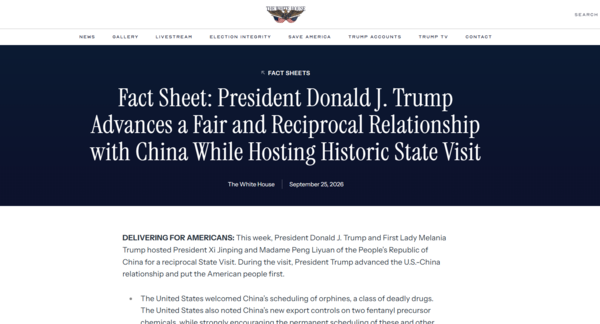
In a fact sheet on the US-China summit released on the 25th (local time), the White House stated: “In discussing international security issues including Russia, North Korea, and Iran, President Trump and President Xi agreed that 'Iran must never possess nuclear weapons,' and subsequently agreed that 'no country or entity should be permitted to impose tolls on international waterways'”. Phrasing that is inevitably uncomfortable for Iran was explicitly included.
Regarding this, Reuters pointed out: "Because the provision did not directly name the Strait of Hormuz or Iran as the subject of the toll clause, it should not immediately be concluded as a 'joint declaration against Iran.' However, given that the Iranian nuclear issue and the international waterway toll issue were presented consecutively in the same passage, and considering that Iran is using navigation in Hormuz as a key bargaining chip, this wording could impose a significant diplomatic burden on Tehran".
[Right After Iranian Foreign Minister’s Visit… Why China Drew the Line at Hormuz]
For Tehran, the timing is especially painful. According to Reuters, ahead of Xi’s visit to the United States, Iranian Foreign Minister Abbas Araqchi visited Beijing to discuss the war and the Strait of Hormuz with Chinese officials. While China places great importance on its relationship with Iran, Beijing has continuously emphasized the prompt normalization of Hormuz and the stability of international energy transport networks.
China's calculation is straightforward. China is Iran’s primary crude oil customer while also being one of the world’s largest oil importers, drawing vast amounts of energy from the entire Gulf region. As the blockade of Hormuz and attacks on vessels continued, international oil prices fluctuated wildly, with both Brent and West Texas Intermediate (WTI) crude surpassing $100 per barrel on the 10th. The longer instability in Hormuz persists, the more China itself must pay in rising energy prices and transport costs.
In the end, from China’s perspective, ‘maintaining strategic relations with Iran’ and ‘supporting Iran’s control over Hormuz’ are two entirely different matters. Xi Jinping’s reaffirmation of the 'no toll' principle with Trump can be interpreted not as taking the side of the US, but rather as a choice prioritizing China’s own energy security and supply chain stability.
[Xi Didn’t Abandon Iran; He Chose ‘China’]
This is precisely the most crucial point of this summit. On the surface, China’s actions appear to be a diplomatic check on its ally, Iran. Hormuz must remain open for Middle Eastern crude bound for China to arrive stably. On the other hand, economic ties with Iran are linked not only to securing cheap crude but also to China’s influence in the Middle East. Therefore, while Beijing maintains strategic relations with Tehran, its interests may overlap with those of Washington regarding the free navigation of Hormuz. The issue begins here.
[Trump Warns Xi Directly… “Support for Iran Will Not Be Tolerated”]
What Trump demanded from China at this summit went beyond opposing tolls in Hormuz. Reuters reported that David Perdue, US Ambassador to China, stated on the 25th: “President Trump directly raised the issue of China’s support for Iran with President Xi”. According to Perdue, “Trump conveyed the stance that any direct or indirect support from China to Iran—whether intelligence, parts, or military equipment—is completely unacceptable”.
Even more notable is what followed. Ambassador Perdue claimed, “We received assurances from China that it would not support Iran”. He asserted that “there are signs China has cut back on some support following the issue being raised by the US,” though he did not disclose which specific activities were halted.
[The ‘China-Iran Link’ Suspected by the US]
There is a clear reason why Trump raised this issue directly during the summit agenda. The US has suspected that Chinese companies, financial channels, and logistics networks play a role in helping Iran evade sanctions and maintain its military capabilities. Reuters also reported that "an off-the-books transaction structure between China and Iran has been operating, utilizing Iranian oil proceeds to purchase Chinese goods".
According to Reuters reporting, an estimated $2 billion to $2.5 billion moved through this mechanism over the past year, which Iran used to procure Chinese products including pharmaceuticals, automobiles, and telecommunications equipment, as well as military equipment. China’s Ministry of Foreign Affairs told Reuters it was unaware of such a structure.
From the US perspective, China is a critical variable determining the success or failure of its pressure policy against Iran. If China continues to purchase Iranian crude and Chinese firms and logistics networks remain an economic outlet for Tehran, the effect of US economic isolation policies will be limited. This background explains why Trump directly confronted Xi on the issue of support for Iran at the head-of-state level.
[Yet a Completely Opposite Message to Iran?… China’s ‘Dual Calculation’]
This is where the most intriguing dynamic emerges. While the US claimed China assured it "would not support Iran," the Iranian side explained that "China delivered a message indicating it would not restrict relations with Iran due to US pressure". Crucially, the latter statement comes from Iranian officials, not an official announcement from the Chinese government.
If both descriptions are accurate, they are not necessarily contradictory. China can draw a line against direct military or intelligence support that Washington takes issue with, while simultaneously refusing to sever crude, economic, and diplomatic relations with Iran in alignment with unilateral US sanctions. Indeed, China has consistently opposed unilateral US sanctions against Iran, and the China-Iran trading mechanism identified by Reuters demonstrates that both nations have worked to minimize the impact of US sanctions.
In short, China’s message can be summarized as follows: “Keep Hormuz open. The war between Iran and the US must not sever China’s energy lifeline. However, do not expect China to simply fold into the US policy of economically isolating Iran.” This is the strategic calculation visible in China's current conduct.
[Drawing the Line Against the US at the UN the Very Next Day]
China’s complex attitude was on display immediately following the summit. In a speech at the UN General Assembly on the 26th, Chinese Vice President Han Zheng emphasized that the sovereignty and security of Middle Eastern nations, including the Gulf region, must be respected, distancing Beijing from Washington’s approach. Reuters reported this as China once again confronting the US over the Iran issue.
This demonstrates that while China may cooperate with the US on the stability and free navigation of Hormuz, it still draws a line against being integrated into the broader US-led pressure campaign against Iran. Ultimately, rather than fully siding with either Washington or Tehran, Beijing continues a case-by-case approach based strictly on its own interests.
[In the End, What the US Wants to Verify is ‘Xi’s Actions’]
Therefore, what matters following this summit is not the wording of the agreement, but what China actually does. The US is likely to closely monitor whether the inflow of Chinese military and dual-use goods into Iran decreases, how Iranian crude oil transactions continue, and whether Chinese financial and logistics networks remain a conduit for Iranian sanctions evasion.
Unresolved issues between the US and China—such as trade, rare earths, advanced technology, and Taiwan—remain intact. Despite the grand state protocol of this summit, significant breakthroughs on major pending issues were limited. Reuters assessed that “while three days of summit diplomacy showcased personal rapport, little tangible progress on various sensitive friction points was publicly displayed”.
[Why Times Insight]
The key takeaway from this US-China summit is not whether Xi Jinping sided with the United States or with Iran. It is that China is handling the Iran issue by compartmentalizing it strictly through the lens of national interest. In Hormuz, its interests align with those of the US. For the Chinese economy, Middle Eastern energy and stable international shipping carry far broader interests than political friendship with Iran. Hence, Xi Jinping reaffirmed the principle of opposing transit fees on international waterways with Trump.
However, fully participating in the US pressure campaign against Iran is a different matter. The US stated that China assured it would not support Iran. On the other hand, the Iranian side claimed China messaged that it would not limit relations with Iran due to US pressure.
While this appears contradictory on the surface, applying the benchmark of China’s national interest reveals a consistent calculation. China does not want Hormuz—its energy lifeline—to be disrupted because of Iran, yet it sees no reason to sacrifice its economic and diplomatic relations with Iran simply because the US demands it.
Thus, the real test of this summit begins now. Practical metrics evaluating Xi Jinping's promises will include whether the flow of Chinese military and dual-use goods into Iran actually decreases, how Iranian crude oil transactions and financial/logistics networks evolve, and how far China moves between US pressure on Iran and its own Middle Eastern interests.
The same applies internally within Iran. Pezeshkian emphasized that the plan to reopen Hormuz was coordinated with the Supreme Leader. However, the critical point is not the words themselves, but whether Iran's power structure—including the military and security apparatus—can translate that agreement into real action.
Ultimately, the current situation surrounding Hormuz boils down to two questions: Will Xi Jinping translate his words to Trump into Chinese action? And can Pezeshkian turn the peace plan coordinated with the Supreme Leader into actual Iranian behavior? The US is now watching China’s actions, while testing whether Tehran's proposals lead to actual implementation by Iranian power structures. The next showdown over Hormuz will likely be decided not by declarations, but by 'execution'.
- TAG