


추부길 whytimespen1@gmail.com
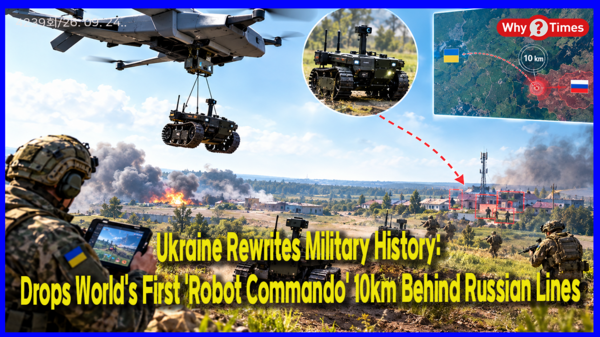
[Ukraine's 'Robot Commando' Dropped from the Sky]
The Ukrainian Armed Forces have marked a groundbreaking moment in military history. Heavy bomber drones carrying kamikaze Unmanned Ground Vehicles (UGVs) instead of conventional bombs flew over 10 km past Russian frontlines to deploy a "robot commando" team deep in enemy territory. A novel form of offensive action has materialized on the actual battlefield—one where electronic warfare blinds Russian forces, drones and robots are deployed ahead of infantry, and mechanized units subsequently break through. The experimental operation testing this new warfare method was named "Operation Vivaldi."
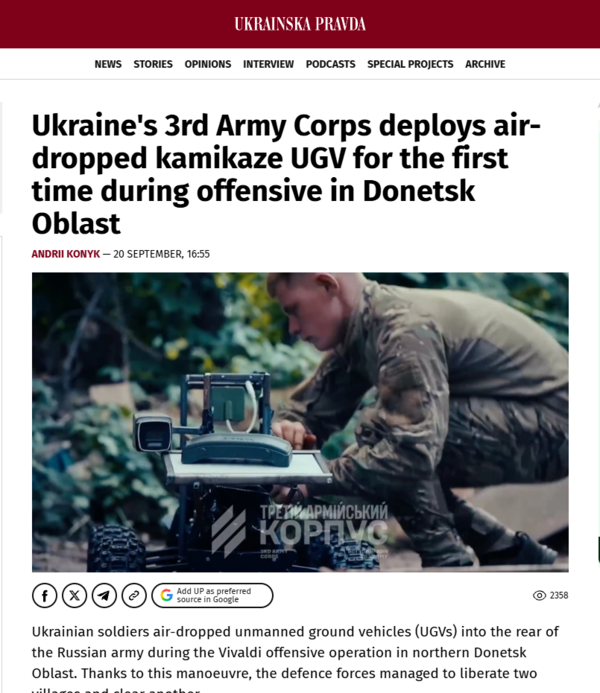
Ukrainska Pravda reported on September 22, "At the center of this operation is Ukraine's 3rd Army Corps. Brigadier General Andriy Biletsky, commander of the 3rd Corps, stated that heavy bomber drones carried kamikaze UGVs over 10 km behind Russian frontlines to deploy them," adding that "the 3rd Corps described this as a world-first tactical method."
Ukrainian defense news outlet Defense Express also reported on September 22, calling it "the world's first combat air-drop of kamikaze UGVs conducted more than 10 km behind enemy lines."
Previously, ground robots had to travel on land to approach frontlines. Traversing minefields, artillery-targeted zones, and dodging Russian First-Person View (FPV) drones inherently restricted their operational radius. However, Ukrainian forces inverted this logic: instead of driving robots to the frontlines, they lifted them into the sky to skip the frontlines entirely.
Defense Express noted, "When heavy drones transport ground robots across enemy lines and drop them in the rear, the robots' operational radius is no longer defined by 'how far they can drive,' but by 'how deep the transport drone can penetrate.' At that moment, Russian command posts, communications hubs, supply routes, and reserve staging areas—even those positioned over 10 km away from the frontlines—are no longer safe zones."
[Blinding Russia First]
Yet, the true core of Operation Vivaldi lies beyond a single robot. Ukrainian forces shaped the battlefield to ensure the robots could operate effectively prior to deployment. Ahead of the push, the 3rd Corps systematically targeted Russian rear supply lines, initially striking 50 km behind the frontlines before extending their engagement range to 120 km.
Fuel depots, supply nodes, communication networks, and command structures were targeted. Fuel proved to be a particularly crucial target, as a significant portion of Russia's electronic warfare (EW) systems relies on diesel generators. Disruptions to fuel supplies not only immobilize vehicles and armored assets, but also degrade the operational capacity of EW systems designed to jam Ukrainian drones. Rather than launching a direct assault against Russian fortifications, Ukrainian forces systematically severed the enemy's eyes, ears, fuel lines, and neural networks.
The Institute for the Study of War (ISW), a U.S.-based think tank, analyzed that "these medium-range interdiction operations weakened Russian electronic warfare capabilities, helping Ukrainian forces secure drone dominance in the Lyman direction and execute mechanized maneuvers."
[Russian Troops Didn't Even Realize the Counteroffensive Had Begun]
The next phase relied on rigorous concealment. Maksym Zhorin, deputy commander of the 3rd Corps, cited strict operational security (OPSEC) as a vital factor behind Operation Vivaldi's success. Throughout the operation, real-time battle reporting was suppressed, while electronic warfare and anti-drone assets were deployed to degrade Russian situational awareness. The 3rd Corps claimed to have neutralized approximately 20,000 Russian drones using its "Protective Drone" system, an integrated network of electronic warfare assets. Once Russian forces were effectively blinded, armored formations were funneled into unexpected axes of advance.
According to ISW, Ukrainian forces capitalized on rain-soaked terrain that Russian command assumed impassable for heavy armor. Preparing tanks to operate in these adverse conditions, Ukrainian units launched armored vehicles through unexpected corridors into Serednje. Unit commanders reported successfully executing the surprise movement without sustaining losses. This maneuver disrupted the prevailing military consensus that large-scale mechanized movement is impossible on battlefields heavily monitored by drones.
[At Least 125 km² North of Lyman… Rattling Russia's 'Northern Pincer']
The results quickly materialized on battlefield maps. When Operation Vivaldi was first disclosed on September 15, Biletsky announced that Ukrainian forces had cleared Russian infiltrating elements from 75 km² and recaptured an additional 10 km² of occupied territory. Reuters also reported these figures at the time, noting that widespread drone warfare made independent verification of territorial changes challenging.
However, the operation did not halt there. On September 22, ISW assessed that "Ukrainian forces liberated at least 125 km² north of Lyman through Operation Vivaldi." The Ukrainian 3rd Corps announced the liberation of Shandryholove and Derylove, alongside full control over Drobysheve. Ukrainian sources claim Russian forces suffered over 3,000 casualties during Phases 1 and 2, though these casualty figures remain official Ukrainian estimates and have not been independently verified.
[Why Lyman?]
The strategic importance of Operation Vivaldi becomes clearer upon examining the map. Russian forces sought to link a "northern pincer" descending from north of Lyman with a "southern pincer" advancing toward Dobropillia, aiming to envelop Ukraine's "Fortress Belt"—a fortified defensive line connecting Sloviansk, Kramatorsk, Druzhkivka, and Kostiantynivka. The Russian salient north of Lyman served as an essential pillar of this northern pincer. Consequently, Ukraine's objective extended beyond reclaiming a few villages; it aimed to disrupt a primary axis of Russia's broader encirclement campaign in northern Donetsk.
On September 15, ISW noted that "Operation Vivaldi achieved 'operationally significant' results in disrupting Russia's planned wide encirclement of the Fortress Belt." ISW further reported that "pro-Kremlin Russian military bloggers acknowledged that Ukrainian gains would delay Russia's offensive toward Sloviansk."
By September 22, ISW advanced its assessment, concluding that Operation Vivaldi demonstrated Ukraine's ability to reintroduce limited mechanized maneuver warfare to a operational environment previously characterized by static positional fighting.
[Robots First, Infantry Later]
The guiding principle underpinning Operation Vivaldi is clear: deploy machines before committing human forces. Ukraine operates under manpower constraints compared to Russia, making prolonged attrition warfare—exchanging heavy casualties for individual trenches or villages—unsustainable over time.
Operation Vivaldi represents an effort to bridge this gap through technology and operational design. First, medium- and long-range drones disrupt Russian fuel and supply lines in the rear. Electronic warfare and anti-drone networks blind Russian reconnaissance drones. Strike drones and air-dropped ground robots penetrate enemy positions ahead of ground troops. Finally, armored vehicles and infantry exploit the resulting gaps. Drones, electronic warfare, robotics, armor, and infantry function as a unified strike architecture. The significance of Operation Vivaldi lies in reorganizing the operational sequence of warfare rather than relying on a single weapon innovation.
[Not an Immediate 'War-Wide Turning Point']
A realistic perspective remains necessary. The success of Operation Vivaldi does not automatically imply that Ukraine has recaptured full strategic initiative across the entire theater. Russian forces continue offensive operations along multiple sectors of the front. In evaluating the operation, ISW specifically described it as a "limited" reintroduction of mechanized maneuver elements.
Nevertheless, meaningful shifts are underway. Following Operation Vivaldi, Russian forces are reportedly redeploying operational reserves to stabilize the Lyman sector. On September 22, ISW cited pro-Kremlin military bloggers and sources associated with Russia's Western Grouping of Forces, reporting that "Ukrainian troops are continuing counteroffensive actions, forcing the Russian military to commit additional forces to maintain defensive positions along the Zherebets River." At least on the Lyman front, the one-sided dynamic of Russian offensive pressure versus static Ukrainian defense has been disrupted.
[Vivaldi's 'Four Seasons'… The Next Chapter Is Crucial]
The operation takes its name from "The Four Seasons," the concerto suite by Italian composer Antonio Vivaldi. According to plans released by the 3rd Corps, Operation Vivaldi consists of four distinct phases.
Thus, the crucial test lies ahead. The key question is whether Ukrainian forces will focus solely on consolidating captured territory or sustain their momentum despite incoming Russian reserves to further disrupt Russian force deployments north of Lyman.
Moreover, the repeatability of these tactics across other fronts will determine their broader impact. A single successful surprise action remains a tactical success. However, if the sequence—blinding enemy ISR, severing rear logistics, inserting ground robotics, and penetrating with mechanized units—can be systematically replicated on other axes, the operational picture changes. In that scenario, "Vivaldi" ceases to be merely an operation name and becomes Ukraine's new offensive doctrine.
[Why Times Insight]
The most notable aspect of Operation Vivaldi extends beyond the 125 km² figure. Ukraine has demonstrated a practical operational model for offseting numerical manpower disadvantages through technological integration and tactical design. By striking logistical lines up to 120 km behind Russian positions and blinding enemy ISR with EW and anti-drone systems, heavy bomber drones delivered kamikaze ground robots over 10 km past the frontlines. Machines engage first before human forces enter the fray.
In conventional warfare, infantry and armor breach defenses while unmanned systems provide auxiliary support. The doctrine demonstrated in Operation Vivaldi flips this sequence: unmanned systems open the breach, and crewed forces follow. This inversion is crucial for Ukraine when confronting a numerically superior adversary, as prioritizing technological and mechanical attrition over human attrition preserves troop strength.
While Operation Vivaldi alone does not instantly alter the strategic balance of the entire war, latest ISW assessments highlight that meticulous preparation, electronic warfare, and operational interdiction can restore limited mechanized mobility even in drone-dominated environments. Furthermore, if Russian command is forced to redirect reserves to stabilize the Lyman sector, Ukrainian offensive action has already begun altering enemy operational behavior.
The true test of Vivaldi begins now. Whether the "robot commando" dropped 10 km behind Russian lines remains an isolated tactical surprise or marks the inception of a new doctrine where machines lead breaches will define the next "season" of this conflict.

- TAG