


추부길 whytimespen1@gmail.com
[China's Rise Hits German Manufacturing Head-On]
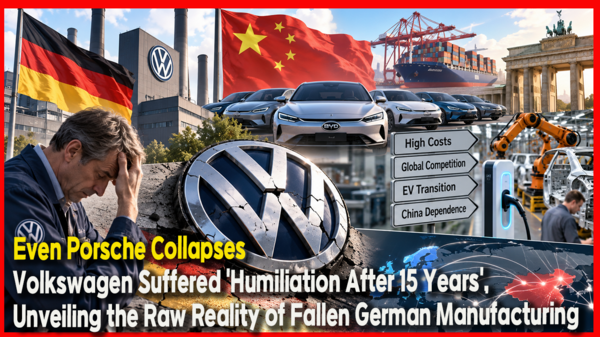
Ominous warning signs are echoing through Volkswagen, the crown jewel and symbol of German manufacturing. Following its removal from the Euro Stoxx 50—the eurozone’s flagship blue-chip index—for the first time in 15 years on the 21st, Volkswagen management announced that existing restructuring plans are no longer sufficient and initiated far more aggressive structural overhauls. Even Porsche, once the group’s "crown jewel," has turned into the epicenter of massive impairment losses.
However, there is a compelling reason why Volkswagen’s crisis cannot be viewed simply as the operational failure of a single automaker. From excessive reliance on China and intensifying global market competition to high domestic production costs and a mismatch in the technological transition of the auto industry, the problems Volkswagen currently faces bear a striking resemblance to the challenges confronting German manufacturing as a whole.
On the 22nd (local time), Reuters cited a recent analysis from the European Central Bank (ECB), reporting: "As China rapidly moves up the value chain into high-value, technology-intensive manufacturing including machinery and transport equipment, it is eroding European companies' global market share—with German manufacturing facing the strongest pressure." The article noted that "the reason is simple: the products Germany sells to the global market and those China offers are increasingly overlapping."
Reuters added, "The ECB noted that Germany's export structure overlaps with China's more than any other major European nation. In the past, China was the premier customer buying vast quantities of German automobiles and machinery, but now China is turning into the fiercest competitor taking away market share from German firms."
Coincidentally, on the same day, Ralf Brandstätter, head of Volkswagen’s China operations, projected that "the Chinese passenger car market will contract by about 20% this year." He added, "Car sales in China have declined for 11 consecutive months through August, putting the current market situation on par with the shock experienced during the COVID-19 pandemic."
According to Reuters, Volkswagen is trapped in a double whammy. While the Chinese auto market itself shrinks, domestic competitors like BYD and Geely have grown significantly stronger. In the past, China was Volkswagen’s goldmine, enabling it to absorb Germany's high domestic production costs. Now, that revenue stream is drying up while Chinese manufacturers are aggressively expanding into Volkswagen’s home turf in Europe.
[Humiliation After 15 Years… Pushed Out of Europe's Premier Blue-Chip Index]
Against this backdrop, a symbolic event occurred on the 21st: Volkswagen was expelled from the Euro Stoxx 50 index after nearly 15 years. The exit itself was determined during STOXX's regular index review in early September, meaning it was not a sudden ejection triggered by the profit warning Volkswagen issued on the 18th. What matters more, however, is why it was ousted during the regular review: based on free-float market capitalization, Volkswagen’s corporate value no longer met the required threshold.
Commenting on this, the Financial Times (FT) pointed out: "Volkswagen’s share price has plummeted by more than 75% from its 2021 peak, dropping to its lowest level in 16 years with a market capitalization of just around €38 billion. Considering its annual revenue sits at approximately €322 billion, this highlights just how low a valuation the market is placing on Volkswagen’s future."
[Even More Shocking is the '€10 Billion Shock'—Not Even Porsche Was Immune]
Just ahead of its index ejection on the 18th, a larger shockwave hit the market. Volkswagen lowered its 2026 operating margin forecast from the previous 4–5.5% down to a maximum of 1%, reflecting approximately €10 billion in one-off charges this year. The company explained that its underlying operating margin, excluding one-off costs, remains around 4%. Still, the core question remains: why did it have to absorb a massive €10 billion hit all at once?
Porsche sits at the center of this blow. Recalculating Porsche’s medium- to long-term earnings outlook, Volkswagen booked an impairment charge of over €6 billion. This was compounded by expenses related to expanded early retirement programs, impairments in Chinese operations, and costs associated with its Osnabrück plant.
['Crown Jewel' Porsche Turns Into Volkswagen's Burden]
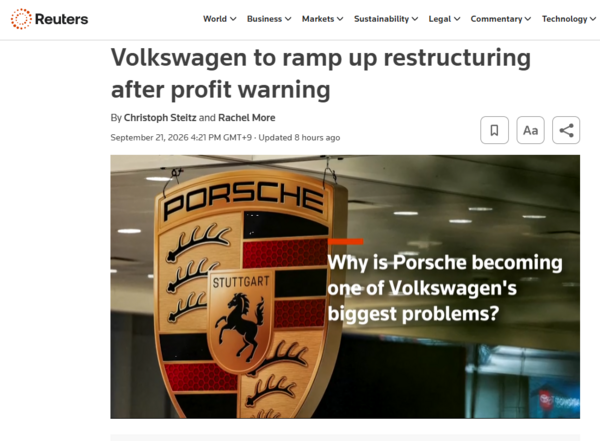
Porsche is the brand that most dramatically illustrates Volkswagen’s current predicament. On the 22nd, Reuters described Porsche as having transformed from "Volkswagen’s most reliable profit generator into a 'problem child'." Porsche was once the "crown jewel" lifting the profitability of the entire Volkswagen Group through high margins. However, as sales plummeted in China’s luxury vehicle market and costs piled up from revising its EV strategy, the tide turned completely.
Porsche’s sales in China peaked in 2021 and have been steadily declining ever since. The era when the Porsche badge served as an absolute status symbol for wealthy Chinese consumers has given way to an era where Chinese buyers compare Porsche against the digital features and price competitiveness of domestic luxury EVs.
[Volkswagen Was Too Late, Porsche Was Too Early]
Attributing Volkswagen's failure solely to "being late to the EV transition" tells only half the story. While Volkswagen's core mass-market brand lagged behind local rivals like BYD and Geely in responding to a market pivoting toward electric vehicles and software, Porsche faced the opposite problem. Porsche had set an aggressive goal to electrify over 80% of its sales by 2030, but luxury sports car consumers did not migrate to EVs as fast as expected.
Ultimately, Porsche pivoted back toward expanding the role of internal combustion engines (ICE) and hybrids, incurring astronomical costs in the process. Within the same parent group, Volkswagen was too slow, while Porsche was too fast. Thus, the essence of the problem lies not simply in whether they adopted EVs or not, but in how accurately they misread the direction and pace of market evolution.
[Eventually 100,000 Layoffs… But Is It Enough?]
The path Volkswagen ultimately chose is the largest restructuring in its corporate history. The company has embarked on massive cost-cutting measures, including approximately 100,000 headcount reductions and a trimmed model lineup. Additional job cuts are also being discussed at Porsche.
Yet the core issue is whether downsizing staff and factories alone can solve the crisis. The rules of competition in the auto industry are shifting away from engines, transmissions, and mechanical engineering toward batteries, software, AI, and autonomous driving. Reducing costs can buy time, but it does not automatically generate new competitive advantages.
Reuters similarly analyzed on the 22nd that "the automotive industry has entered a war of scale and adaptability," noting that "if traditional automakers misread evolving consumer demand, they can lose profitability regardless of their brand history or scale."
[Why Times Insight]
Why did Volkswagen end up here? Explaining it merely as the "price of arrogance for ignoring the trends of the time" falls short. Volkswagen was late to China's EV market, while Porsche was overly optimistic about electrification and had to reverse course.
However, both failures share a common root cause: the era of their market dominance lasted too long. Volkswagen believed China would continue buying German cars indefinitely, while Porsche assumed its powerful brand equity would compel consumers to follow them into the EV era. Because their track record of establishing global automotive standards endured for so long, they failed to recognize that the market was transforming faster than they were.
In this regard, Volkswagen serves as a microcosm of the German economy. For decades, Germany exported products globally built on world-class automotive, mechanical, and chemical engineering, reaping enormous profits—especially from the massive Chinese market. Today, however, China has turned from a customer into a rival, tariff barriers are rising in the U.S., and high domestic labor and energy costs are weighing heavily on manufacturing.
It is deeply telling that the European Central Bank (ECB) singled out Germany on the 22nd as the European nation facing the strongest competitive pressures from China's industrial upgrading. The challenges Volkswagen faces align almost identically with those confronting German manufacturing as a whole.
That said, it is premature to conclude this marks the "downfall of the German economy." On the 23rd, the Financial Times observed that "signs of economic recovery are appearing in Germany, driven by fiscal expansion and a rebound in exports," while noting that "traditional manufacturing industries, including Volkswagen, continue to face structural headwinds." In short, rather than an entire economy collapsing, it is more accurate to say that the existing growth model that propelled Germany to the top of global manufacturing has reached its structural limits.
Furthermore, a symbolic detail lies hidden behind Volkswagen’s exit from the Euro Stoxx 50: one of the companies replacing Volkswagen is Nokia. Once the textbook definition of corporate decline after falling behind in the smartphone revolution, Nokia transformed into a telecommunications infrastructure giant and reclaimed its spot among Europe's top blue chips. Meanwhile, Volkswagen—the icon of European industrial manufacturing in the internal combustion engine era—was pushed out.
Past glory does not guarantee future survival. Markets do not reward how great a company used to be; they evaluate whether a company can compete and remain profitable in the era ahead.
Ultimately, one fundamental question remains for Volkswagen: Can it abandon the legacy playbook that made it the world's best and forge a new formula for success in a new era?
And today, that question is directed not only at Volkswagen, but at the entirety of German manufacturing.
- TAG