


추부길 whytimespen1@gmail.com
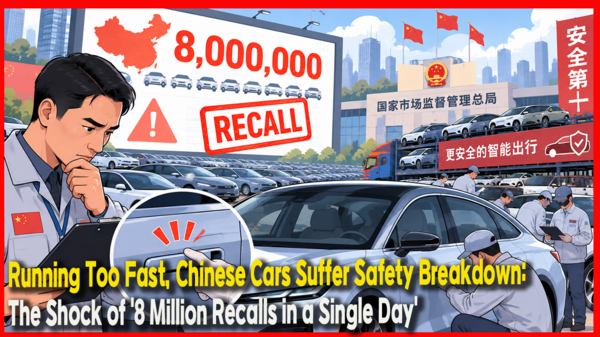
[Authorities State: "Nearly 8 Million Recalls on August 21"... Warning on New Technology Safety Defects]
Is the Chinese automotive industry beginning to pay the price for driving the world's fastest smart car innovation? An official from China's State Administration for Market Regulation (SAMR) revealed that nearly 8 million vehicles were recalled in the Chinese market on August 21 alone, citing safety defects stemming from new technologies. Notably, over 4.27 million vehicles were recalled due to issues with flush and electronic door handles. The core concern lies not in the recall mechanism itself, but in whether the safety verification frameworks of Chinese automakers are keeping pace while rushing toward the world's largest EV and smart car market.
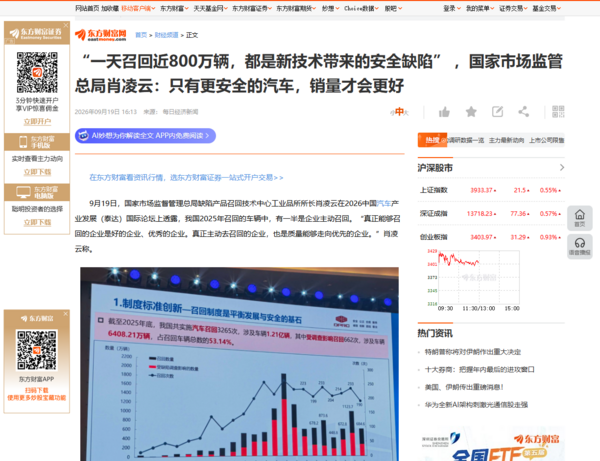
Eastmoney (Dongfang Caifu), a major online financial platform in China, reported that the numbers disclosed by Xiao Lingyun, Director of the Industrial Products Research Institute at SAMR's Defect Product Recall Center, during the 2026 TEDA Forum in Tianjin were startling. Xiao stated that nearly 8 million vehicles were recalled in the Chinese market on August 21, all linked to safety defects brought on by emerging technologies. This indicates that China's automotive industry, having built the world's largest EV market, is now being tested on how safely it can control innovation rather than how fast it can innovate.
Cumulative statistics reveal further context. Official SAMR data indicates that through the end of 2025, China conducted 3,265 automotive recalls affecting 121 million vehicles. In 2025 alone, 190 recall events took place involving 6.846 million vehicles, of which 2.652 million were new energy vehicles (NEVs). Notably, design-related issues accounted for 4.215 million recalled vehicles in 2025, representing 61.6% of the annual total.
These metrics should not be interpreted simply as 121 million defective vehicles, given that recalls represent standard administrative procedures to identify and rectify defects. Xiao noted that roughly half of the 2025 recalls were initiated voluntarily by automakers, characterizing proactive companies as responsible actors. Consequently, the primary significance rests not on the total recall volume, but on the mass emergence of non-traditional safety defects as vehicles transition toward smart systems.
[4.27 Million Vehicles Affected Simultaneously... The Issue: 'High-Tech Door Handles']
The most prominent issue in the August 21 recall involved door handle mechanisms. SAMR announced that recalls related to door handle safety affected vehicles across nine manufacturers, including FAW, BAIC, Dongfeng, Chery, Geely, Xpeng, Leapmotor, Tesla, and Xiaomi. Combined, these door handle recalls involved 4.276 million vehicles, marking the largest single-issue recall event in the Chinese automotive market.
Safety risks emerged during collision scenarios rather than routine operation. SAMR disclosures indicated that internal emergency mechanical release handles in certain models lacked color contrast with interior trim, hindering rapid identification and operation. Under extreme conditions where collision forces disrupt low-voltage electrical systems, occupants could face difficulties executing emergency egress. Flush and electronic door handles designed for aesthetic appeal consequently introduced secondary operational risks during critical incidents.
In response, Chinese regulatory authorities are revising technical benchmarks. China promulgated mandatory national standard GB 48001-2026, "Safety Technical Requirements for Automobile Door Handles," set for enforcement beginning January 1, 2027. The standard mandates specific requirements for emergency internal handle installation, labeling, power-operated external handle safety protocols, and testing methodologies. Advanced design features are thus being re-evaluated against fundamental crash safety principles requiring unassisted passenger extraction during total power loss.
[Chinese Official Directly Declares: "Safety Defines the Automobile"]
Xiao Lingyun's regulatory warnings highlight wider structural considerations. Xiao noted that while autonomous vehicle testing is extensive, many evaluations rely on standardized parameters, whereas daily driving encounters numerous non-standard road scenarios. He emphasized that regulators are strengthening crash reporting, safety monitoring, and sandbox oversight, noting that while innovation drives development, safety truly defines the automobile.
This shifts the focus beyond door handle mechanics. As vehicles transition from mechanical hardware into integrated platforms combining batteries, sensors, software, and algorithms, regulatory approaches require adjustments. Chinese authorities formalized plans in 2025 to tighten market access, recall management, and Over-the-Air (OTA) updates for connected vehicles, requiring manufacturers to maintain quality responsibility while enhancing supervisory capabilities in defect identification and sandbox testing.
[The Root Challenge: 'China's Speed' and Compressed Development Cycles]
This situation exposes structural pressures within China's automotive sector. Intensely competitive conditions in the Chinese NEV market have driven rapid product launch schedules, aggressive pricing, and frequent feature updates. The central challenge is ensuring safety verification frameworks remain uncompromised amidst accelerated commercial timelines.
Automotive systems differ fundamentally from consumer electronics. While software glitches in mobile applications can await routine patches, errors in vehicle software or electronic components directly affect braking, steering, battery management, and door actuation. Relying on post-launch OTA updates to rectify basic safety defects presents inherent risks to consumer safety. In response, China established national standards governing automotive software updates and strengthened requirements for pre-market verification across emerging technologies.
[Beyond 'World's Largest': Is It the Safest?]
Categorizing the 8-million-vehicle recall solely as an industry failure presents an incomplete picture. Proactive recall mechanisms serve to identify defects and mitigate consumer risk, with regulatory bodies treating voluntary filings as compliant corporate behavior. Nevertheless, the simultaneous recall of nearly 8 million vehicles and official acknowledgment of technology-induced defects signal clear operational vulnerabilities.
Furthermore, official statistics showing that design-phase flaws accounted for 61.6% of total recalled units in 2025 underline existing engineering challenges. As competition pivots toward electrification and software integration, validating system safety under extreme operational conditions becomes as critical as introducing new technological features.
[Why Times Insight]
China's automotive industry faces a transitional phase. Having prioritized rapid expansion over the past decade to establish the world's largest EV production capacity, global market expectations now emphasize product reliability and long-term safety validation alongside volume capabilities.
A key risk lies in development cultures that rely on real-world market deployment to surface unverified technical issues, followed by post-hoc OTA updates or formal recalls. Sustained reliance on post-release remediation risks degrading consumer confidence and brand equity. Regulatory initiatives integrating market entry, recall procedures, OTA oversight, and mandatory safety standards reflect efforts to counteract these operational tendencies.
Xiao's assertion that "safety defines the automobile" captures the core challenge facing manufacturers. To transition from a high-volume manufacturing base into a globally competitive automotive leader, performance metrics must balance innovation speed and price competitiveness with rigorous safety validation. This large-scale recall serves as a regulatory signal prioritizing safety compliance alongside technical advancement.
- TAG