

추부길 whytimespen1@gmail.com
[Iran Hardliner Rezaei Makes the First Move]
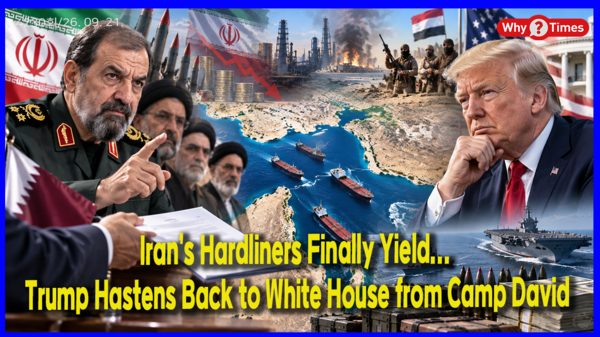
The standoff over Iran has arrived at a critical juncture. This time, it was not the Iranian reformists or moderates extending a hand, but Mohsen Rezaei—a key hardliner at the center of Iran’s security apparatus—who directly relayed negotiation terms to Washington. Rezaei transmitted seven specific conditions to the U.S. via Qatari mediators and publicly disclosed that Tehran is now "awaiting President Trump's reply." Coincidentally, U.S. President Donald Trump cut his weekend stay at Camp David short by a day to hurry back to the White House. While a direct connection between the two developments remains unconfirmed, both Washington and Tehran are fast approaching a moment of truth, particularly given Trump’s declaration just two days prior that a "major decision" on Iran was imminent.
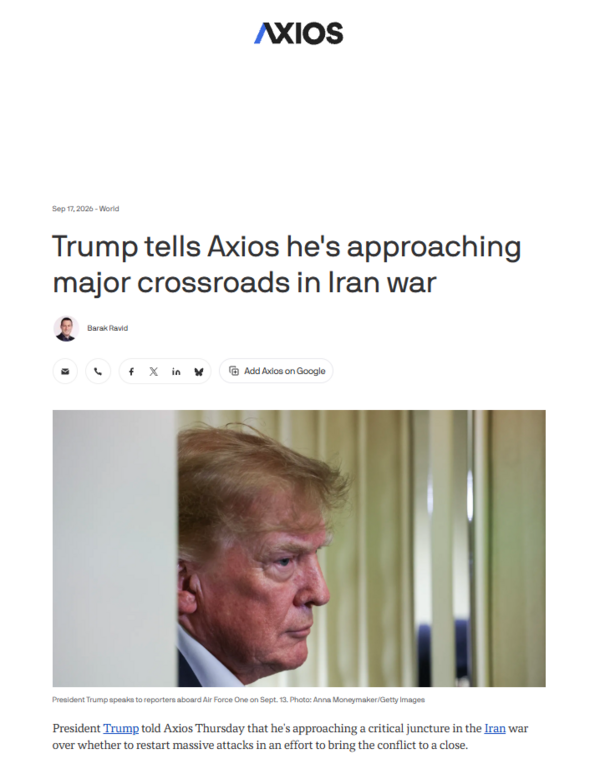
Axios reported on September 20 that in an interview with the outlet, President Donald Trump stated the conflict with Iran stands at a monumental crossroads. Trump noted that Washington faces a heavy decision on whether to launch a full-scale campaign to dismantle the Iranian regime or refrain, emphasizing that "anything can happen."
In a related report, Al Jazeera noted that Mohsen Rezaei, Secretary of Iran's Supreme National Security Council (SNSC), revealed in a September 19 interview that he had forwarded seven conditions through Qatari intermediaries to resume talks with Washington. While all seven conditions were not made public, Rezaei explicitly outlined three core demands for ending the conflict: a complete end to the war on all fronts, the unfreezing of Iranian assets, and the lifting of the U.S. naval blockade.
Rezaei further explained that contacts with Qatar remain ongoing and that Qatari officials conveyed Iran's terms to Washington with the goal of ending hostilities. He then added a crucial remark: "We are awaiting President Trump's response." This marks a distinct shift—rather than Iran merely evaluating a U.S. proposal, Tehran has formulated concrete terms and is publicly demanding an answer from the American president.
What matters most here is not the number of conditions, but the identity of the messenger. As Al Jazeera highlighted, Rezaei is no moderate diplomat. He is a former Commander-in-Chief of the Islamic Revolutionary Guard Corps (IRGC) and an indisputable hardliner who assumed the post of SNSC Secretary roughly a month ago. For a figure of his standing to not only transmit terms in secret but publicly declare he is awaiting Trump's answer demonstrates that the push for negotiations has moved far beyond the internal preferences of the presidential office or the foreign ministry.
[Surrender, or a Face-Saving Exit Strategy?]
Even so, it would be premature to label this a formal declaration of surrender by Tehran. While speaking of negotiations, Rezaei issued a concurrent warning that Trump’s threats would yield no results and that if Washington rejects the terms, Iran stands prepared to fight a decisive war. Tehran is extending a hand to the negotiating table without relinquishing its military rhetoric.
However, a distinction must be drawn between hardline rhetoric and tangible actions. Had Iran’s sole aim been the continuation of war, it would have had no reason to relay seven conditions to Washington through Qatar and publicly announce that it is awaiting the U.S. president's answer. This suggests Tehran may be attempting to preserve its public stance of non-submission while quietly constructing an off-ramp to end the war.
[The Iranian Economy Can No Longer Hold Out]
Driving this maneuver is an Iranian economy pushing past its limit. Reuters reported on September 17, citing interviews with Afghan migrants returning from Iran, that the domestic situation has deteriorated drastically. The compounding effects of war with the U.S. and Israel, sanctions, and the American naval blockade have driven consumer price inflation near 90% year-over-year, with food prices skyrocketing nearly 130%. The sharp devaluation of the rial has wiped out over two-thirds of the savings value for many households.
Crucially, Reuters pointed out that due to the U.S. naval blockade, Iran has been unable to export meaningful volumes of crude oil through the Strait of Hormuz in recent weeks. This contextualizes why two of the three publicly disclosed demands from Rezaei were the lifting of the naval blockade and the unfreezing of assets. Tehran has placed its most pressing cash and export bottleneck at the forefront of the negotiation framework, signaling precisely where the pressure hurts most.
[Trump Departs Camp David for the White House]
Against this backdrop, President Trump’s sudden movements have drawn intense focus. Newsmax reported that Trump cut short his planned weekend retreat at Camp David on September 19, returning to the White House on Saturday evening instead of staying through Sunday night. The White House offered no official explanation for the sudden schedule change.
The timing, however, is noteworthy. It coincided almost exactly with the public disclosure by Iran’s top security chief that terms had been delivered to Washington and that Tehran was awaiting Trump’s reply. Furthermore, Trump had already signaled in his September 17 Axios interview that he was facing a "big decision" regarding whether to resume large-scale strikes on Iran. Orders directing U.S. forces to maintain current troop deployments through the end of the year further indicate that military options remain firmly on the table.
Trump is slated to meet with leaders of the six Gulf Cooperation Council states—Saudi Arabia, the UAE, Qatar, Bahrain, Kuwait, and Oman—on the sidelines of the UN General Assembly in New York next week to address the Iran crisis. According to Axios, Trump intends to consult directly with Gulf allies before finalizing his next move. These meetings could serve as a decisive turning point, determining whether Washington escalates military pressure or leverages the diplomatic off-ramp presented by Iran.
[Washington Cannot Sustain an Indefinite Conflict]
Focusing solely on Iran's desperation misses half the picture; the U.S. is also incurring substantial costs as the conflict drags on. Reuters noted that the Congressional Budget Office (CBO) estimated U.S. Department of Defense expenditure on the war with Iran at roughly $38 billion through August 1, with ongoing operations running up to an additional $3 billion per month.
That figure has since climbed higher. According to AP reporting citing the latest estimates from U.S. Central Command, total U.S. war costs reached $43.6 billion as of September 3. Expenditure on advanced munitions has surged, driving growing concern over inventory levels for air defense interceptors like Patriot and THAAD systems. Consequently, expanding the war indefinitely is not a frictionless option for Washington either.
[Flames Reach Riyadh: Delays Threaten Regional Escalation]
Moreover, the conflict has already spilled past the borders of the primary combatants. The Wall Street Journal reported on September 19 that a fire broke out at a jet fuel storage facility near King Khalid International Airport in the Saudi capital of Riyadh. Yemen's Houthis claimed responsibility, stating they executed missile and drone strikes targeting sensitive sites in Riyadh as well as Saudi Aramco facilities in Yanbu along the Red Sea coast. Saudi air defenses reported intercepting the majority of incoming projectiles.
On September 20, mixed signals of compromise and defiance emerged from the Iranian Parliament as well. Speaker Mohammad Bagher Ghalibaf declared that for Iran to consider returning to prior negotiation frameworks or reopening the Strait of Hormuz, Tehran’s conditions must first be met with guaranteed U.S. compliance. This reinforces that conditional negotiation is not merely an isolated proposal by Rezaei, but a broader stance solidifying within the core of Iranian leadership.
[Why Times Insight]
The most critical element in this development is not the words of Iran’s hardliners, but their actions. Rezaei continues to speak of a "decisive war" and shows no willingness to easily unblock Hormuz. Yet, simultaneously, he used an intermediary nation to deliver terms to Washington and publicly stated he is awaiting Trump’s answer. Viewed alongside Iran's severe economic distress, it becomes evident that even the hardline core of Iranian leadership sees an urgent need for an exit strategy.
The ball is now in President Trump's court. Washington holds substantial leverage through its naval blockade and economic sanctions. Succumbing to calls for a hasty lifting of the blockade risks surrendering that hard-won leverage prematurely. Conversely, launching another major military offensive risks igniting broader regional escalations across Hormuz, Yemen, and Saudi Arabia—all while the U.S. absorbs tens of billions in defense costs and strains its interceptor stockpiles.
Ultimately, Trump's core dilemma is not simply whether to apply more pressure on Iran, but at what precise moment that pressure should be converted into a negotiated outcome. Moving too early risks handing Tehran a strategic lifeline; waiting too long risks letting a conflict that has already reached Riyadh escalate beyond control.
This is precisely why the "seven conditions" put forward by Rezaei carry a far different weight than previous messaging out of Tehran. Iran continues to issue aggressive statements, but for the first time, its top hardline security official is explicitly waiting for an answer from the American president. Having returned to the White House a day early from Camp David, Trump now faces his moment of decision.