


추부길 whytimespen1@gmail.com
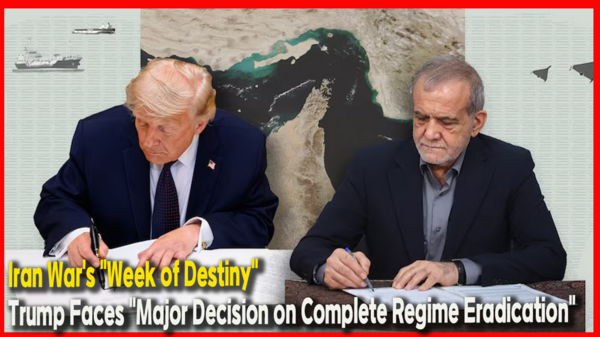
[Trump: "To Completely Eradicate or Not… A Major Decision"]
The most critical week since the outbreak of the Iran War is fast approaching. U.S. President Donald Trump publicly stated that he faces a "major decision" on whether to re-initiate large-scale military operations against the Iranian regime. Ahead of this decision, he is set to meet directly with leaders from six Gulf nations—including Saudi Arabia, the UAE, and Qatar—in New York on September 22 to hear their perspectives.
Adding to the gravity of the situation, Iranian President Masoud Pezeshkian is scheduled to arrive in New York during the same period to attend the United Nations General Assembly. Meanwhile, back in Tehran, calls for Pezeshkian's removal are resurfacing among hardline factions. The coming week is emerging as a critical turning point that will shape not only the trajectory of a potential ceasefire or further escalation, but also the internal power struggle within Iran.
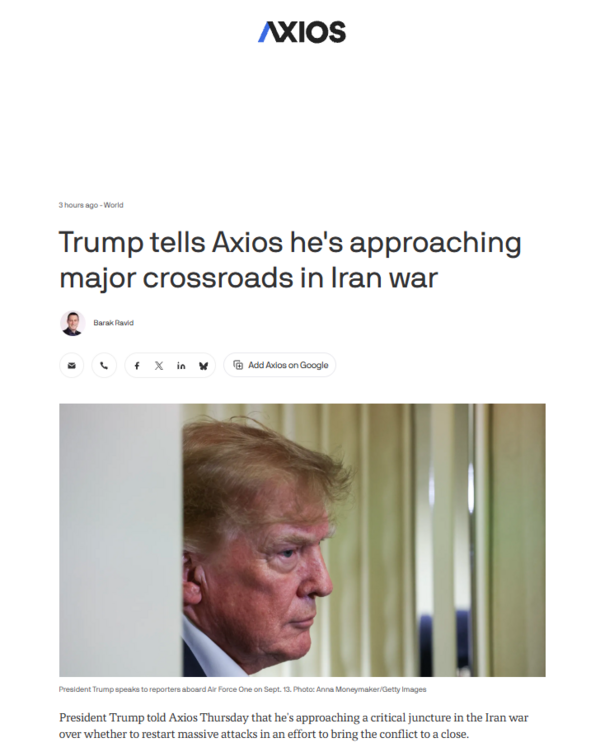
U.S. news outlet Axios reported on an interview with President Trump on September 17, emphasizing that the Iran War is approaching a "major crossroads." In the interview, Trump revealed that he faces a monumental decision regarding whether to launch a full-scale military campaign to completely eradicate the Iranian regime or refrain from doing so. Axios evaluated these remarks as a clear indication that the conflict has reached a decisive inflection point.
Axios further highlighted that the weight of Trump's statement stems from the fact that it was not merely a warning directed at Iran, but a direct explanation of his decision-making process. Coinciding with the UN General Assembly, Trump plans to meet with leaders or foreign ministers of the six Gulf Cooperation Council (GCC) member states—Saudi Arabia, the UAE, Qatar, Bahrain, Kuwait, and Oman—to deliberate on the next phase of the war. According to Axios, the White House intends to gather feedback from Gulf allies during this session to concrete its post-war strategic plan.
Underlying Trump’s focus on reaching a decision is the practical reality that maintaining the current status quo indefinitely is unsustainable. Axios reported that the U.S. had suspended a planned expansion of large-scale military operations in August after nations like Saudi Arabia and Qatar expressed strong concerns that Iranian retaliatory strikes could target their oil and gas infrastructure. While Trump paused the escalation at the time, U.S. military forces in the Middle East have been instructed to maintain their current force posture through the end of the year to prepare for potential operation expansions.
A central complication remains the unresolved disruption in the Strait of Hormuz. Ship-tracking data cited by Reuters showed that only three commercial cargo vessels passed through the Strait of Hormuz on September 16, a sharp decline from 12 vessels the previous day and an average of roughly 17 over the preceding 10 days. Although the actual number of transiting ships might be higher due to vessels disabling their Automatic Identification System (AIS) transponders, the underlying reality remains unchanged: global energy transport through this critical maritime choke point is severely constrained.
Concurrently, the U.S. is intensifying its economic and financial pressure. Reuters reported that the U.S. Department of the Treasury imposed sanctions on September 17 against BitBank, a cryptocurrency exchange operated by Iranian businessman Babak Zanjani. The Treasury alleged that the exchange processed hundreds of millions of dollars for vessels seeking safe passage through Hormuz, subsequently channeling funds to the Islamic Revolutionary Guard Corps (IRGC). Thus, even as Trump weighs military courses of action, economic measures aimed at choking off Iran’s financial pipelines are actively intensifying.
[Pezeshkian Also Heading to New York]
This dynamics makes the upcoming UN General Assembly particularly noteworthy. AP reported that despite the ongoing conflict, the Trump administration approved visas for a high-level Iranian delegation, including President Pezeshkian and Foreign Minister Abbas Araghchi, to travel to New York. Although the U.S. imposed travel restrictions within the city, banned luxury purchases, and capped the size of the delegation compared to previous years, it permitted the Iranian president's physical attendance at the UN General Assembly.
Consequently, President Trump, leaders or senior diplomats from the six Gulf nations, and President Pezeshkian will gather in New York almost simultaneously next week. To date, there are no confirmed reports of scheduled direct talks between Trump and Pezeshkian, nor of any formal U.S.-Iran summit-level negotiations. Nevertheless, the simultaneous presence of U.S. decision-makers, Gulf state leadership, and the Iranian president in the same city to shape the next phase of the conflict elevates this UN General Assembly into a pivotal diplomatic nexus.
[Pezeshkian Heads to New York as Hardliners Demand His Removal at Home]
The diplomatic burden Pezeshkian carries to New York extends beyond the military confrontation with the United States. Iran International reported that ultra-hardline factions in Tehran are once again raising demands for the president's impeachment. Sparked by statements from Mojtaba Zarei, a lawmaker representing the Qom constituency, political debates surrounding the president's perceived "political incompetence" and the prospect of early presidential elections have re-ignited. Iran International noted that suspicions are circulating within Iranian political circles that hardline groups—specifically those aligned with Saeed Jalili, who lost to Pezeshkian in the 2024 election, alongside the Sharian and Paydari factions—are driving this internal push.
However, available evidence remains insufficient to conclude that Pezeshkian's removal is imminent. Iran International analyzed that demands for resignation or impeachment by hardliners consistently resurface whenever political, economic, or diplomatic pressure intensifies, adding that there is currently no proof of a cohesive parliamentary coalition capable of ousting the president. The primary significance lies not in the immediate probability of a successful removal, but in the extent to which hardline pressure can constrain the president's diplomatic maneuverability.
[Constraining the President's Hand vs. Successful Removal]
Crucially, the push to oust Pezeshkian intersects with internal fractures regarding Iran's overarching war strategy. According to Iran International, the present internal friction cannot be reduced to a simple "conservative versus reformist" binary. Key conservative figures, such as Parliament Speaker Mohammad Bagher Ghalibaf, oppose the movement to strip Pezeshkian of power, placing them at odds with ultra-hardline factions like Paydari, Sharian, and Jalili's camp. This ideological struggle over war policy and potential negotiations with Washington is actively splintering Iran’s conservative establishment.
In this context, Pezeshkian's trip to New York carries significance far beyond standard UN diplomacy. Failing to secure a diplomatic exit route with the U.S. could intensify political pressure from domestic hardliners. Conversely, achieving any form of diplomatic breakthrough could alter the trajectory of the internal power struggle in Tehran. Ultimately, New York serves as both an international diplomatic stage and a high-stakes domestic political test of Pezeshkian's approach to negotiations with the U.S.
[Trump Cannot Act Without Gulf Nation Consensus]
President Trump’s strategic calculations are equally complex. Axios noted that re-initiating a large-scale military campaign carries the direct risk of triggering Iranian missile and drone strikes against oil and gas infrastructure across Gulf states. This exact threat prompted countries like Saudi Arabia and Qatar to express severe concern during the U.S. escalation push in August. Consequently, Trump’s emphasis on directly consulting the leaders of the six Gulf nations on September 22 reflects the reality that subsequent military choices directly affect the security and energy exports of U.S. Gulf allies.
Furthermore, the conflict has expanded beyond a bilateral dynamic between Washington and Tehran. Reuters reported on September 17 that as Houthi military attacks threatened Saudi oil exports and Red Sea maritime lanes, Saudi Arabia sought assistance from Beijing, prompting China to privately pressure Iran to restrain the Houthis. With both the Strait of Hormuz and the Bab-el-Mandeb Strait—the world's two critical energy transit choke points—facing simultaneous instability, the conflict has transformed into a broader security crisis encompassing both the Gulf and the Red Sea.
Concurrently, Washington has begun evaluating "day-after" scenarios. According to Axios, the White House is formulating a post-war framework designed to contain Iran while expanding the normalization of relations between Israel and neighboring regional states. This strategy is expected to feature prominently during the September 22 consultations with Gulf leaders. Thus, the upcoming New York meeting functions not merely as a tactical council on military strikes, but as a strategic forum shaping the future architecture of the Middle East.
[Why Times Insight]
The core dynamic over the coming week extends beyond whether the U.S. will resume large-scale military strikes against Iran. Washington faces a strategic choice regarding where to draw the line on military involvement; Gulf nations face a decision on how far to support U.S. re-escalation; and Tehran faces an internal choice on how much political space to afford a president seeking diplomatic avenues.
President Pezeshkian remains a central figure to watch. As he travels to New York for the UN General Assembly, ultra-hardline factions in Tehran are reviving calls for his removal. While evidence of an imminent impeachment remains limited, the fact that internal conflict over war exit strategies has breached the political domain in Tehran represents a critical variable in assessing the conflict's direction.
Ultimately, two distinct conflicts will unfold simultaneously in New York next week: the external military confrontation between the U.S. and Iran, and the internal power struggle within Iran over the trajectory of war and diplomacy. The strategic choices announced by Trump following his consultations with the six Gulf nations, combined with the diplomatic messaging delivered by Pezeshkian in New York, will serve as the primary indicators determining the next phase of the crisis.
Whether the conflict moves toward a resolution or reverts to large-scale military confrontation, the Iran War is entering its most decisive crossroads.
- TAG