


추부길 whytimespen1@gmail.com
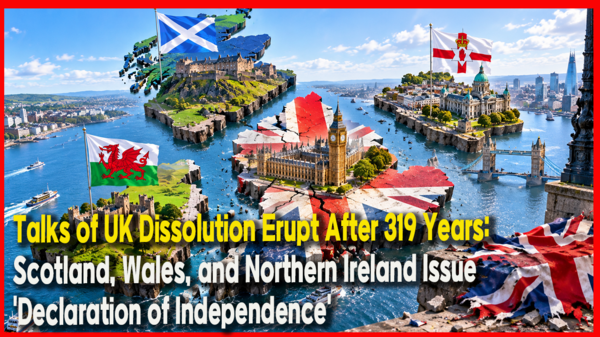
[“The Westminster Era is Coming to an End”… A Bomb Dropped in Cardiff]
Voices seeking to leave the United Kingdom have now begun to connect simultaneously from the north and west of London. Leaders of political parties pursuing independence or Irish reunification in Scotland, Wales, and Northern Ireland gathered in one place for the first time to jointly declare their right to self-determination and demand that the British government prepare for future constitutional changes. While this does not mean the UK will split into three pieces overnight, the very fact that the ruling forces of all three regions have publicly raised the prospect of a "post-United Kingdom future" and formed a united front is unprecedented in British politics. The real issue starts now: Why have these movements emerged simultaneously in a United Kingdom that has endured for over 300 years, and what will happen to the UK if actual separation occurs?
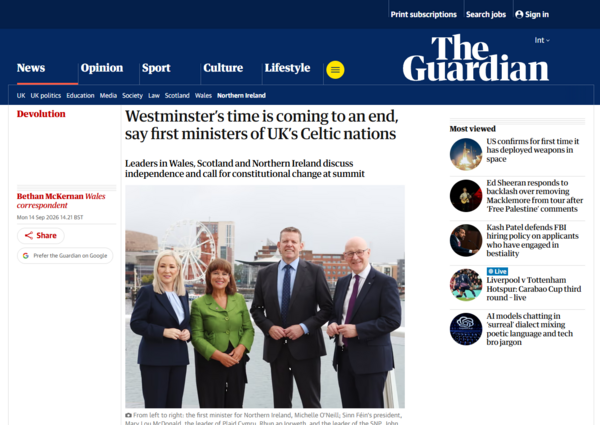
The UK’s Guardian reported on the 15th: “On the 14th in Cardiff, Wales, John Swinney, First Minister of Scotland and leader of the SNP, Rhun ap Iorwerth, First Minister of Wales and leader of Plaid Cymru, and Michelle O'Neill, First Minister of Northern Ireland and deputy leader of Sinn Féin, gathered alongside Mary Lou McDonald, leader of Sinn Féin.” The report noted, “They signed a Memorandum of Understanding (MOU) to the effect that 'our people have the right to determine their own future, and no Westminster government has the right to block democracy,' while demanding that the British government prepare for and support constitutional changes in Scotland, Wales, and Northern Ireland.” Importantly, the three leaders did not sign an intergovernmental agreement representing devolved governments, but rather signed in their capacity as leaders of their respective political parties.
The Guardian continued: “The reason this meeting is drawing attention is that parties aiming for independence or Irish reunification are leading the governments in all three regions simultaneously.” It added, “The MOU marks the first time First Ministers of Scotland, Wales, and Northern Ireland have all belonged to political forces seeking independence or separation from the UK, emphasizing that 'the era of Westminster is coming to an end.'” Beyond self-determination, the three parties agreed to strengthen cooperation in areas such as relations with Europe, economic development, and energy.
The Guardian also pointed out: “However, it is inaccurate to immediately interpret this as 'Scotland, Wales, and Northern Ireland deciding to withdraw from the UK.' The goals of the three regions are fundamentally different: the Scottish National Party (SNP) aims for an independent Scotland, and Plaid Cymru aims for an independent Wales, but Sinn Féin's goal is not an independent Northern Irish state, but rather Northern Ireland leaving the UK to unite with the Republic of Ireland.”
The Guardian noted, “The timing and strategy for referendums are also different. Therefore, the core of the Cardiff meeting is not an 'agreement on the dissolution of the UK,' but rather that three distinct nationalist political forces have established a united front under a single banner of 'self-determination.'”
[A Single Remark by Burnham Awakens Scotland]
What fueled the flame was a remark by British Prime Minister Andy Burnham. When asked about a second Scottish independence referendum during Prime Minister's Questions in the House of Commons on the 9th, Burnham responded to the effect that “I do not believe there is currently majority support for a rerun,” and “until that changes, there will be no referendum.” The SNP immediately seized on this phrasing. John Swinney began to pressure the central government by interpreting this logic to mean: 'Doesn't that imply a referendum will be recognized if majority support emerges?'
However, the Burnham government stepped back immediately. The government reaffirmed its position that a second Scottish independence referendum remains 'out of the question.' Therefore, Burnham’s remarks should not be interpreted as a policy shift by the British government to permit a second vote. Nevertheless, the pro-independence camp gained significant political leverage, as they can now pose the question to Westminster: 'How many Scottish citizens must desire it before a re-vote can take place?'
[Enter Trump... “I Want to See a United Ireland”]
To top it off, unexpected remarks by U.S. President Donald Trump joined the fray. Reuters reported: “Trump expressed a desire to see Northern Ireland and the Republic of Ireland become one during his visit to Ireland, and on the 13th, he reiterated his stance supporting Irish reunification.” On the other hand, “he avoided giving a direct answer regarding Scottish independence, saying he would save his opinion for another day, which immediately drew strong backlash from pro-British Unionist political forces in Northern Ireland.”
However, Trump's remarks should not be overinterpreted as an immediate shift in U.S. government policy toward Great Britain. What is currently confirmed is President Trump's public statement, which does not mean the U.S. government has adopted UK separation or Irish reunification as new official foreign policy. Still, the fact that the U.S. President publicly expressed an opinion on the territorial and constitutional issues of a key ally adds another variable to the UK's internal debate.
[Could the UK Really Break Apart?]
The reality is far more complex than political slogans. First of all, Scotland does not possess the independent legal authority to pursue an independence referendum. On November 23, 2022, the UK Supreme Court ruled that “the Scottish Parliament does not have the power to legislate for an independence referendum without the consent of Westminster.” The rationale was that “matters of independence relate to the reserved powers of the central government, namely the UK Union itself and the UK Parliament.” Therefore, agreement with the central government remains the critical variable to hold a legal referendum like the one in 2014.
Northern Ireland, however, is entirely different. The Northern Ireland Act 1998 stipulates that the Secretary of State must hold a referendum if it appears likely that a majority of the people of Northern Ireland wish to leave the UK and form a united Ireland. On the other hand, Wales currently has no legal pathway for an independence referendum comparable to Scotland's 2014 vote or Northern Ireland's so-called 'border poll.' Although the three regions have joined hands politically, their actual legal paths to leaving the UK are different.
[Public Opinion is Still Far from the 'Dissolution of the UK']
More important is the actual choice of the residents. According to The Guardian, recent polls show that about 47% of Scottish voters support independence, about 32% in Wales support independence, and about 36% in Northern Ireland support Irish reunification. In Scotland's case, support for independence has generally hovered between 45% and 50% since the 2014 referendum. In short, while demands for constitutional change exist in all three regions, it is difficult to conclude that the 'dissolution of the UK is imminent' based on current figures alone.
In particular, the situation in Wales differs significantly from Scotland. Plaid Cymru maintains the position that it “will not hold an independence referendum during the current term,” focusing first on expanding autonomy to the level of Scotland and Northern Ireland. Northern Ireland also has a long-term goal of Irish reunification, but current public opinion makes it difficult to view reunification as being backed by a clear majority. The fact that three leaders sat at the same table does not mean the political choices of the residents in all three regions have unified as one.
[Why the UK Government Has No Choice But to Be Nervous]
Nevertheless, the reason this meeting cannot be taken lightly is that the very structure of British politics has changed. According to The Guardian, Scottish independence, Welsh nationalism, and Irish reunification have operated under different histories and legal frameworks until now. This time, however, under circumstances where parties asserting self-determination lead governments in all three regions simultaneously, their leaders gathered in one place to send a joint message to Westminster. Although political goals and timetables differ, the core of the Cardiff meeting is that three previously separate streams have formed a single axis of political pressure for the first time.
Furthermore, if Scottish independence were to become a reality in the long run, the issue would not end with simply drawing a new border line. The Scottish Government itself has proposed continuing to use the Pound in the initial phase following independence before introducing an independent 'Scottish Pound' in the long term, and acknowledges that the division of UK national debt and assets would inevitably become a subject of negotiation. On top of that, massive issues such as trade, fiscal policy, financial stability, and relations with the EU would all land on the negotiating table at once.
[Why Times Insight]
Reading this situation as 'the UK will dissolve tomorrow' misses the essence. The more important shift is that the question of whether to preserve the United Kingdom is no longer a problem exclusive to Scotland. In the past, Scottish independence, Welsh nationalism, and Irish reunification moved as separate political issues. In Cardiff, however, these three streams found a common language in 'self-determination' for the first time.
That does not mean the interests of the three regions are identical. Scotland has established independence as the most realistic political issue, with support hovering near half; independence support in Wales remains a minority; and Northern Ireland's future is determined within a separate institutional framework governed by the Good Friday Agreement and the Northern Ireland Act 1998. Therefore, the current reality of this 'independence triple alliance' is closer to a political solidarity aimed at pressuring Westminster on rights to self-determination and constitutional change, rather than an immediate joint exit plan.
Still, it is difficult for the UK government to ignore. Although public opinion on independence and reunification has not reached a decisive level right now, if a dynamic where forces advocating self-determination lead governments across three regions persists long-term, and if approval ratings for independence and reunification rise, debate over the legitimacy of the United Kingdom will only grow fiercer. Notably, what this MOU demanded from the British government was not immediate approval of independence, but rather to 'prepare, plan, and facilitate future constitutional changes that may occur.' This exact point carries the true political significance of the Cardiff meeting.
Ultimately, the question sparked in Cardiff is not 'Will the UK split apart soon?' It is: 'Will the people of Scotland, Wales, and Northern Ireland continue to want to remain in the UK in the future?'
319 years since the Acts of Union between England and Scotland in 1707. While there is no evidence to suggest the dissolution of the United Kingdom is imminent right now, it appears clear that the political debate surrounding the future of the Union has entered a brand-new phase.
- TAG