


추부길 whytimespen1@gmail.com
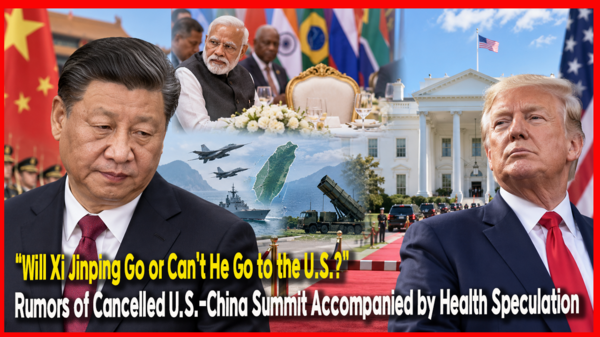
[China Warns: “Arms Sales to Taiwan Mean No Summit” … Trump: “I’m Not Worried”]
With just ten days remaining before the U.S.-China summit scheduled for September 24 between President Donald Trump and President Xi Jinping, rumors of a cancellation have abruptly emerged. Ostensibly, the catalyst is the issue of U.S. arms sales to Taiwan. Yet only days prior, China signaled active preparation by making a massive purchase of roughly 1 million metric tons of U.S. soybeans.
Simultaneously, at the 18th BRICS Summit in New Delhi, Indian Prime Minister Narendra Modi raised eyebrows by publicly checking on Xi’s condition mid-speech, after which Xi skipped the official gala dinner. Are these diplomatic threats purely about Taiwan, or is an underlying health issue driving the uncertainty?
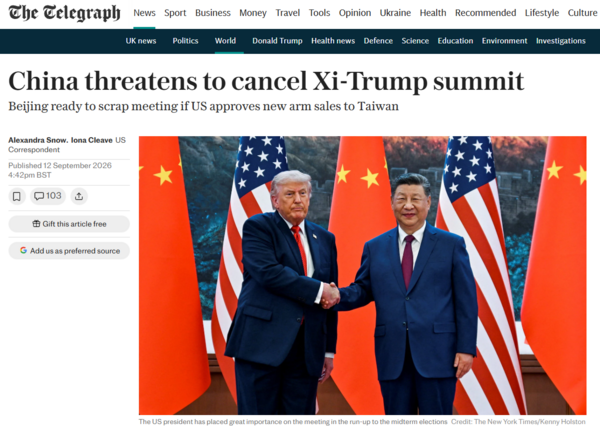
The UK’s Telegraph, citing Japan’s Kyodo News, reported on the 13th that an unusual atmospheric rift had opened following Beijing’s stern warning. China reportedly informed Washington that any approval of new arms packages to Taiwan prior to the meeting could result in cancelling Xi’s visit. By defining Taiwan as an uncrossable "red line," Beijing effectively leveraged the summit itself as a bargaining chip.
President Trump’s reaction, however, was remarkably nonchalant. Speaking on September 13 regarding China’s cancellation threat, Trump stated he was “not worried.” Emphasizing his good personal relationship with Xi and mutual desire for cooperation, Trump publicly demonstrated zero distress over Beijing’s bluff.
[Why Buy 1 Million Tons of Soybeans Before Threatening to Cancel?]
This inconsistency presents a fundamental question. On September 10, Reuters reported that Chinese state-backed grain firm Sinograin purchased 14 to 15 shipments—roughly 1 million tons—of American soybeans. This purchase pushed China’s imports close to half of its 25-million-ton annual commitment.
The timing is critical: the transaction occurred right before Xi’s planned trip to Washington. While domestic supply deficits and reduced Brazilian yields played economic roles, executing a massive state purchase two weeks prior to a summit demonstrates Beijing was actively building economic goodwill for top-level diplomacy.
Why would a nation intent on scrapping a summit buy 1 million tons of soybeans days before? This suggests Beijing's warning is less an absolute ultimatum and more a classic late-stage negotiating tactic to extract concessions on Taiwanese arms sales.
[Unexpected Incident in India Draws Intense Focus]
As diplomatic maneuvers unfolded, a completely different variable materialized. On September 12, President Xi arrived in New Delhi for the 18th BRICS Summit—his first visit to India in seven years.
During his opening speech on day one, Prime Minister Modi unexpectedly paused, turned toward Xi's delegation, and asked the interpreter, “Is it okay?” Indian media noted that Xi appeared visibly uncomfortable.
Compounding the mystery, Xi was absent from the official gala dinner hosted by Modi that evening, sending Foreign Minister Wang Yi in his place. The Indian Express cited sources indicating Xi had returned to his hotel to rest.
While both incidents might be benign individually, occurring back-to-back just ten days before a major U.S. trip has intensified rumors surrounding the leader's health.
[What Is the Real Reason Behind the Cancellation Rumors?]
Evaluating the entire landscape reveals a striking contrast between China’s rhetoric and actions. While threatening a cancellation over Taiwan, Beijing continues to stabilize bilateral trade ties via major agricultural purchases.
Furthermore, Chinese private processors are eager for tariff relief on U.S. imports, giving Beijing strong economic incentives to execute the summit.
Trump previously announced back in July that Xi would visit Washington on September 24. Yet Reuters reported that Beijing has consistently refrained from officially confirming the exact date. If Beijing officially confirms the schedule shortly, the cancellation rumors will likely fade; extended silence or sudden rescheduling will only deepen global suspicion.
[Why Did Trump Say He Is “Not Worried”?]
Trump’s relaxed posture reflects two main calculations based on Reuters reporting:
Leverage Confidence: Washington believes Beijing needs this summit to address pressing trade, tariff, and economic pressures. Reports that Xi plans to bring a delegation of high-level Chinese CEOs further validate that Beijing seeks economic outcomes.
Asymmetric Risk: Trump loses little if the meeting is delayed. His stance translates to a pragmatic calculation: "If Xi comes, we negotiate; if he doesn’t, we wait."
[Why Times Insight]
The core anomaly of this situation lies in the mismatch between Beijing's words and actions: aggressive warnings regarding Taiwan alongside active economic preparations for a Washington visit.
However, health is an unnegotiable variable. While there is no official medical proof of Xi's ill health, diplomatic schedules, physical public appearances, and official confirmations from Beijing over the coming days will serve as the true indicators.
If the September 24 summit proceeds as planned, this sequence will be remembered as a brief diplomatic episode. But if Beijing postpones without clear justification, global focus will swiftly shift from Taiwan to the internal dynamics of Zhongnanhai.
- TAG