


추부길 whytimespen1@gmail.com
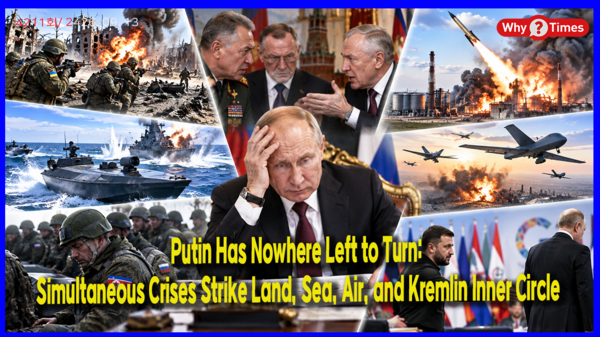
[Signs of Division Within Kremlin Elite: 'War Proponents' vs. 'Negotiators']
Simultaneous warning signs are erupting across multiple theaters of war, leaving Russian President Vladimir Putin with nowhere left to turn. On land, distorted reporting systems and frontline pressures have been exposed. In the air, Russia's defense industry faces long-range Ukrainian missile strikes. At sea, Ukraine claims the first-ever naval drone duel in history. Compounding these setbacks, Ukrainian intelligence reports a growing rift inside Putin's inner circle between pro-war hardliners and peace negotiators, while Japanese media cite records showing 2,288 North Korean soldiers killed in action. Yet at this critical juncture, Putin rejected President Zelenskyy's invitation to meet at the upcoming G20 summit.
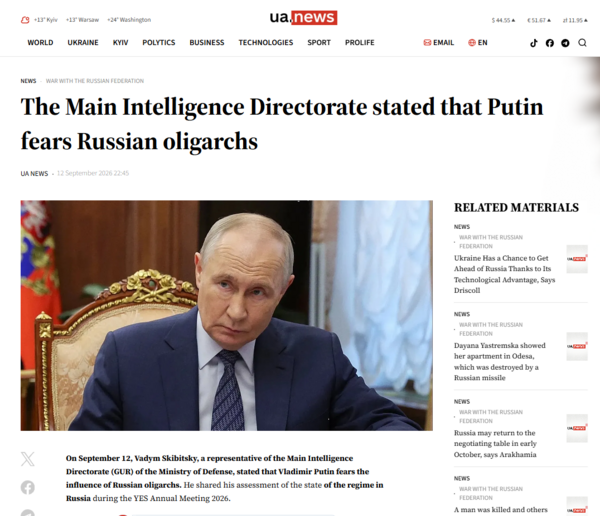
Ukrainian media portal UA.News reported on the 13th that Vadym Skibitsky, Deputy Head of Ukraine’s Main Directorate of Intelligence (HUR), highlighted conflicting interests among Russia’s ruling elite and noted the regime’s acute sensitivity to potential domestic instability. HUR analysis reveals that recent Russian battle casualties exceed new troop replenishment rates, underscoring the systemic pressure a prolonged war exerts on Moscow.
As the conflict drags on, Russian elites face questions not only of how to win, but when and under what terms to end the war. For Putin, maintaining the war effort has transcended military and diplomatic strategy to become a direct variable of regime survival.
[No Safe Haven Outside Kremlin Walls]
The situation north of Lyman exemplifies the operational challenges on land. Beyond Ukrainian counterattacks, a more severe vulnerability lies in exaggerated and false combat reports within the Russian military hierarchy. If Putin operates on distorted battlefield intelligence, decision-making at the supreme command level becomes inherently flawed.
Personnel shortages further constrain Moscow. Ukrainian intelligence reported that in August alone, Russian forces suffered approximately 43,000 casualties against only 39,000 new recruits. Skibitsky noted that internal Russian General Staff assessments indicate tactical objectives remain unachievable without additional mobilization.
[From the Sky: 'Flamingo' Strikes Russia's Defense Industry]
Ukraine’s indigenously developed FP-5 'Flamingo' cruise missile is directly targeting Russian defense production. According to The Kyiv Independent, manufacturer Fire Point confirmed an 11th-strike on the Volgogradpromproekt facility in Volgograd, causing severe fires. The plant produces specialized chemical components critical to Russia's military-industrial complex.
Kyiv’s strategy targets key links in Russia’s war machine simultaneously. Rather than engaging solely on the frontlines, Ukraine is striking chemical, missile production, energy, and logistics infrastructure—drastically raising the defense costs required for Moscow to sustain the war. Skibitsky emphasized that these defense industry strikes specifically aim to disrupt or halt the production of key weapons and critical components.
[At Sea: A Historic Milestone in Naval Warfare]
On the 12th, a historic engagement took place in the Black Sea. The Ukrainian Navy announced that a joint operation with HUR destroyed a Russian unmanned surface vessel (USV) using Ukraine's 'Sargan-3000' drone boat. After HUR units detected the target, the Sargan-3000 intercepted and destroyed it with a 12.7mm 'Protector' Remote Weapon Station.
The Ukrainian Navy designated this as the world’s first "USV vs. USV" naval battle. Released footage demonstrates that surface drones have evolved from kamikaze anti-ship weapons into combat platforms capable of detecting, tracking, and engaging enemy uncrewed craft directly.
This evolution compounds Putin's strategic pressure. Ukrainian sea drones have long restricted Russian Black Sea Fleet operations; as Russia deploys its own naval drones, the Black Sea has transformed from a 'ship vs. drone' battleground into a 'drone vs. drone' testing arena. Beyond technological rivalry, this widening domain continually forces Russia to disperse defensive resources.
[2,288 North Korean Casualties Recorded]
The human and financial toll of relying on external troop deployments has also come to light. Citing sources who visited the Memorial Museum of Combat Feats at the Overseas Military Operations in Pyongyang, Japan's Sankei Shimbun reported that 2,288 North Korean soldiers deployed to Russia are recorded as killed. Headstones for 300 designated 'heroes' stand near the memorial, while the remains of the rest are enshrined on the building's upper floors.
Eye-witness testimony regarding the casualties remains striking. Sankei reported that over half of the deceased are presumed to have self-detonated to avoid capture, with high casualties also resulting from Ukrainian drone strikes.
[Zelenskyy to Putin: "Let's Meet at the G20"]
Political developments on the 13th unified these battlefield events. The Kyiv Post reported President Zelenskyy’s willingness to meet Putin directly at the upcoming G20 summit in Miami this December to discuss ending the war. However, Kremlin spokesperson Dmitry Peskov promptly dismissed the proposal, reiterating that a summit could only take place in Moscow.
Significantly, Moscow has not closed the door on negotiations entirely. Kyrylo Budanov, Head of the Office of the President of Ukraine, noted preparations for potential trilateral talks involving Ukraine, Russia, and the U.S. in October. Putin's core hesitation lies less in whether to negotiate and more in whether to sit across from Zelenskyy as an equal sovereign leader.
[Why Putin Refuses to Meet Zelenskyy]
The Kyiv Post outlined three primary reasons behind Putin's reluctance:
Mandatory Concessions: A face-to-face meeting immediately places Russian concessions on the executive agenda. The primary deadlock remains the status of the Donbas region, which Russia does not fully control. Unlike working-level talks, a summit forces Putin to make binding personal decisions.
Political Symbolism: Putin has long questioned the legitimacy of Zelenskyy's government. Meeting one-on-one on an international stage like the G20 in the U.S. contradicts Moscow's narrative and frames both figures as equal warring counterparts. Demanding a meeting in Moscow is a theatrical assertion of leverage.
The War Scorecard: A peace agreement forces Putin to justify four and a half years of war. Having committed massive casualties, financial reserves, and foreign troop deployments without securing initial objectives, accepting a compromise exposes Putin to severe internal criticism from the military, political elites, and the public.
[Why Times Insight — Where Can Putin Turn His Gaze?]
Isolated, each event represents a distinct headline: land-based reporting failures, air strikes by Flamingo missiles, historic naval drone battles, 2,288 North Korean deaths, and widening fissures inside the Kremlin. Taken together, they reflect Putin's strategic dilemma. Continuing the war causes military, economic, and human losses to compound; entering direct negotiations forces an accounting of what was gained and surrendered over four and a half years of war.
Putin's greatest threat is not a single missile, sea drone, or tactical loss, but the simultaneous convergence of crises across every domain. As costs mount and elite interests diverge, the primary decisive front of the war may shift from the trenches of Ukraine to the corridors of the Kremlin.
- TAG