


추부길 whytimespen1@gmail.com
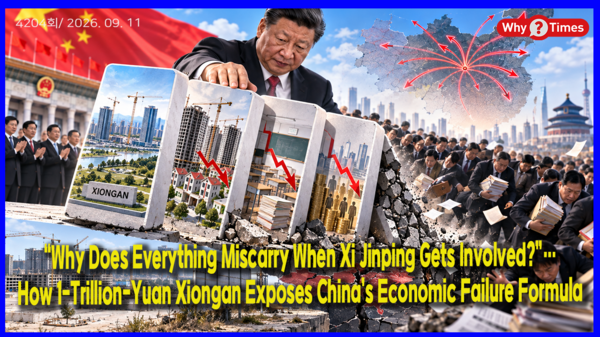
[In September, the "1-Trillion-Yuan Millennium Project" Debate Reignites Across the Sinosphere]
A distinct sense of sarcasm has recently spread across overseas Chinese communities, encapsulated in the narrative that "whatever Xi Jinping personally directs turns out poorly." Far from mere anti-Xi slogans, this sentiment is backed by a string of high-profile initiatives into which Xi directly placed his political authority: Xiongan New Area, real estate regulations, private tutoring crackdowns, and the Common Prosperity campaign. In September 2026, Xiongan New Area—Xi's signature "city of the future" backed by over 1 trillion yuan in investment—has once again taken center stage in this debate.
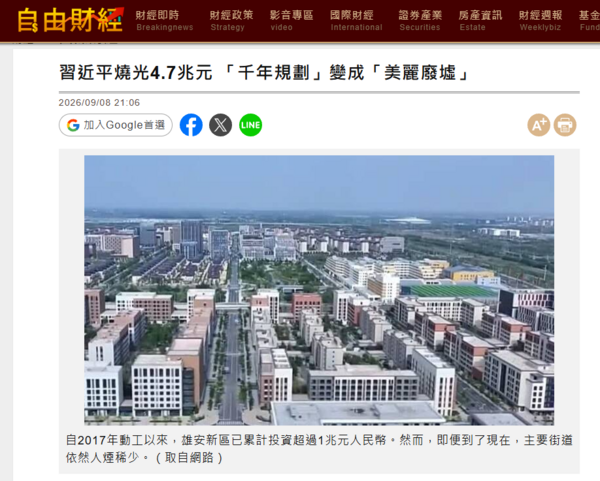
On September 8, Taiwan's Liberty Times financial portal published a focused report on Xiongan, noting that despite cumulative investment exceeding 1 trillion yuan since construction began in 2017, key thoroughfares and commercial districts remain sparsely populated. The outlet highlighted growing critiques characterizing the touted "millennium strategy" as a set of "beautiful ruins." This report revisits concerns raised in 2024 by Bloomberg, which conducted on-the-ground reporting concluding that "Xi Jinping’s dream city shows the limits of his power."
Announced directly by the Xi leadership in April 2017 as a national-level new area, Xiongan spans Xiong, Rongcheng, and Anxin counties in Hebei Province, roughly 100 kilometers southwest of Beijing. The core design was to decentralize non-capital functions from Beijing by relocating state-owned enterprises (SOEs), universities, hospitals, and research institutes. Rather than treating it as a standard urban development, Chinese leadership defined Xiongan as a "millennium plan and a major national affair," imbuing it with heavy political symbolism tied directly to Xi.
However, international coverage highlighted issues extending beyond empty buildings. Bloomberg observed that while Xi personally conceptualized the new city in rural Hebei and ordered government organs, universities, and central SOEs to relocate, the actual movement of people and businesses failed to match the speed of state construction. Concerns regarding the risk of Xiongan becoming a massive ghost town, raised shortly after its 2017 launch, were noted as increasingly realized in 2024 field reports.
[Beijing Claims "Success"… But Why Did Xi Personally Urge Action Again in March?]
Official Chinese state narrative presents a contrasting view. Xinhua News Agency reported that as of January 2026, Xiongan's developed area reached approximately 215 square kilometers, with over 5,300 buildings constructed and a resident population of roughly 1.4 million. In March, state media assessed that with over 400 central SOE-affiliated entities and more than 600 high-tech firms congregating in the area, Xiongan was transitioning from blueprint to reality. Cumulative investment officially surpassed 1 trillion yuan by the end of 2025.
A notable detail emerged on March 23 of this year, when Xi visited Xiongan once again, instructing officials to accelerate the relocation of Beijing’s non-capital functions. Observers interpreted this visit as a renewed push to populate the city with residents and institutions. This raised an underlying paradox: if the city were operating successfully, there would be little need for the top leader to conduct personal inspection visits nine years in to demand more aggressive relocations.
[A Figure More Striking Than 1 Trillion Yuan: Population Growth Falls Short of Expectations]
The cited "1.4 million population" metric requires contextual examination. Xiongan was not built on entirely uninhabited land. During the 2020 census, the combined registered resident population of the counties forming Xiongan was already approximately 1.2 million. Therefore, the current figure of 1.4 million cannot be interpreted as an influx of 1.4 million new residents driven by the new city project.
Furthermore, during construction, many local rural residents were relocated to newly built apartment complexes via land requisition and resettlement programs. Consequently, nominal increases in local residents differ fundamentally from the organic formation of a dynamic economic hub driven by the voluntary relocation of corporate entities, universities, and skilled professionals from Beijing. The core issue regarding Xiongan centers not on construction volume, but on whether individuals choose to live and work there without administrative mandates.
[Xiongan Is Not an Isolated Case: Retreat on the Real Estate "Three Red Lines"]
This dynamic explains why Xiongan features prominently in broader economic discussions across the Sinosphere, as similar patterns have emerged in other core policy initiatives. A prime example is real estate policy. In 2020, China introduced the "Three Red Lines" policy to curb excessive leverage among property developers. While the intent to control debt was rational, the aggressive implementation constrained developer liquidity, triggering series of defaults starting with Evergrande in 2021 and precipitating a broader property sector crisis. Reuters reported in January that authorities effectively ended these restrictions, noting that the policy had triggered a real estate debt crisis that continues to weigh on the broader economy.
Reversing the regulations, however, has not automatically restored market momentum. A Reuters survey of financial institutions published on August 28 projected that Chinese home prices would decline by another 3.4% in 2026, property investment would drop by 20%, and floor area sold would contract by 10%. While the policy stance was reversed, market confidence has proven difficult to rebuild.
[Severe Private Tutoring Restrictions Soften: Seeking Market Forces After Eliminating Them]
A similar trajectory marked the 2021 "Double Reduction" policy. Aiming to reduce academic burdens on students and families, Beijing implemented an outright ban on for-profit tutoring in core academic subjects for primary and middle school students. The private tutoring industry, then valued at approximately $1200 billion, was severely disrupted overnight, causing market valuations of major firms like New Oriental and TAL to plunge and leading to widespread job losses.
As economic momentum slowed and youth unemployment emerged as a major challenge, enforcement measures surrounding private tutoring began to soften. Reuters noted that tutoring firms have resumed hiring and learning centers have gradually reopened public operations. After suppressing an entire industry, authorities have selectively permitted its recovery to support employment and domestic consumption.
[Common Prosperity Leaves Behind Corporate Anxiety]
The "Common Prosperity" initiative similarly originated with the objective of narrowing income inequality. However, its execution coincided with broad regulatory crackdowns across the platform economy, real estate, and private education. Market uncertainty escalated to the point where Chinese financial regulators directly reassured foreign financial institutions that the regulations were not intended to eliminate private enterprise. Reuters reported that this regulatory push erased hundreds of billions of dollars in market capitalization from major tech firms and weighed heavily on foreign investor sentiment.
[The Same Challenge Persists: Factory Output Expands While Consumption Lags]
These issues remain active factors in the current economic landscape. On September 10, Reuters published an analysis of Hefei—a key city in China's state-led high-tech manufacturing push—noting that while industrial production surged, local retail sales growth managed just 0.6% in the first half of the year. The report emphasized that while state investment can build advanced factories and industrial bases, administrative directives alone cannot generate consumer confidence or spending.
This dynamic connects directly back to Xiongan. The state can construct physical buildings, mandate corporate registration changes, and direct state banks to extend credit. However, it cannot compel individuals to reside in a city, force entrepreneurs to invest, or mandate consumer spending.
[The Core Issue Extends Beyond "Policy Missteps"]
Narratives describing policy outcomes in hyperbolic political terms must be viewed through a broader analytical lens. Because Xiongan remains a long-term development initiative scheduled through mid-century, reaching a final conclusion on its success or failure at this stage would be premature.
Nevertheless, the structural characteristics of the policy decision-making process warrant examination. The initiatives surrounding Xiongan, property market leverage, private education, and Common Prosperity all demonstrate a model where top-level directives trigger immediate mobilization across the bureaucratic apparatus. When mechanisms for intermediate adjustment based on market feedback or private sector responses are constrained, initial policy miscalculations can amplify across the economy.
[Why Times Insight]
Characterizations framing these developments solely through political rhetoric obscure the underlying structural realities. Because Xiongan is designed as a long-term project spanning through 2049, with relocations of central SOEs, universities, and medical centers actively underway, categorizing it as an absolute failure is inaccurate.
However, a more fundamental analytical question remains. The common thread running through Xiongan, the "Three Red Lines," the "Double Reduction" campaign, and Common Prosperity is the concentration of policy direction at the top, followed by nationwide administrative execution. When direction is accurate, this model delivers rapid implementation; when assumptions miss market realities, execution risks scale nationally.
This represents a key structural variable in China's contemporary economic management. Under earlier reform paradigms, state policy often adapted to and facilitated market-driven initiatives. Under the current framework, market actors are expected to align with state-directed priorities.
Xiongan serves as a physical manifestation of this philosophy: the state constructs urban infrastructure, lays rail lines, builds residential complexes, and mandates institutional relocations, expecting population dynamics to follow. Yet economic activity operates differently than administrative command. Directives can relocate a corporate address, but they cannot manufacture investor confidence. The state can build residential units, but it cannot mandate buyer demand. Regulatory frameworks can curtail leverage, but administrative decrees alone cannot restore market trust.
While the ultimate trajectory of Xiongan New Area remains to be seen after nine years and over 1 trillion yuan in committed capital, the broader economic inquiry is clear: Is the current economic slowdown a result of insufficient state intervention, or does it stem from policy directives moving ahead of market realities? The primary challenge facing the economic model may not simply be cyclical headwinds, but a structure where market mechanisms struggle to adjust top-down directives
.
- TAG