


추부길 whytimespen1@gmail.com
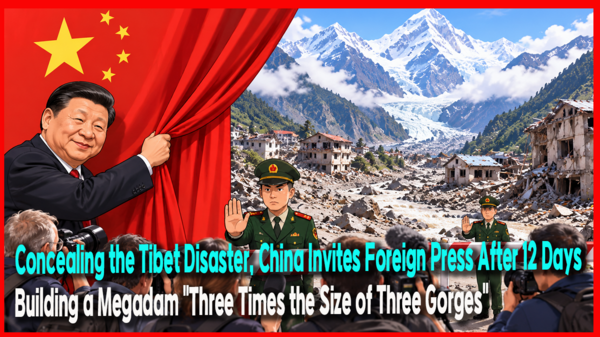
[Tibet Closed for 12 Days… Why Did China Open its Doors Now?]
China has belatedly opened Tibet to foreign media after keeping it strictly sealed off following the Himalayan disaster. However, what China showcased was a highly restricted site visit where authorities invited reporters and dictated both the coverage areas and schedules. Even more striking is that despite the disaster reconfirming the fragile Himalayan environment—where glaciers and entire mountains can collapse—China is constructing the world's largest hydroelectric project in Tibet, designed to generate roughly three times the power of the Three Gorges Dam. Furthermore, even researchers affiliated with the Chinese government are warning of active fault lines and slope failure risks in the project area.
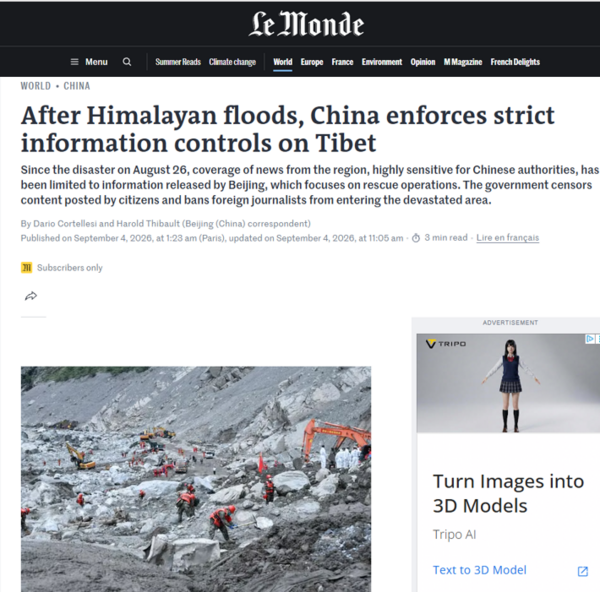
On the 5th, the prominent French daily Le Monde reported: "Immediately following the disaster on the 26th of last month, the responses of China and Nepal stood in sharp contrast. In Nepal, foreign journalists entered the affected areas to cover survivors and families of the missing, whereas independent access for foreign reporters was barred in the Chinese-controlled Tibetan disaster area." It added: "Even a week after the disaster, foreign journalists were unable to enter the disaster zone or the Tibet Autonomous Region. Then, China suddenly shifted its stance, with authorities escorting a select group of foreign journalists to the affected Gyirong area in Tibet on the 5th and 6th."
Le Monde further noted: "The key takeaway is not that free journalistic coverage of Tibet was granted, but rather that it was a restricted field visit conducted according to an itinerary set by the Chinese government." It concluded: "Ultimately, the question remains: why block access immediately after the accident, only to invite foreign press after the scene had been largely cleared?"
[Foreign Media Step In to Reveal the Scene… The Border Gateway Itself Has Vanished]
Regarding this, Reuters also reported: "The scene at the Gyirong border area, as verified firsthand by reporters, was devastating. The commercial facilities connecting China and Nepal were buried under massive mud and rock, and the sites of border facilities and buildings were reduced to rubble." Reuters added: "Rescue teams were deploying excavators and heavy equipment to search for the missing," noting that "a key gateway cultivated by China to connect Nepal and South Asia was virtually paralyzed by a single natural disaster."
Although the Chinese government continues to release updates on rescue operations and casualties, the discontent among families of the missing remains unresolved. Reuters pointed out: "Families and some diplomats are demanding the disclosure of more specific information, including DNA testing, CCTV footage, and identification procedures." It noted: "While the Chinese government counters that it is transparently releasing information and cooperating with relevant nations, the core issue is that had independent coverage been permitted from the start, the current controversy over the credibility of official announcements would have been vastly diminished."
On social media both inside and outside China, claims are circulating that the damage is far greater than officially reported. However, at present, there is insufficient evidence to independently verify claims of several thousand casualties. At the same time, local testimony and social media materials should not be dismissed as entirely false simply because they do not appear in Chinese state media. In Tibet, where media and internet controls are strict, it is reasonable to treat social media videos and resident testimonies not as established facts, but as clues to cross-verify official announcements. This time as well, on-scene footage that first surfaced online served as a crucial starting point for tracing the reality of the damage through subsequent foreign media coverage and satellite data.
[Yet China Builds the World's Largest Dam Here—"Three Times the Size of Three Gorges"]
This is precisely why the disaster does not end as a simple natural disaster news story. Reuters reported: "China is constructing the world's largest hydroelectric project along the lower reaches of the Yarlung Zangbo River. China officially commenced construction in July 2025, with a total project cost of approximately 1.2 trillion yuan (roughly USD 167 billion)." It added: "The plan is to build five cascading hydroelectric stations to generate approximately 300 billion kWh of electricity annually, which is nearly three times the annual power generation of the Three Gorges Dam, the world's largest hydroelectric facility."
According to Reuters, China selected this location due to its immense hydraulic drop. The Yarlung Zangbo River loops sharply around the Himalayas in southeastern Tibet, exhibiting an elevation drop of nearly 2,000 meters over a short distance. From China's standpoint, it is a natural powerhouse capable of generating massive energy. From another perspective, however, that very rugged terrain and extreme elevation drop are key factors that heighten the risks of complex disasters such as earthquakes, landslides, glacial collapses, and natural dam failures.
[A More Chilling Warning… Active Faults Uncovered by Chinese Geologists]
An even more noteworthy aspect is that Chinese researchers themselves are sounding the alarm. On July 9, Hong Kong's South China Morning Post (SCMP) reported: "Chinese researchers surveyed the activity of the Paizhen Fault located in the lower Yarlung Zangbo project area, raising the possibility that this fault could affect the stability not only of the dam itself, but also of surrounding infrastructure such as tunnels, roads, and bridges." It noted that "concerns were also raised regarding the need for reinforcement measures to prepare for slope instability and landslide risks around the reservoir."
This is not a matter that can be dismissed merely as political rhetoric from India or the West attempting to check China. At this year's European Geosciences Union (EGU) General Assembly, research evaluating the induced seismicity risk related to the lower Yarlung Zangbo hydroelectric project was presented. In short, the inherent danger arising when giant water storage facilities meet the geologically active Himalayas has already become a subject of study in the international geological community.
[This Disaster Demonstrated It… In the Himalayas, "The Mountain Itself Becomes a Dam"]
A clear line must be drawn here: there is currently no definitive evidence that this Himalayan disaster was caused by China's construction of the Yarlung Zangbo hydroelectric plant. However, the warning this disaster poses to China's megadam is an entirely separate matter. Reuters stated: "In the Himalayas, earthquakes or glacial and rock collapses can create massive landslides, where fallen soil and rock block rivers to form giant natural dams." It added: "When those natural dams subsequently breach, catastrophic volumes of water and debris surge downstream all at once. In fact, following this disaster, Chinese authorities launched emergency responses due to additional risks of mountain-formed natural dams."
Ultimately, when assessing the safety of China's megadam, it is insufficient to merely ask whether a concrete dam can withstand an earthquake. One must account for a cascading disaster chain: Earthquake → Glacial/Rock Collapse → Landslide → River Blockage → Natural Dam Formation → Outburst Flood. If a massive water storage facility, power plants, tens of kilometers of tunnels, roads, and bridges are introduced into this equation, disaster interactions become infinitely more complex. This disaster proved that such scenarios are not mere theoretical assumptions within computer models, but actual events that can occur in the Himalayas.
[Why It Is Scarier Than Three Gorges… The Disaster Does Not Stop at China's Border]
In this regard, Reuters pointed out: "The Yarlung Zangbo project is also a far more sensitive international issue than the Three Gorges Dam." It explained: "The Yarlung Zangbo River does not terminate within China; after passing through Tibet, it enters India to become the Siang and Brahmaputra Rivers, and flows through Bangladesh into the sea. Therefore, if China builds ultra-large hydroelectric facilities upstream, the resulting impact on water volume, sediment, ecosystems, and downstream safety during extreme disasters cannot be treated solely as a domestic Chinese issue."
Reuters continued: "China claims that the project will not negatively affect downstream nations and will instead aid in flood control and disaster prevention. However, India is already pushing forward with the construction of large-scale hydroelectric facilities in its Arunachal Pradesh region to counter China's mega project." It concluded: "Ultimately, the Yarlung Zangbo River is transforming beyond a mere power generation site into another geopolitical variable—a water and security competition between China and India."
[Why Times Insight; The Issue Is Not the 'Size of the Dam,' But Whether China Can Be Trusted]
The question this Himalayan disaster poses to the world is not simply whether the death toll announced by the Chinese government is accurate. Why did China block independent foreign press coverage immediately after the accident? Why did on-scene videos and the voices of local residents vanish from the Chinese internet? And why did authorities begin showing the site to foreign media only after considerable time had passed, following an itinerary set by the government? These are the real questions. There are even allegations that Chinese authorities deliberately restricted foreign journalists to cover up the disaster scene.
This issue directly ties into the Yarlung Zangbo megadam. Once the world's largest hydroelectric facility is operational, data on earthquakes, glaciers, water levels, and landslides held by China ceases to be information for the Chinese public alone. It becomes an international public good directly linked to the safety of hundreds of millions of people downstream, including in India and Bangladesh. When an accident occurs, controlling information for days or disclosing it only when the Chinese government deems fit cannot build the trust required for a transboundary megadam.
Therefore, what the world must demand of China is not Beijing's declaration that "it is safe." It requires independent verification and real-time information-sharing systems regarding geological survey results, active fault data, design standards for dams and tunnels, simulations of cascading glacial and landslide disasters, emergency discharge plans, and potential impacts on downstream nations.
Following this disaster, China eventually opened Tibet's doors partially to foreign media. However, when it comes to the world's largest dam, opening the doors after an accident occurs will be far too late. If this Himalayan disaster serves as a warning, ignoring it means the next catastrophe may not end as China's disaster alone.

- TAG