


추부길 whytimespen1@gmail.com
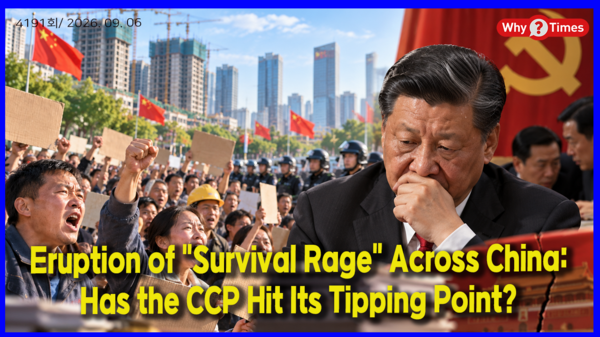
[5,343 Warnings: Chinese Citizens Begin Taking to the Streets]
Unusual movements are rippling across China. According to tracked data, collective actions in China reached 5,343 cases last year—a staggering 44% increase from the previous year. The trend continued into the first quarter of this year, rising 18.6% year-on-year. Crucially, the vast majority of these actions are not political demonstrations demanding democratization or regime change; they stem directly from survival issues such as wage arrears, real estate disputes, and land conflicts. As the public's patience with economic hardship wears thin, "social stability"—the Chinese Communist Party's (CCP) most sensitive priority—is resurfacing as a critical vulnerability.
The China Dissent Monitor (CDM), a project run by Freedom House tracking protests and resistance in China, noted: "Confirmed collective actions in China reached 5,343 cases in 2025, surging 44% in just one year from 3,704 in 2024." CDM highlighted that in Q4 of last year alone, labor disputes accounted for 54% of all collective actions, followed by property owners (22%) and rural residents (14%). This underscores that Chinese protests and collective actions are no longer confined to political dissidents but are broadly linked to labor, housing, and rural grievances. CDM added that "this momentum has not easily slowed down entering this year."
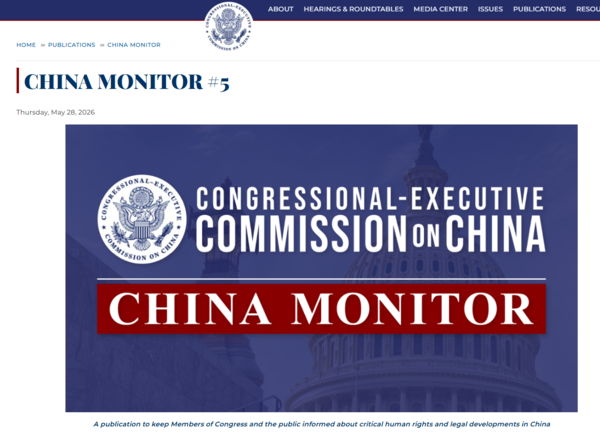
An analysis by the Congressional-Executive Commission on China (CECC) based on CDM data revealed that at least 1,241 protests were documented in China in Q1 2026—an 18.6% increase from 1,046 cases in the same period last year. The CECC similarly pointed out that due to strict Chinese government censorship and the inherent risks of tracking protests from within, the actual scale of collective action is likely far larger than the documented numbers suggest.
["Pay Our Wages, Return Our Homes": The Fear of Survival Rage Over Political Dissent]
The underlying motives driving people into the streets are even more significant. CECC reports indicate that most documented collective actions are not political struggles shouting slogans like "Down with the CCP" or "Democratization." Instead, unpaid laborers, residents left stranded by real estate crises despite having paid for homes, and farmers caught in land disputes are taking to the streets to demand their basic right to survival. Structural defects in the Chinese economy are directly pushing citizens toward collective action.
In the four months leading up to Lunar New Year 2026, labor action triggered by wage arrears jumped 60% compared to the same period in the previous year. Freedom House analyzed that "this new surge reflects China's economic slowdown and an increasing number of companies failing to pay their workers." Because unpaid wages and livelihoods—rather than political ideology—serve as the direct fuel for these actions, this presents a far more intractable problem for the CCP.
As Freedom House observes, political dissidents can be arrested, organizations dissolved, and social media accounts terminated. However, police force and internet censorship cannot fix corporate insolvencies, ruined life savings tied up in unfinished housing, or collapsing local commerce. Ultimately, rage rooted in basic survival poses a far more persistent and unmanageable threat to social stability than political slogans.
[A 45% Drop in Q2 Protests? The Censorship Trap Hidden Behind the Numbers]
In Q2 of this year, seemingly contradictory figures emerged: CDM confirmed 846 collective actions, representing a 45% decrease compared to the same period last year. Does this indicate sudden stability in Chinese society? Freedom House argues otherwise. The sharp decline in statistics is largely explained by the severe intensification of state censorship, which drastically reduced the visibility of protest information on social media.
On February 12, China's Cyberspace Administration launched a special crackdown titled "Qinglang: Creating a Joyful and Peaceful Online Environment for Lunar New Year 2026." Among the explicit targets cited by authorities were "contents maliciously stoking negative emotions." Authorities later announced the purging of numerous accounts and posts under this initiative, signaling that the state officially categorized the online spread of "negative emotions" as a matter of national cyberspace control.
The impact was evident in the data. Preliminary analysis by Freedom House estimates that protest-related posts on Douyin (China's TikTok) between March and June dropped by approximately 50% compared to the same period prior to the censorship campaign. A reduction in visible protest videos is fundamentally different from an actual decrease in protests. This highlights why events in China cannot be assumed non-existent merely because they lack coverage in state-controlled media.
[Two Out of Three Protest Videos Deleted]
This aggressive censorship is not a sudden phenomenon. Freedom House tracked 2,970 protest-related posts uploaded to Douyin between June and December 2025 and found that approximately two-thirds were subsequently deleted. Deletion rates were disproportionately high for posts depicting protests in Beijing and Xinjiang, petitioning activities, and footage showing authorities arresting protesters or using physical force.
The pervasive information gap in China is precisely why CDM was established. Freedom House explains that the project exists to bridge the information void caused by severe media restrictions and the dangers of gathering protest data domestically. This necessitates cross-referencing news reports, civil society data, and domestic Chinese social media. Looking solely at official Chinese media makes it impossible to grasp what is truly occurring on the streets.
[Haikou Fire Kills 6: Why the Fear of "Social Revenge" Is Spreading]
Against this backdrop, a major tragedy occurred on the 3rd in Haikou, Hainan Province. According to the Haikou Fire and Rescue Bureau, a fire broke out at around 2:45 PM during interior construction at the Yexiangyuan Restaurant on Xiuying Avenue East, leaving six dead and three injured. The fire was extinguished by 3:10 PM following three search sweeps. Official announcements remain limited to stating that "the cause of the fire is under investigation," with no confirmed evidence pointing to arson or retaliatory crime.
However, the hyper-sensitivity within Chinese society toward the phrase "revenge against society" (报复社会) stems from a clear context. The Soufan Center noted that in 2024, China recorded over 20 public violence incidents resulting in more than 90 fatalities, analyzing that many vehicular and knife attacks were linked to economic/social frustration or blocked grievance channels. A prominent example was the November 2024 Zhuhai Sports Center vehicle attack, which left 35 dead and 43 injured.
Thus, the Haikou fire should not be prematurely categorized as a "revenge against society" crime. The critical takeaway is that public anxiety has intensified to a level where any major disaster or indiscriminate violence immediately triggers widespread fear of targeted social retaliation. Numerous analyses have identified economic pressures, social alienation, and blocked petition channels as catalysts for extreme violence.
[What the CCP Fears Is Not a Single Protest]
Looking at the actors behind Q2 collective actions tracked by CDM, property owners comprised the largest group at 36%, followed by laborers (24%) and rural residents (18%). Other groups taking to the streets included parents, students, small business operators, investors, consumers, and petitioners. Geographically, Guangdong reported the highest concentration, alongside widespread incidents in Hebei, Shaanxi, Henan, and Shandong. This is no longer an isolated issue confined to specific regions or classes.
There is currently no basis to label these scattered collective actions as a unified, nationwide anti-government movement or a popular uprising. Most remain localized protests raising distinct economic and livelihood demands. From the CCP's perspective, however, this localization presents a unique danger: if unpaid workers, property victims, farmers, and small vendors begin to realize that their individual hardships stem from a shared, structural reality, the fundamental nature of social unrest could instantly transform.
[Why Times Insight]
It is premature to conclude that the current wave of collective action in China signals imminent regime collapse. Most confirmed protests are economic and survival-driven resistance over wages, housing, and land rather than political movements demanding democratic revolution. Nevertheless, the 44% surge in collective actions in 2025 and the further 18.6% rise in Q1 this year serve as major indicators that societal stress in China has reached alarming levels.
For the CCP, the core dilemma is that these grievances cannot be resolved through police power alone. Dissidents can be detained, organizations dissolved, and online protest videos purged. Indeed, Chinese authorities tightened cyberspace controls targeting "negative emotions" this year, leading to an estimated 50% drop in protest posts on Douyin. Yet, unpaid wages, unfinished housing, and economic stagnation cannot be erased by an algorithm.
The primary error to avoid when analyzing contemporary China is assuming that "unseen means non-existent." With roughly two-thirds of protest posts on Douyin deleted last year and censorship intensifying further this year, a significant gap exists between actual street-level unrest and what the world can observe online.
Ultimately, the Xi Jinping administration's true fear is not a single isolated protest today. It is the moment when workers, homeowners, farmers, and small merchants—each protesting for different reasons—connect the dots and recognize their struggles as symptoms of a single structural failure. While evidence does not show China has reached that threshold yet, the persistent, cross-regional expression of economic anger across diverse social strata represents a trend the CCP must monitor with utmost vigilance.
Surveillance cameras can track individuals, security forces can disperse crowds, and internet censors can erase footage. They cannot, however, delete economic rage. The defining question for China today is this: In one of the world's most formidable systems of social control, why do so many people continue to risk taking to the streets? Finding that answer is the key to reading China's future trajectory.
- TAG