


추부길 whytimespen1@gmail.com
[Shocking Figures Confirmed by Reuters: "Only Two Months Remaining"]
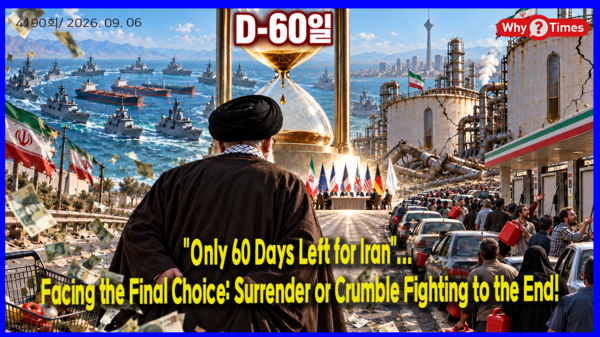
A perilous countdown has begun in Iran. A alarming warning originated from within the Iranian government that, despite being a major global oil producer, the country has only about two months' worth of domestic gasoline supplies remaining. Should the U.S. maritime blockade and financial sanctions persist at their current intensity, these next 60 days could transition from a severe economic crisis into an existential test of the Islamic Republic regime's survival.
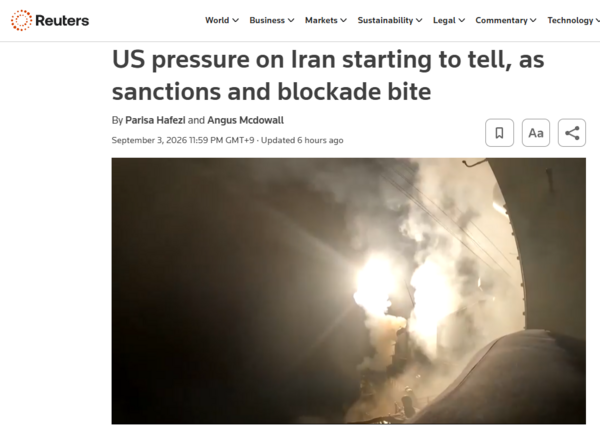 On September 3, Reuters reported, citing three senior Iranian sources, that the U.S. maritime blockade and secondary sanctions have begun exerting pressure beyond what the Iranian economy can sustain. Specifically, one senior official disclosed that Iran's secured gasoline supplies would last only about two months.
Reuters noted that while Iran is a major global crude producer, its refining capacity remains limited, leaving it dependent on gasoline imports for part of its domestic needs. The core issue is that with foreign currency reserves and international financial access blocked simultaneously, acquiring necessary fuel has become increasingly difficult. Senior Iranian officials explained that front companies, unregistered tankers, and smuggling networks—which had bypassed sanctions for decades—are no longer operating effectively as transaction costs surge.
[Maritime Blockade Severs Iran's Cash Flow Unstopped by Previous Sanctions]
Compounding the crisis, crude oil exports—Iran's primary source of revenue—have effectively ground to a halt. Citing data from sources such as Kpler, Reuters revealed that since the U.S. resumed its maritime blockade on July 14, meaningful new shipments of Iranian crude bound for China through the Strait of Hormuz have virtually ceased over a seven-week period. Consequently, Iranian crude and condensate loadings plummeted from roughly 2 million barrels per day in March to between 220,000 and 255,000 barrels per day in August.
Reuters evaluated this shift, noting that the U.S. blockade achieved what years of conventional sanctions could not. While Iran continues selling pre-stored crude from Asian waters outside the blockade zone to China, these inventories will inevitably deplete without new supply arrivals.
[Running Out of Funds: Rial Collapses as Inflation Hits 70%]
The inability to sell crude has led directly to a severe foreign currency shortage. The Iranian rial has plummeted from roughly 1 million per U.S. dollar a year ago to over 2.2 million rials recently. Official statistics indicate an average 12-month inflation rate of 69.9%, with price increases for food, beverages, and tobacco surging to nearly double that figure.
Official unemployment has reached 9.1%. While the average monthly wage stands at approximately $125, basic household expenditures are estimated at around $450. President Pezeshkian publicly acknowledged that Iran's overall trade has contracted by 25% to 35%, with imports dropping even more sharply. U.S. pressure is no longer confined to state finances; it is directly impacting the daily lives of Iranian citizens.
[UAE Cuts Ties, U.S. Targets Networks in Türkiye]
Furthermore, the United Arab Emirates—historically Iran's vital trade and financial bypass route—has closed its doors. The UAE government officially announced on August 19 that it would suspend all trade, commercial exchanges, and financial transactions with Iran until further notice. Reuters concurred that the closure of the UAE corridor poses a critical barrier to Iran's import capabilities and financial operations.
The U.S. did not stop there. According to Reuters, the U.S. Department of the Treasury sanctioned Türkiye's Golden Global Bank and two of its affiliates on September 4. The sanctions were imposed for supporting an IRGC-linked financial network that processed proceeds from Iranian crude sales to China, routing funds through Türkiye to convert them into cash and gold. This marks the first instance of a NATO member state's bank being directly targeted since the sanctions campaign escalated.
This serves as a significant signal, indicating that as Gulf financial channels close, the U.S. is preemptively tracking and blocking attempts to redirect Iranian funds through secondary nations such as Türkiye. Treasury Secretary Bessent stated that additional sanctions against other banking institutions could follow next week.
[Trump's 'Economic D-Day' Takes Effect]
This strategy lies at the heart of "Operation Economic Outcast," declared by Treasury Secretary Bessent on August 24. Labeling the campaign "Economic D-Day," the U.S. Treasury Department announced its intention to isolate Tehran by severing the economic lifelines that sustain the Iranian regime. Just ten days later, enforcement expanded from UAE financial networks to target institutions within Türkiye.
The U.S. strategy aims not at an instantaneous collapse, but at systematically cutting off essential cash flow. By preventing oil tankers from departing, blocking payment collection on sales, and denying access to international banking networks, the campaign targets the financial circulation required to maintain both Iran's economy and military operations.
[Why Pezeshkian Advocated Negotiations]
This backdrop illuminates the internal rift between President Pezeshkian and hardliners. Pezeshkian's public acknowledgement of sanction impacts and his emphasis on negotiations stem from a realistic assessment that time is not on Iran's side. With crude exports and foreign revenue severed, and gasoline reserves down to two months, Iran's bargaining position will likely weaken further over time.
Conversely, hardliners centered around the Islamic Revolutionary Guard Corps (IRGC) hold a different strategy. They assess that yielding on nuclear capabilities, missile programs, regional proxy networks, and economic foundations would extend beyond policy shifts to threaten their own power and survival. Consequently, they view enduring the pressure and awaiting potential shifts in U.S. posture as preferable to immediate negotiations.
[The IRGC Eyes November]
A key element in this calculation is the upcoming U.S. midterm elections in November. A senior Iranian official informed Reuters that Iran intends to leverage inflation and rising energy prices to pressure the Trump administration ahead of November. The strategy assumes that while Washington seeks the collapse of the Iranian economy, Tehran can target Trump's political timeline by stoking tensions in Hormuz and driving up global oil prices.
Thus, the current confrontation extends beyond conventional military warfare into a war of timelines. Tehran calculates that holding out until November will force a shift in U.S. stance, while Washington assesses that the Iranian economy will reach its breaking point before November arrives.
[Why Times Insight — Whose Clock Will Stop First?]
A two-month domestic gasoline reserve does not guarantee a regime collapse in precisely 60 days. Iran will likely attempt to extend its timeline through stricter rationing, consumption limits, and emergency import efforts.
However, the trajectory remains clear. Crude exports dropped from 2 million barrels per day in March to the 200,000-barrel range in August, UAE financial conduits are severed, and the U.S. is now targeting alternative networks in Türkiye. The rial has collapsed, inflation approaches 70%, and internal warnings highlight a two-month gasoline limit. Concurrently, separate pressure points are converging on a single critical junction.
Consequently, President Pezeshkian and the IRGC operate on divergent timelines. Pezeshkian views time as working against Iran, whereas hardliners believe enduring until November could shift leverage in their favor.
Yet this gamble carries severe risks. Should the U.S. blockade persist while fuel, foreign currency, and import channels reach a simultaneous tipping point, Iran may no longer face a choice on negotiating terms, but rather how much to concede to resolve the crisis.
Conversely, if the IRGC chooses escalation in Hormuz, it may drive up global oil prices and impose political costs on Trump. However, should the U.S. respond with kinetic strikes and tightened financial blockades, Iran risks reaching its own limit first.
The next two months will be critical in determining whether Iran returns to the path of negotiation proposed by Pezeshkian or pursues the hardline strategy of endurance and escalation favored by the IRGC. Ultimately, the outcome may hinge on a single question: Will Trump's political clock or Iran's economic clock run out first before November?
- TAG