


추부길 whytimespen1@gmail.com
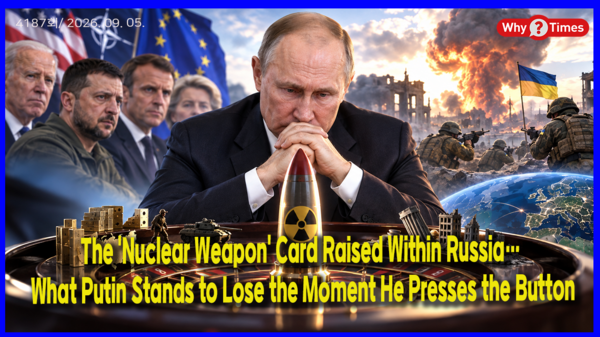
[Bloomberg: "Possibility of Tactical Nuclear Use Discussed Among Russian Officials"]
Unsettling talk has begun circulating around the corridors of Russian power. This is not merely the usual nuclear saber-rattling from Dmitry Medvedev. According to sources familiar with the Kremlin, a growing number of Russian officials are openly discussing the possibility that President Vladimir Putin may ultimately resort to tactical nuclear weapons in Ukraine as an extreme measure. Yet, no physical signs indicate that Russia is actively preparing for an actual nuclear strike. This very contradiction encapsulates the Kremlin's current predicament.
The central question is not simply "Will Putin actually press the nuclear button?" The more critical issue is why talk of nuclear employment has resurfaced within the leadership after Russia—possessing the world’s largest nuclear arsenal—has waged war against Ukraine for over four and a half years without securing its desired political and military outcomes. Examining recent battlefield dynamics alongside internal economic pressures clarifies the context behind these discussions.
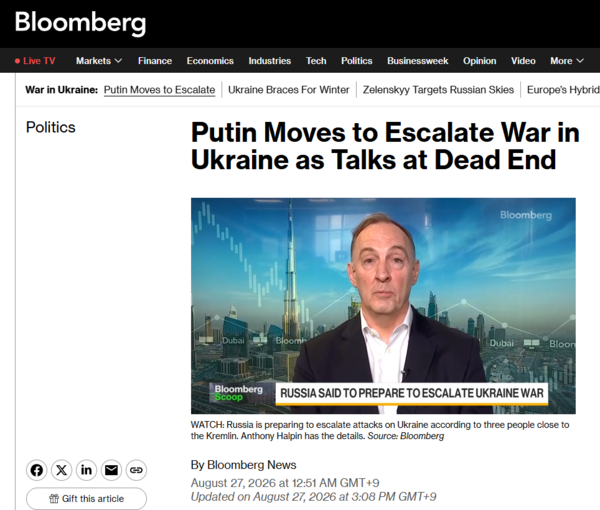
Citing sources close to the Kremlin in late August, Bloomberg reported that the Russian leadership assesses negotiations with Ukraine as effectively stalled. If Ukrainian attacks on Russian territory persist, Putin may pursue broader military escalation. In particular, an increasing number of Russian officials are raising the extreme option of tactical nuclear weapons. However, Bloomberg explicitly noted that there are currently no indications of actual preparations for a nuclear strike.
Even more telling was the Kremlin's response the following day. Kremlin Spokesperson Dmitry Peskov warned of a "heavy response" to Ukrainian attacks on Russia’s economic and logistics infrastructure, yet drew a line regarding further military escalation, stating it was "not necessary". The justification offered was that Russian forces were already advancing. Once reports of nuclear deliberation leaked externally, the Kremlin promptly moved to downplay its escalation intent.
[Yet the Battlefield Contradicted Explanations from Peskov and Putin]
On September 1, President Putin claimed that Russian forces were winning on the battlefield and that the speed of their offensive was accelerating. He asserted that in Donetsk alone, Russian troops had secured 270 square kilometers during August. While acknowledging damage from Ukrainian strikes on Russian oil refineries, he maintained that Russian air defenses were improving and that the overall trajectory favored Moscow.
Open-source intelligence analysis by the Institute for the Study of War (ISW), however, presented a starkly different reality. ISW verified that Russia’s net territorial gain across all of Ukraine in August was approximately 90.35 square kilometers—less than one-fifth of the 505.55 square kilometers gained in August of the previous year. In Donetsk, confirmed gains stood at roughly 73.14 square kilometers, falling far short of Putin’s 270-square-kilometer claim. ISW assessed that Putin’s public statements were detached from ground realities, serving primarily as Kremlin cognitive warfare designed to project an impression that Ukrainian defense lines are on the verge of collapse.
Data from the opposing side is equally notable. On September 1, ISW highlighted that Ukrainian forces had recaptured at least 129.81 square kilometers in August, particularly around the Lyman and Oleksandrivka directions. While Russian forces continue their offensive, the territory gained relative to the massive toll in personnel and equipment has diminished sharply. ISW further noted Ukrainian estimates indicating over 40,000 Russian casualties in August alone, highlighting how high attrition rates are straining Russia's manpower recruitment system.
[Russia is Not on the Verge of Collapse… But No 'Path to Victory' is in Sight]
It would be inaccurate to conclude that Russia is collapsing on the front lines. Reuters noted that Russian forces maintain control over significant Ukrainian territory and retain the capacity for large-scale, long-range missile and drone strikes. On September 4, Russian drones targeted the Ukrainian Security Service (SBU) headquarters in central Kyiv. As Ukraine expands its strike range deep into Russian territory, Russia continues to strike core state institutions in the Ukrainian capital, sustaining an intense exchange of deep strikes.
Describing Russia’s condition as a strategic quagmire—incurring immense costs without generating a decisive outcome to end the war—is therefore more precise. Furthermore, the burdens of war extend far beyond the front lines. Boris Titov, Putin’s special representative for sustainable development, warned on September 1 that over-concentrating the Russian economy on the defense sector risks causing the broader economy to go "berserk." Projections for Russia's economic growth have slowed to around 0.4%, raising concerns over stagnation in non-military sectors.
Ukrainian attacks on Russian oil refineries add to this burden. Reuters noted that crude oil production forecasts have dropped to 17-year lows due to war impacts and refinery damage. Operational disruptions caused by Ukrainian drone strikes have forced Russia to impose export restrictions on refined petroleum products to safeguard domestic fuel supplies. The longer the conflict drags on, the higher the economic price Russia must pay.
[Hence, the Reemergence of the 'Nuclear Card']
This context explains why talk of nuclear weapons usage has reemerged within Russia. If a conventional war were progressing toward an overwhelming victory and Western support were eroding, Russia would have little incentive to escalate nuclear threats. Conversely, when immense war costs fail to subdue the adversary and Ukrainian strikes reach deep into Russian territory, the temptation to leverage its ultimate deterrent—the weapon the opponent fears most—grows significantly.
Russia previously conducted unannounced strategic nuclear force exercises in May. The German Council on Foreign Relations (DGAP) analyzed at the time that Russia’s recurring nuclear signaling was closely linked to unfavorable battlefield developments in Ukraine. Rather than signaling immediate operational preparations for a nuclear strike, these moves functioned as coercive signals aimed at influencing Western decision-making and masking Russian vulnerabilities.
[Why Pressing the Nuclear Button Remains Difficult for Putin]
A fundamental paradox exists here: the value of a nuclear weapon as a threat differs entirely from its value once used. Employing one or two tactical nuclear weapons would not automatically reverse the current battlefield dynamics. Unlike Cold War-era battlefields characterized by concentrated armored formations, the Ukrainian theater features highly dispersed troops, command structures, and supply lines. Consequently, a vast asymmetry exists between the limited military utility of a tactical nuclear strike and the catastrophic political and military costs Russia would incur. Nuclear weapons can destroy cities or military installations, but they cannot occupy land, administer territory, or automatically compel a government’s surrender.
Furthermore, the actual use of nuclear weapons fundamentally alters the nature of the conflict. Thus far, the U.S. and NATO have provided extensive military aid while maintaining a line to avoid direct military confrontation with Russia. Should Russia cross the nuclear threshold, Putin cannot predict how far Western responses might escalate. To achieve limited tactical gains in Ukraine, Russia would risk direct conflict with NATO, deeper international isolation, and severe economic consequences simultaneously.
Nevertheless, dismissing the risk of nuclear escalation entirely remains dangerous. In 2024, Russia revised its nuclear doctrine to broaden the scope of nuclear deterrence, framing an attack by a non-nuclear state backed by a nuclear power as a joint attack. Russia is deliberately signaling a lower threshold for nuclear employment to the West. The nuclear card remains both an operational deterrent and a tool of coercion intended to make the West hesitate in escalating its support for Ukraine.
[For Putin, Nuclear Weapons Are Not the 'Ultimate Weapon' But a 'Final Gamble']
For Putin, nuclear weapons represent a paradoxical tool. Unused, they serve as a potent deterrent that constrains adversary actions. Once used, however, the strategic ambiguity surrounding nuclear threats vanishes, ushering in an unpredictable phase beyond Russia's control.
Crucially, if nuclear weapons are used and still fail to compel Ukraine's surrender, Putin faces a worst-case scenario. Russia would bear the immense political burden of being a nuclear aggressor and face heightened risks of escalation with the West, all while remaining bogged down in an ongoing war. Ultimately, nuclear weapons do not offer Putin a guaranteed path to victory; they represent a high-stakes gamble that places the future of Russia itself on the line without guaranteeing a favorable outcome.
Therefore, the internal discussions regarding tactical nuclear options carry significant analytical weight. Rather than signaling imminent nuclear employment, the fact that extreme options are once again being debated among the Russian leadership after four and a half years of conventional warfare illustrates the depth of the Kremlin's strategic dilemma.
[Why Times Insight]
The central story here is not whether Russia will ultimately use nuclear weapons, but rather why discussions surrounding nuclear employment have resurfaced within Kremlin circles at this juncture.
Russia has not been defeated. It retains military capacity and the ability to continue offensive operations against Ukraine. Yet, despite committing vast military personnel and state resources, it has failed to subjugate Ukraine, and its rate of advance has slowed significantly. Meanwhile, Ukrainian strikes have expanded to target Russian oil refineries, military bases, and airspace safety. President Zelenskyy recently warned airlines and insurers publicly that Russian airspace can no longer be considered secure.
This creates a sharp dilemma for Putin. Halting the war would mean acknowledging the failure of his stated war aims. Continuing the war under the current strategy ensures the steady depletion of manpower, economic resources, and energy infrastructure. Conversely, resorting to nuclear weapons to dramatically alter the conflict would instantly drag Russia into an even more dangerous and unpredictable confrontation.
Putin's strategic options are narrowing. Nuclear weapons are not a guaranteed instrument for victory. They remain most effective when held in reserve; the moment they are deployed, Russia risks losing control over what follows. Consequently, the resurgence of nuclear discourse within Russia reflects not a demonstration of strength, but the deep strategic quagmire facing a Kremlin unable to secure its objectives through conventional warfare alone.
- TAG