


추부길 whytimespen1@gmail.com
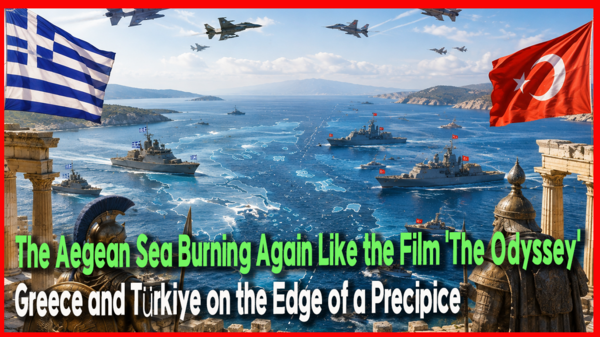
[“The Calm Waters Are Over”… The Aegean Sea Warmer Than 'The Odyssey']
Director Christopher Nolan’s film The Odyssey has surpassed 9 million admissions in South Korea, reigniting intense interest in Homer’s 3,000-year-old world. However, in the Eastern Mediterranean and Aegean Sea—spanning the waters between ancient Troy and Odysseus’s home island of Ithaca—a fierce real-world storm has begun to brew. Greece and Türkiye, which had maintained a period of relative calm since 2023, are clashing once more over marine parks, territorial waters, and the militarization of Aegean islands. The core problem is that both nations are NATO members.
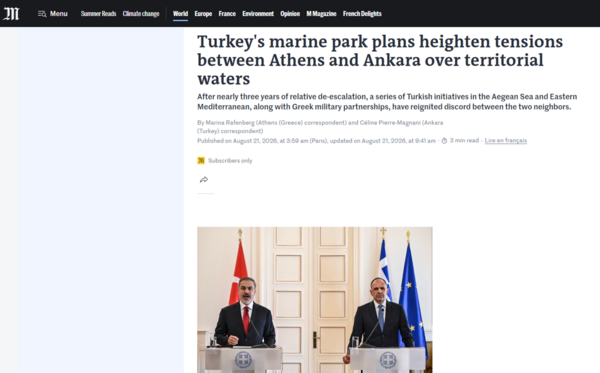
A notable analysis recently issued a warning while looking over the Aegean: after nearly three years of relative de-escalation, the rift between Greece and Türkiye is resurfacing. International relations experts have expressed deep concern that the era of so-called 'calm waters'—a term long used to describe bilateral relations—may be drawing to a close.
This diplomatic friction broke into open view as Turkish President Recep Tayyip Erdogan publicly warned Greece to “turn back from the wrong path.”
Coincidentally, Christopher Nolan’s The Odyssey is currently sweeping global box offices. Troy, which Odysseus breached with his wooden horse, lies in modern-day Türkiye, while Ithaca, his ultimate destination, belongs to Greece. While the film portrays Odysseus navigating the treacherous waters between these two worlds to return home, reality shows two NATO allies clashing over that exact maritime space.
[“Three Years of 'Calm Waters' Could Come to an End”]
The rapid deterioration of Greek-Turkish relations was difficult to foresee just a few months ago. Following the devastating 2023 earthquake in Türkiye, Greece dispatched immediate rescue operations, fostering a thaw in diplomatic relations. In December of that year, President Erdogan and Greek Prime Minister Kyriakos Mitsotakis signed the Declaration on Friendly Relations and Good Neighbourliness. Subsequent summits and working-level talks led both nations to characterize their ties as 'calm waters.'
However, that nearly three-year period of relative ease began to falter as Türkiye initiated a series of new measures in the Aegean and Eastern Mediterranean while Greece simultaneously bolstered its military alliances. Latent maritime boundary disputes resurfaced when Türkiye designated two national marine parks in the northeastern Aegean and Eastern Mediterranean.
[How a 'Fish Sanctuary' Became a Matter of National Sovereignty]
On the surface, marine parks are designed for environmental protection. However, the boundaries drawn by Türkiye ignited the dispute. The park in the northeastern Aegean overlaps with waters near Lemnos and Samothrace, while the southern park in the Eastern Mediterranean intersects sensitive maritime zones around the Greek island of Kastellorizo. The Greek government protested the move as 'illegal,' arguing that the zones set by Türkiye extend into international waters and encroach upon Greece’s claimed continental shelf.
More importantly, this move did not occur in a vacuum. Greece had previously created two marine parks within its own waters, drawing fierce opposition from Türkiye. Retired Admiral Cihat Yaycı, a key architect of Türkiye’s 'Blue Homeland' initiative, explicitly stated that Ankara's marine park designations were a direct response to Athens' prior actions. Consequently, what began as drawing lines to protect marine life rapidly evolved into a sovereignty dispute over control of the Aegean Sea.
[Erdogan: “Turn Back from the Wrong Path”]
President Erdogan entered the dispute directly, using an interview aboard his presidential plane while returning from a visit to Bishkek, Kyrgyzstan, to pressure Greece into altering its stance by taking issue with the militarization of Aegean islands. Türkiye asserts that certain Greek islands are subject to military restrictions under international treaties.
Greece's logic is the exact inverse. Athens contends that Türkiye maintains substantial military forces directly facing the Aegean along its mainland coast. Furthermore, with the Turkish Parliament having passed a 1995 resolution declaring any extension of Greek territorial waters a casus belli (cause for war), Greece argues it cannot abandon its island defenses. Therefore, framing the dispute simply as 'Greece arming demilitarized islands' is inaccurate; different treaties and legal statuses apply to individual islands, and the two nations' interpretations of those treaties conflict head-on.
[The Numbers '6' and '12' Deciding the Fate of the Aegean]
Understanding the Aegean conflict does not require deep knowledge of complex international law—only two numbers: 6 nautical miles and 12 nautical miles. Currently, both Greece and Türkiye observe a 6-nautical-mile territorial sea limit in the Aegean. However, Greece maintains its right to extend its territorial waters up to 12 nautical miles under the United Nations Convention on the Law of the Sea (UNCLOS). The primary complication lies in the Aegean's geography; numerous Greek islands are scattered right up to the doorstep of the Turkish mainland. If Greece extends its territorial waters to 12 nautical miles, the spatial structure of the Aegean Sea changes fundamentally.
This prompted the Turkish Parliament’s 1995 resolution authorizing the government to take necessary measures, including military action, should Greece expand its Aegean territorial waters beyond 6 nautical miles. This resolution remains a persistent casus belli hanging over bilateral relations.
This underlying dispute explains why naval warships deploy whenever issues arise regarding marine parks, undersea power cables, or natural gas exploration vessels. Though superficially about environmental or energy policy, every dispute boils down to one fundamental question: Where does Greek sea end, and where does Turkish sea begin?
[Unresolved Issues from the 100-Year-Old Treaty of Lausanne]
The roots of this conflict trace back to the dissolution of the Ottoman Empire. Greece, having gained independence from Ottoman rule in the 19th century, secured the Aegean islands through a succession of wars. Following World War I, Greek forces advanced into Anatolia but were ultimately defeated by Turkish nationalist forces led by Mustafa Kemal Atatürk.
The 1923 Treaty of Lausanne established the borders of modern Türkiye and the territorial framework of the Aegean islands, yet it failed to eradicate underlying tensions. Differing interpretations regarding territorial waters, continental shelves, Exclusive Economic Zones (EEZs), airspace, and the military status of specific islands remained unresolved.
As a result, the two nations teetered on the brink of military conflict in 1987 and 1996, and naval warships faced off again in 2020 over Eastern Mediterranean natural gas exploration. A century ago, land borders were drawn, but maritime boundaries were left incomplete.
[Erdogan’s Real Trump Card: 'Blue Homeland']
The most critical element to observe in this crisis is Türkiye’s 'Blue Homeland' (Mavi Vatan) strategy. As conceptualized by architects like Yaycı, the doctrine asserts that approximately 462,000 square kilometers of surrounding maritime space should fall under Ankara's jurisdiction. Their core argument holds that Greek islands must not function as a 'wall' blocking the maritime rights of the Turkish mainland.
An even more significant shift is underway: Türkiye is moving to institutionalize these unilateral maritime claims into law. Legislation governing maritime jurisdiction, dubbed the 'Blue Homeland Law,' is slated for consideration in the Turkish Parliament. Should it pass, the doctrine—previously limited to military strategy and mapped assertions—will be elevated into domestic law and administrative policy.
[The Aegean Skies Heating Up Again]
Tensions are not limited to rhetoric. Records from the Greek Ministry of National Defense reveal a sharp increase in reported Turkish airspace violations, surging from zero recorded incidents in 2024 to 225 in 2025, and rising further to 433 in 2026. A substantial portion of these incursions involves unmanned aerial vehicles (UAVs). While these figures represent data compiled by the Greek government, they serve as a clear indicator that military tensions, which had eased since 2023, are climbing once again.
Another flashpoint is the proposed subsea electricity cable designed to link Greece, Cyprus, and eventually Israel. Portions of the planned route pass through maritime areas claimed by Türkiye. In 2024, the project experienced delays when five Turkish warships deployed near the island of Kasos where survey vessels were operating. As subsea surveys resume, naval forces from both sides risk facing off on-site once more.
[Cyprus: The Secondary Powder Keg]
Compounding these issues is the unresolved status of Cyprus. In 1974, following a coup backed by the Greek military junta aiming to unite the island with Greece, Turkish forces intervened, leaving Cyprus effectively divided between north and south. To this day, Türkiye remains the only country recognizing the 'Turkish Republic of Northern Cyprus.'
A recent maritime tragedy involving a passenger vessel capsizing between northern Cyprus and Türkiye resulted in casualties and missing persons, triggering emotional disputes between both sides over how the location of the incident should be officially designated. While not a direct trigger for the Aegean boundary dispute, it illustrates the depth of historical grievances that have persisted for over 50 years.
[Why Times Insight]
Viewing the current situation in the Aegean merely as "another routine spat between Greece and Türkiye" misses the broader picture. The essential question is whether the rules of 'managed peace' maintained since 2023 are beginning to fracture.
At present, an immediate slide into open war remains unlikely. Both nations are NATO members deeply interconnected through trade and tourism. Crucially, the crisis management channels established between heads of state, foreign ministries, and military authorities since 2023 remain operational.
Nevertheless, risk factors are steadily accumulating. Divergent flashpoints—marine parks, the 12-nautical-mile limit, island militarization, subsea power cables, and airspace violations—are escalating simultaneously. If Türkiye moves to codify the 'Blue Homeland' into law, opposing claims will solidify from diplomatic posture into official state policy.
Furthermore, Erdogan’s strategic horizon extends beyond the Aegean. While keeping open the possibility of full membership in the Shanghai Cooperation Organization (SCO)—led by China and Russia—he has maintained that this does not signify an abandonment of NATO or the West. This reflects Ankara's intent to maximize its strategic leverage by becoming an indispensable actor to both East and West rather than committing strictly to one side.
Consequently, Aegean tensions are not merely a bilateral issue. They directly impact cohesion along NATO's southeastern flank, EU-Türkiye relations, the Eastern Mediterranean energy grid connecting Greece, Cyprus, and Israel, and broader European security strategy aimed at containing Russia.
Coincidentally, as The Odyssey captures millions of cinema viewers, it serves as a reminder of geography: ancient Troy lies in modern Türkiye, and Ithaca in Greece. Three millennia ago, Homer crafted tales of gods, men, war, and homecoming across these waters. Now, in the Aegean, a modern 'Odyssey' is unfolding—one shaped by territorial limits, island sovereignty, warships, drones, energy networks, and nationalism.
Whether the end of 'calm waters' remains a temporary diplomatic storm or swells into a geopolitical tempest shaking the core of NATO is precisely why the Aegean Sea demands close attention.
- TAG