


추부길 whytimespen1@gmail.com
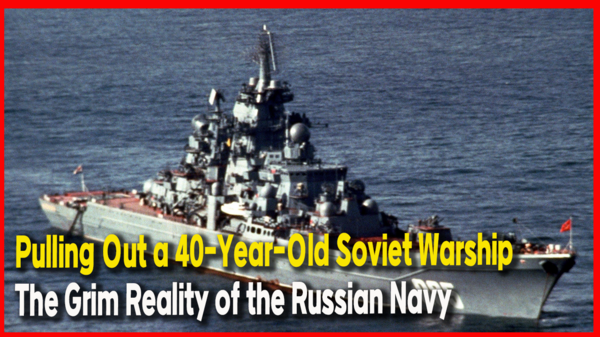
[The Insider Asks: "Why Spend $2.3 Billion on a Single Soviet Warship?"]
Russia is pouring over $2.3 billion into putting a Soviet-era nuclear-powered cruiser back to sea after nearly 30 years out of service. The ship is the Admiral Nakhimov, commissioned in 1988. While Russia boasts about the return of one of the world's largest surface combatants, looking at the time and money spent to revive this vessel reveals a very different picture of the Russian Navy. It reflects Russia's reality: having to resurrect a 40-year-old Soviet ship instead of building a new heavy cruiser.
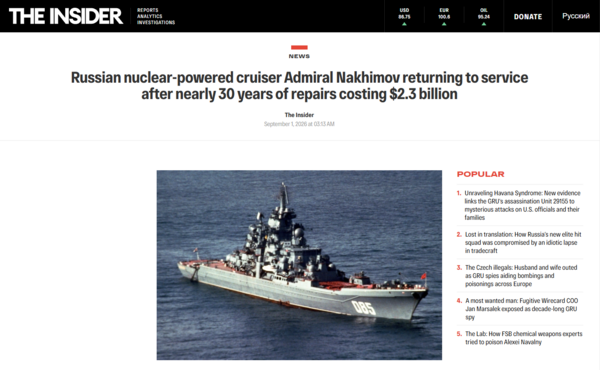
The Insider released a report titled "Russian nuclear-powered cruiser Admiral Nakhimov returning to service after nearly 30 years of repairs costing $2.3 billion." According to the report, the Nakhimov is currently completing shipyard and sea trials, with plans for state trials before potentially rejoining the active battle order of the Russian Navy by the end of 2026.
However, what captured The Insider's attention was not the Nakhimov's massive firepower, but the underlying decision-making. The Insider questioned why Russia directed so much time and immense resources toward saving a single Soviet-era ship. While official modernization costs remain undisclosed, state news agency TASS cited figures exceeding 200 billion rubles in 2023—equivalent to roughly $2.3 billion. The Insider pointed out that throughout this process, Russia concentrated scarce shipyard capacity, skilled technical personnel, and critical resources into restoring a single old hull.
This point is central. The primary issue is not whether the Nakhimov is a powerful warship. The real question is why Russia, approaching the mid-21st century, remains anchored to a 20th-century Soviet-built vessel.
[Commissioned in 1988… Not Putin's Warship, but a "Soviet Warship"]
The operational history of the Nakhimov brings this issue into sharper focus. The Insider noted that the vessel was not built by the Russian Federation. Constructed as a Soviet-era Project 1144 Orlan-class (Kirov-class) cruiser, it originally entered service with the Soviet Navy in 1988 under the name Kalinin. After its last operational voyage in July 1997, it effectively dropped out of service and was officially placed at the Sevmash shipyard in 1999 for repairs, though full-scale modernization only began in 2013.
Thus, a ship that had not seen active duty since 1997 is preparing to return to active service in 2026. In June, the Nakhimov put to sea for the first time in 28 years to begin final sea trials. Admiral Alexander Moiseyev, Commander-in-Chief of the Russian Navy, previously stated plans to return the cruiser to the fleet by year-end, with Russian media reporting intentions to finalize state trials following sea tests.
[The Missiles Are Modern… Making the Paradox Even Starker]
Russia did not merely repair an aging vessel; it extensively overhauled the interior and weapons systems. According to The Insider, workers removed the original 20 P-700 Granit anti-ship missile launchers and installed 80 universal vertical launch cells capable of firing Kalibr cruise missiles, Oniks anti-ship missiles, and Zircon hypersonic missiles. Russian sources also claim the ship is fitted with 96 cells for air defense missiles, giving it an offensive and defensive missile payload capacity among the highest for surface warships globally.
Therefore, dismissing the Nakhimov as mere scrap metal would be inaccurate. If fully operationalized, it represents a potent long-range strike platform that naval analysts cannot ignore. Yet, this highlights a key paradox: the platform chosen by Russia to host modern missiles and electronics is not a modern surface combatant, but a hull laid down by the Soviet Union in the 1980s.
[Russia's Issue Is Not an Inability to Build Ships Entirely]
A clear distinction is necessary here. It is not that modern Russia is entirely incapable of naval construction. Russia continues to build submarines, as well as Gorshkov-class frigates, corvettes, and small missile ships.
The issue lies in scale. Since the collapse of the Soviet Union, Russia has been unable to construct new 20,000-ton large surface combatants like the Nakhimov. Plans for next-generation large surface ships to replace the Soviet Navy's Kirov-class cruisers never transitioned into large-scale serial production. Consequently, one of the largest surface combatants Russia can deploy today is a ship built by the Soviet Union four decades ago—a detail more telling than the ship's 80 missile cells.
[Meanwhile in the Black Sea, Battered by a "Fleetless Ukraine"]
What renders the return of the Nakhimov particularly stark is the ongoing operational environment in the Black Sea. Ukraine possesses no traditional large surface fleet to engage the Russian Black Sea Fleet directly. However, by combining Neptune anti-ship missiles, long-range cruise missiles, attack drones, and uncrewed surface vessels (USVs), Ukraine has inflicted heavy losses on Russian naval power.
Nor is this dynamic confined to the sinking of the flagship Moskva in 2022. The Insider noted that Ukrainian forces struck Novorossiysk—a key Russian naval base—inflicting varying degrees of damage on four Russian warships, including the Project 11356R frigates Admiral Makarov and Admiral Essen, a Buyan-M class corvette, and a Vasily Bykov-class patrol ship. While independent confirmation from Russian sources remains limited, the key development is Ukraine's sustained ability to strike Russian naval assets even after pushing them out of Crimean ports toward Novorossiysk.
A similar pattern emerged in early August. Based on statements from Robert Brovdi, commander of Ukraine's Unmanned Systems Forces, at least 12 Russian-linked vessels in the Black Sea and Sea of Azov were targeted by Ukrainian drones between August 1 and August 8. Thus, as Russia highlights the revival of a massive nuclear-powered cruiser in the north, inexpensive uncrewed systems continue to apply pressure to Russian naval power in the south.
[A $2.3 Billion Capital Ship vs. Low-Cost Sea Drones]
The Insider highlighted this tactical dilemma, questioning the survivability of massive, costly surface warships in modern conflict. Given Ukraine's effective use of relatively low-cost anti-ship missiles and sea drones, concentrating enormous firepower, crew, and financial investments into a single hull like the Nakhimov creates an extraordinarily high-value target.
Ultimately, two distinct eras of naval warfare are colliding within the Russian Navy. In the Northern Fleet, a 28,000-ton Soviet-era nuclear cruiser is being restored at a cost exceeding $2.3 billion. In the Black Sea, Ukraine is using significantly smaller, lower-cost sea drones and aerial systems to target Russian vessels.
One side represents the flagship symbolism of a Cold War blue-water navy; the other represents 21st-century uncrewed attrition warfare. Based on the results of the war in Ukraine thus far, that contrast presents a complex challenge for Russian naval strategy.
[Why Times Insight]
The return of the Admiral Nakhimov undoubtedly adds firepower to the Russian Navy. A 28,000-ton nuclear-powered surface ship capable of deploying Kalibr, Oniks, and Zircon missiles from 80 vertical launch cells is a significant platform. However, the most defining figures in this development are not its missile cell count, but rather "1988, 1997, $2.3 billion, and nearly 30 years."
A warship commissioned into the Soviet Navy in 1988 effectively left active service in 1997, only to re-emerge in 2026 after a modernization effort costing over 200 billion rubles.
Investing this amount of time and capital raises a fundamental question: why was Russia required to spend resources restoring a 40-year-old Soviet cruiser rather than building a modern heavy surface combatant? The answer underscores structural constraints within Russian naval shipyards.
Russia retains world-class nuclear submarine capabilities, strategic nuclear deterrence assets, and continues to build new frigates and submarines. Asserting that the Russian Navy has collapsed would be an overstatement.
However, regarding whether Russia can reconstruct a modern blue-water surface fleet comparable to the Soviet Navy, the Nakhimov serves as an indicator. It is a restored Soviet cruiser returning to service rather than a new class of heavy warship.
This dynamic is further complicated by events in the Black Sea. A Ukrainian military lacking a large surface fleet deployed missiles, drones, and USVs to sink the Black Sea Fleet flagship Moskva and constrain Russian naval operations. Attacks targeting Russian naval bases and vessels have continued throughout 2026.
At the moment Russia completes a $2.3 billion overhaul on a 40-year-old capital ship, asymmetric and uncrewed systems are demonstrating how low-cost platforms can challenge large surface combatants in high-intensity conflicts.
The returning Admiral Nakhimov reflects the current state of Russia's surface fleet. It presents a large, nuclear-powered profile equipped with hypersonic missiles and the displacement of a major surface warship. Beneath that exterior, however, lies a 1980s Soviet hull maintained through 21st-century refits.
While Moscow may frame the ship's return as the revival of a major naval asset, the broader strategic question remains: why did Russia need to spend $2.3 billion to restore a 40-year-old Soviet warship to maintain its blue-water surface presence? Rather than symbolizing a naval renaissance, the return of the Admiral Nakhimov highlights the operational and industrial boundaries of Russia's modern surface fleet.

- TAG