


추부길 whytimespen1@gmail.com
[Zelenskyy Reaches Out to Airlines: "Russian Skies Are Becoming Dangerous"]
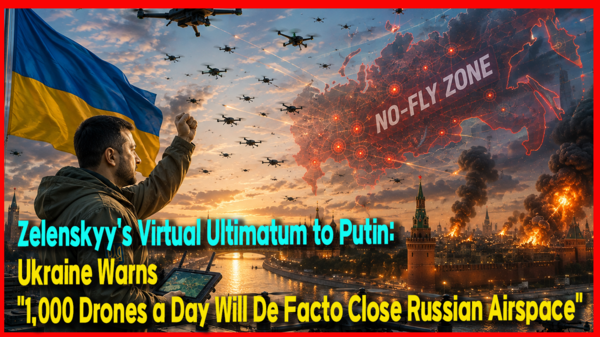
Ukrainian President Volodymyr Zelenskyy has issued a virtual ultimatum to Russian President Vladimir Putin. The core message is clear: if Russia continues to launch missile and drone strikes against Ukrainian cities, the impact of the war will no longer be contained within Ukraine’s borders. While Zelenskyy did not explicitly use the term "ultimatum," his public warning that Russian airspace will effectively be closed due to extreme operational hazards carries equivalent political and military weight. The central objective is unmistakable—Ukraine intends to scale up long-range drone operations to elevate risk levels across all Russian airspace.
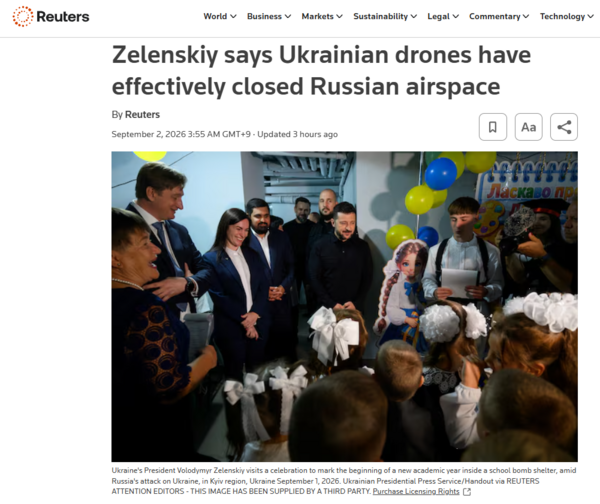
Reuters reported that President Zelenskyy directed his warning toward an unusual audience during his nightly address: not the Russian military or the Kremlin, but international airlines and insurance providers operating within Russian airspace.
Reuters noted that Zelenskyy emphasized that airlines and insurers continuing to utilize key Russian airports must factor in the escalating risks. While clarifying that Ukraine is not targeting civil aviation, he warned that the vast expansion of Ukrainian drone operations means Russian airspace is heading toward a de facto closure. According to Reuters, this moves beyond a routine aviation safety notice; it serves as a global declaration that Russian airspace is no longer a safe zone, signaling that Ukraine's long-range strikes are expanding beyond border areas to Russia's deep rear, including Moscow and St. Petersburg.
[The Number '1,000': A Shift in Ukraine’s Drone Warfare]
This warning is backed by concrete military targets set just days prior. On August 28, following a meeting of the Supreme Commander-in-Chief's Staff, Zelenskyy established a goal to scale long-range strikes against Russia from an average of over 300 drones per day to 1,000 per day.
The warning regarding Russian airspace directly aligns with this target. By announcing a threefold increase in daily attack volume before issuing warnings to the international aviation sector, Ukraine has structured its political messaging around operational goals.
Zelenskyy previously issued a similar warning in June, emphasizing that Moscow would not remain safe if Russian airstrikes continued, stressing that while Ukraine did not seek this war, it would respond in kind.
[Exploiting the 'Air Defense Dilemma']
Regarding this strategy, Reuters noted that Ukraine does not need to carpet-bomb the entirety of Russian territory. The key objective is to overwhelm the number of critical targets Russia must defend. To simultaneously protect Moscow, St. Petersburg, airbases, munitions factories, oil refineries, ports, and power stations, Russia is forced to disperse its air defense assets across a vast geography.
Ukraine’s continuous strikes on Russia’s energy infrastructure have targeted key refining, export, and storage facilities that sustain Russia's war economy. Reuters analyzed that Ukraine is sustaining these attacks to weaken Russia's military resources and fuel supply capacity.
These actions have already impacted domestic fuel supplies within Russia. Reuters reported in late August that Russian gasoline production fell to roughly 70% of domestic demand, driven in part by drone strikes on major refining facilities, forcing Moscow to restrict exports and increase imports.
In asymmetric drone warfare, Russia's vast geography turns into a strategic vulnerability. Reuters highlighted that repeated saturation attacks using hundreds to 1,000 long-range drones force Russian command to make continuous decisions on prioritization, creating an enduring "air defense dilemma."
[Immediate Operational Execution]
On September 1, the Main Directorate of Intelligence of Ukraine (HUR) announced that it had conducted a "Deep Strike" operation targeting the Novatek-Ust-Luga complex in the Leningrad region near St. Petersburg using long-range drones, carried out jointly by its Active Operations Department and Unmanned Systems Forces alongside the Armed Forces.
Ukrainska Pravda reported that Ukrainian sources claimed strikes on key oil processing and operational equipment at the Baltic Sea energy export hub.
Ukrainska Pravda further noted the significant symbolism of this attack: while early-war Ukrainian strikes focused on border regions like Belgorod and Kursk, the radius has now expanded to Russia's inland and Baltic energy hubs, demonstrating that Zelenskyy's warnings about Russian airspace are already materialized threats.
[Countering Asymmetric Strikes]
The immediate backdrop to Zelenskyy's statement is Russia’s ongoing air campaign, which included six consecutive days of strikes on Kyiv and surrounding areas leading into September 1, causing 12 civilian casualties and damage to energy, rail, and residential infrastructure.
Reuters reported that Ukraine’s foreign minister appealed to the West for additional air defense support as inventories of Patriot interceptor missiles decline, a vulnerability Russia is exploiting through combined ballistic missile and drone strikes.
Reuters also noted that Russian strikes targeted export infrastructure, border checkpoints near Romania, and energy facilities in Odesa to simultaneously strain Ukraine's export routes and energy grid.
However, Reuters observed that Zelenskyy is turning this strategy back on Russia asymmetrically. Instead of matching Russia missile-for-missile, Ukraine aims to use mass-produced long-range drones to impose high economic costs and disperse Russian defensive assets deep behind the front lines, reflecting a resolve to end the dynamic where only Ukraine absorbs the damage.
[Political Impact on the Russian Domestic Front]
This strategy also targets Russian domestic perception. While the war previously felt distant to much of the Russian public, flight disruptions at major airports and routine strikes on logistical and energy infrastructure bring the operational costs of the conflict directly into daily life.
Reuters reported that Russia’s crude oil production forecasts for 2026 have already been adjusted downward to a 17-year low, as war and refinery disruptions strain fuel production and export projections.
Reuters noted why this poses a distinct problem for Putin: the costs of war are no longer confined to front-line soldiers and border residents, but are now felt by enterprises, aviation, energy industries, and citizens in Moscow and St. Petersburg.
Zelenskyy’s statement does not declare intent to strike civilians, explicitly confirming that civil aircraft will not be targeted. Rather, it exerts political pressure by making clear that the costs of Putin's war will no longer be borne solely by Ukrainians.
[Russia’s Response]
Russian President Vladimir Putin responded during a press conference on September 1, criticizing Ukraine's strike campaign and warning of retaliatory measures. He characterized warnings aimed at the aviation sector as "state terrorism" while claiming Russian military gains of 270 km² in the Donetsk region during August. Reuters noted that it could not independently verify these battlefield claims.
Interestingly, Reuters observed that while Putin labeled Ukrainian leadership "terrorists" and claimed negotiations were difficult, he did not entirely close the door on peace discussions should diplomatic opportunities arise.
Reuters analyzed that Russia may intensify strikes in the short term, noting Putin's announcement that Russia is preparing large-scale attacks on Ukrainian energy infrastructure. The interplay between Zelenskyy's drone expansion and Putin's retaliation threatens to escalate reciprocal attacks on rear infrastructure.
[Why Times Insight]
Zelenskyy is issuing a virtual ultimatum to Putin. While not a formal diplomatic document, the message is clear: if the war continues, Russia will no longer remain a safe zone. Combining the August 28 goal of 1,000 drones per day with the September 1 airspace warning makes this intention explicit.
Ukraine cannot wage a symmetrical missile war against Russia's vast inventory of ballistic missiles, cruise missiles, and strike drones. Instead, Ukraine has chosen asymmetric warfare through volume, using mass-produced long-range drones to force Russia into defending numerous strategic facilities across its vast territory simultaneously.
The target of 1,000 drones per day is crucial here. Not all 1,000 drones need to hit their targets; even if a fraction penetrates air defenses, Russia must decide where to concentrate its defensive assets among Moscow, St. Petersburg, oil refineries, airbases, ports, and munitions plants. Ukraine is effectively turning Russia's immense size into a defensive burden.
Furthermore, the economic impact of these strikes is already visible. Russian gasoline production fell to 70% of domestic demand by late August, requiring fuel imports and export restrictions. Long-range drone warfare has evolved from striking military targets into an economic war that brings the cost of conflict into the daily lives of the Russian public.
Therefore, Zelenskyy's declaration represents a fundamental shift. It signals to Putin that continuing the war means defending Russia's entire rear, while messaging Russian society that they cannot remain insulated from the economic and security costs of Putin's war.
However, Putin's initial response was a warning of retaliation rather than negotiation, publicly signaling preparations for major strikes on Ukrainian energy infrastructure. This ultimatum-like warning may trigger short-term escalation rather than immediate diplomacy.
Nonetheless, the core question of the war has changed. Where the primary focus was once how much missile and drone pressure Ukraine could endure, Ukraine's scaling of long-range drone capacity introduces a parallel question: how long can Russia sustain a war where its own airports, refineries, ports, and military industries face constant drone threats?
The first person required to answer that question is not the Russian public, but Putin himself. Whether he responds with further retaliation or seeks diplomatic exits before the domestic costs become unmanageable will be the primary narrative to follow. The war in Ukraine is transitioning from a battle of how long Ukraine can endure to how long Putin can afford the costs returning to the Russian homeland.

- TAG