


추부길 whytimespen1@gmail.com
[Bessent Warns of Weekly Sanctions: Financial Institutions Hit First]
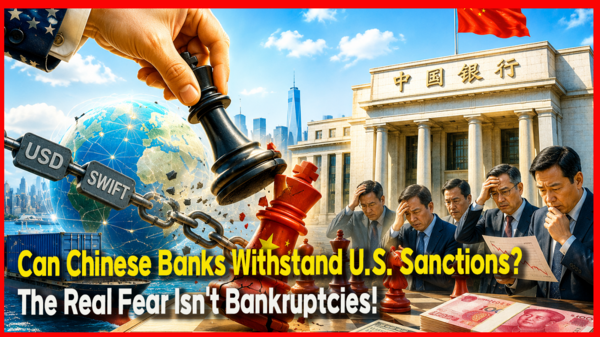
The United States has finally set its sights on the most sensitive nerve of China’s financial system. U.S. Treasury Secretary Scott Bessent signaled plans to roll out weekly secondary sanctions targeting entities linked to Iran, prioritizing international financial institutions for primary pressure. This raises a critical question: as the largest purchaser of Iranian crude, could China’s mega-banks weather direct U.S. sanctions? The short answer is that while Chinese banks will not collapse overnight, cutting off their external connections—such as U.S. dollar clearing access and global correspondent networks—would unleash a shock of an entirely different magnitude.
Central Florida Public Media
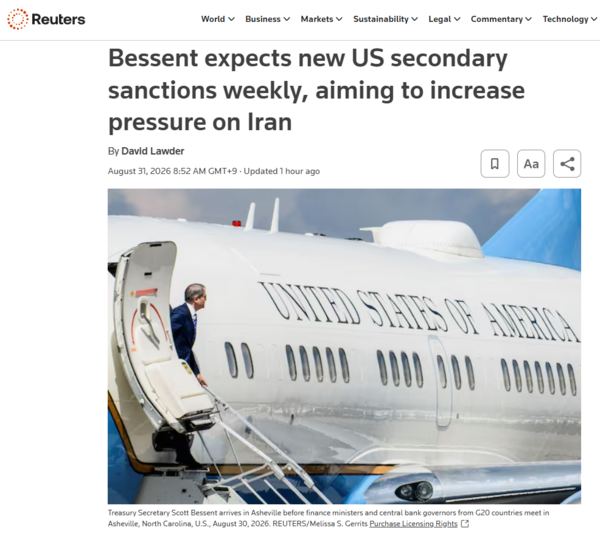
Reuters reported on August 31 that Treasury Secretary Bessent announced weekly waves of secondary sanctions against countries, firms, and financial institutions continuing business with Iran. Bessent warned that compliant-defying institutions face total exclusion from the U.S. dollar-based financial system, signaling a direct offensive against third-country financial intermediaries rather than just select Iranian firms.
Reuters noted that tangible enforcement is already underway. The U.S. Treasury cut UAE branches of Egypt’s Banque Misr off from dollar transactions due to Iran-related dealings, forcing central banks in both Egypt and the UAE to step in to manage the fallout. This confirms that Bessent’s threat of expulsion from dollar networks is an operational reality rather than mere rhetoric.
This campaign builds on Operation Economic Outcast, launched on August 24. While Washington signaled sweeping secondary sanctions to sever Iran's global financial links, it initially spared major Chinese banks, opting to target Chinese and Hong Kong entities and individuals while holding off on the core of China's financial system.
Wikipedia
[Sanctions Will Not Instantly Topple Chinese Banks]
A common misconception is that U.S. sanctions will cause immediate bankruptcies among major Chinese banks. They will not. China’s banking system rests on a massive domestic deposit base, with state control underlying most major institutions. The People's Bank of China (PBOC) can freely inject renminbi (RMB) liquidity, and Beijing can backstop these lenders via capital injections and policy funding. Washington cannot unilaterally erase domestic RMB assets.
AP News
Viewing U.S. financial sanctions as an attempt to force Chinese banks into insolvency misses the point. The actual target is not domestic asset holdings, but rather the international interface connecting Chinese lenders to global financial markets—specifically, U.S. dollar clearing mechanisms, correspondent banking accounts within the U.S., and institutional counterparty relationships abroad.
[What Washington Aims to Cut: Not the 'Money,' but the 'Highway']
Consider a major Chinese bank as a massive city. Financial sanctions cannot destroy the factories or buildings within that city. They can, however, block the highways, ports, and airports linking it to the outside world. In international finance, those lifelines consist of USD clearing, correspondent accounts, trade finance, foreign exchange markets, and global interbank credit lines.
If global financial institutions in Europe, Japan, South Korea, or the Middle East risk secondary sanctions by dealing with a targeted Chinese bank, they will naturally restrict transactions with that bank. Consequently, while the bank's domestic deposit and lending activities continue uninterrupted, Chinese enterprises face severe cost spikes and delays in import-export settlements, USD fundraising, letters of credit (L/C), and international project financing. This operational friction is precisely what Washington seeks to create.
[The 2012 Bank of Kunlun Precedent]
The U.S. Treasury previously tested this mechanism against Chinese lenders. In July 2012, the Treasury sanctioned China's Bank of Kunlun for processing substantial financial transactions for designated Iranian banks. Investigations revealed that Kunlun provided services to over six sanctioned Iranian institutions and processed hundreds of payments totaling roughly $100 million from Bank Tejarat accounts alone.
Rather than seizing assets or forcing insolvency, Washington prohibited U.S. financial institutions from opening or maintaining correspondent or payable-through accounts for Bank Kunlun, ordering existing accounts closed within 10 days. This effectively severed Bank of Kunlun from the U.S. financial system.
[Sanctioning One Institution deters Ten Others]
The primary force of U.S. financial sanctions lies in their "chilling effect" rather than direct enforcement alone. If Washington aggressively penalizes a single Chinese financial institution over Iran-related activity, competing Chinese lenders are forced to reassess their exposure. This triggers over-compliance: banks preemptively scale back Iranian dealings, heighten due diligence on high-risk clients, and reduce select USD transactions to avoid becoming the next target.
For Chinese banks, the risk-reward calculation is straightforward. While Iranian trade remains a key energy vector, access to the USD-denominated global financial infrastructure underpins China’s trade and outbound investments. Washington can effectively reshape institutional behavior across the board without having to sanction every individual Chinese bank.
[Can CIPS and the Renminbi Offer an Escape?]
Beijing is fully aware of these vulnerabilities, driving its push for RMB internationalization and the expansion of the Cross-Border Interbank Payment System (CIPS). Settling trade in local currencies with partners like Russia and Iran forms a key pillar of its strategy to dilute reliance on USD financial networks.
However, CIPS cannot replace the U.S. dollar network overnight. International trade relies on a deeply integrated ecosystem of trade credit, letters of credit, maritime insurance, ship finance, foreign exchange swaps, and international bond markets. While expanding RMB settlement cushions against sanctions, it cannot replicate the global USD ecosystem in the short term.
[Targeting the Big Four Changes the Game]
A distinct line remains for Washington: targeting China’s state-owned mega-banks—Industrial and Commercial Bank of China (ICBC), Bank of China (BOC), China Construction Bank (CCB), and Agricultural Bank of China (ABC). Cutting the world's largest banks off from dollar clearing carries systemic consequences far exceeding sanctions on regional lenders or targeted branches.
While Beijing could supply domestic RMB liquidity to protect domestic operations, a mass reduction in dealings by foreign counterparties would disrupt Chinese import-export financing and global capital procurement. Conversely, given the massive footprint of China's Big Four in global capital markets, U.S. and European financial institutions would face significant collateral damage. This systemic interdependence explains why Washington has refrained from using this option lightly.
Yet, the strategic value of this measure lies in its potential leverage. The threat of cutting major Chinese banks off from dollar clearing can influence institutional behavior without requiring immediate execution. Secretary Bessent’s announcement of weekly sanctions targeting financial institutions demonstrates that this psychological pressure campaign is intensifying.
Sullivan & Cromwell LLP
[How Much Pressure Can Chinese Banks Absorb?]
China’s defensive capabilities against U.S. financial sanctions break down into three tiers:
Central Florida Public Media
Targeted Point-Sanctions: China can easily absorb isolated sanctions against smaller financial institutions or specific transaction conduits.
Action Against Mid-to-Large Lenders: Sanctions expanding to one or two major Chinese banks would severely damage their international divisions, even while domestic solvency remains intact.
Systemic Exclusion of the Big Four: Systematic severance of dollar clearing and correspondent relationships for primary state-owned banks would alter the landscape entirely. While instant collapse remains unlikely, it would trigger structural strain across exports, foreign exchange, outbound investment, and cross-border trade—marking a transition from secondary enforcement into direct economic conflict.
[Why Times Insight]
Can Chinese banks withstand U.S. sanctions? While the banks themselves can maintain internal domestic operations, they cannot avoid the severe fallout of being severed from global financial networks. Recognizing this dynamic, Washington is deploying a strategy of incremental escalation—targeting international institutions linked to Iran to send a clear signal, rather than launching an immediate strike on China's Big Four.
Central Florida Public Media
The objective is to alter the internal calculations of Chinese financial leadership: forcing them to weigh the yield of Iranian trade against the risk of exclusion from the USD system. Once that calculus takes hold, sanctions exert influence far beyond the designated entities list, much as financial institutions voluntarily withdrew from Iranian trade following the 2012 Bank of Kunlun sanctions.
Moving forward, three key indicators warrant close attention:
Whether the U.S. officially adds major Chinese state-owned banks to its primary sanctions lists.
Whether Washington directly restricts USD clearing and U.S. correspondent account access for Chinese lenders.
Whether Chinese banks proactively roll back trade transactions with Iran ahead of explicit U.S. enforcement actions.
If Chinese banks begin scaling back trade preemptively, Washington will have achieved its primary policy objectives without firing a direct shot at China’s largest lenders. Conversely, if the U.S. moves to cut off dollar access for any of China's Big Four, it will mark a definitive shift—escalating beyond trade and tech disputes into an all-out financial war.
Would you like me to adjust the tone for a specific media outlet (e.g., formal news agency, policy memo, or journalistic op-ed) or focus on specific technical financial terms?
- TAG