


추부길 whytimespen1@gmail.com
[From Running and Dancing to Kung Fu... Yet 20% of Human Productivity in Factories]
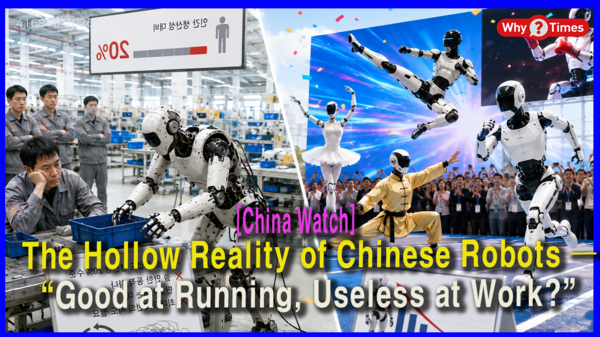
Chinese humanoid robots are capturing global attention by sprinting, dancing, performing Kung Fu, and boxing. Some analysts suggest China is poised to surpass the United States in leading the humanoid robot era. However, moving these machines from flashy demonstration stages onto real factory floors reveals a vastly different reality. In basic tasks, their efficiency reaches only about 20% of human productivity, requiring up to 300 attempts to master a single usable motion. A substantial gap remains between China's public image of "robot dominance" and its actual industrial capabilities.
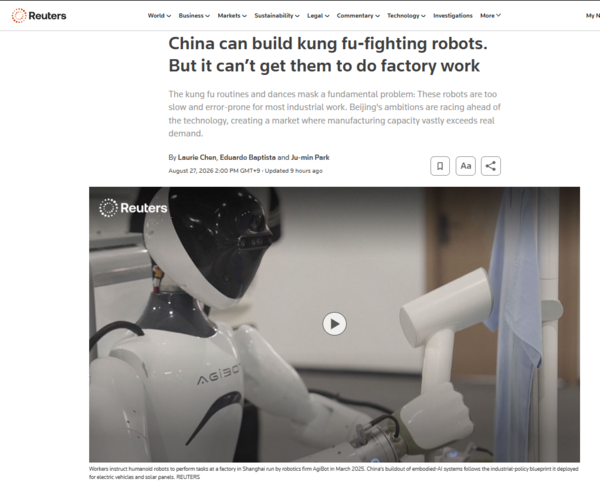
Reuters released an in-depth report detailing the hidden realities behind China’s robot industry. Reuters reported that at a robot training facility in Liuzhou, Guangxi Zhuang Autonomous Region, over 100 humanoids built by UBTech were lined up—a facility funded by an $18 million contract from the local government. To train a robot on basic tasks like sorting boxes, packing noodles, or brewing coffee, novice trainers needed up to 300 attempts to achieve a usable movement sequence, while experienced trainers required roughly 50 repetitions.
The productivity metrics raise further concerns. Reuters reported that facility officials noted current humanoids perform simple tasks at roughly 20% the speed and output of human workers, meaning that while impressive on stage, their real-world output remains a fraction of a single human worker.
Tang Wenbin, co-founder and CEO of robotics startup Yuanli Lingji, remarked that "the robots' IQ is too low" and characterized many public demonstrations as "dancing disguised as work." The core vulnerability of Chinese humanoids lies not in physical movement, but in a lack of operational intelligence when environments vary slightly.
[World-Class at Sprinting, but Plugging in a Single Cable Remains Difficult]
Reuters highlighted that recent videos showing Chinese humanoids completing marathons, engaging in martial arts, and dancing created the impression that China leads the world in humanoid technology. Reuters noted that at the World Humanoid Robot Conference in Beijing, certain units recorded running speeds faster than human world records, but real-world utility hinges on practical tasks such as packaging, warehouse sorting, EV charging, and cable insertion.
Industry insiders in China acknowledge these limits. Yu Chao, CEO of Lumos Robotics, emphasized that robots must resolve actual operational challenges to provide value, noting that running and jumping alone do not drive industrial productivity. Physical athleticism and commercial utility remain distinct challenges.
Regarding hardware manufacturing, China’s scale is significant. BofA Global Research data cited by Reuters indicates that Chinese manufacturers accounted for 95% of the approximately 20,000 humanoid units shipped globally last year, with Beijing aiming for over 100,000 units this year.
However, volume production does not equate to effective deployment. Reuters concluded that while Chinese firms possess strong hardware manufacturing capabilities, their humanoids lack the intelligence required for general-purpose labor, struggling whenever tasks depart from pre-programmed routines.
Current output reflects mass manufacturing of robot bodies rather than fully functional autonomous workers. Wang Qian, CEO of X Square Robot, told Reuters that while hardware is largely prepared, the underlying AI decision-making systems lag behind. Many of these robots continue to rely on foreign chips, such as those from Nvidia.
[Not Built for Commercial Sales: Government Serves as the Largest Customer]
A key question is whether China's humanoid market is sustained by genuine private demand. The National Development and Reform Commission reports over 150 humanoid enterprises in China—exceeding the number of domestic EV brands. Central and local government procurement of robotics equipment reached at least $230 million, representing roughly 3.7 times the previous year's total and 38 times that of the same period in 2024.
State intervention supports the sector through direct subsidies and public procurement. DEEP Robotics generated roughly 42% of its $4.2 million net profit last year from subsidies, while selling only four humanoid units across 2024 and 2025. UBTech secured at least $123 million in new contracts from state-owned enterprises in Q4 last year. State procurement, rather than private industrial demand, remains the primary driver.
[Replicating the EV Playbook Without the "Brain"]
According to Reuters, Beijing is applying the industrial playbook previously used for electric vehicles and solar panels: deploying subsidies, encouraging competition, scaling production to lower costs, and consolidating the market around surviving champions.
However, key differences exist. EVs and solar panels were mature product categories with established market demand when mass production began. Humanoids face unresolved core challenges in dexterity, reliability, environmental adaptation, and artificial intelligence. Capacity is expanding ahead of proven market utility.
Kevin Xu, founder of US investment firm Interconnected Capital, noted that some Chinese robotics founders already refer to the sector as a "bubble," forecasting an eventual major market consolidation.
[500,000 Hours vs. 100 Million Hours: A 200-Fold Data Gap]
The primary vulnerability remains intelligence. A humanoid must visually assess an object, process spatial parameters, and execute precise physical manipulation. Minor variations in lighting, angle, or surface texture can lead to operational failure. Jia Baoxiong, a researcher at the Beijing Institute for General Artificial Intelligence, described this challenge as bridging the final margin from 10 cm down to 1 cm, and ultimately 1 mm.
Data availability presents a major hurdle. Industry estimates indicate that roughly 500,000 hours of high-quality robot training data are currently available, compared to an estimated 100 million hours required for functional physical intelligence—a 200-fold gap that capital expenditure alone cannot resolve quickly.
[Why Xiaomi’s Smart Factory Prefers Robotic Arms Over Humanoids]
Industrial practice illustrates these limits. Reuters reported that at Xiaomi’s Beijing EV plant, where assembly is 91% automated, operations rely on over 700 traditional industrial robotic arms for welding, riveting, and gluing rather than humanoids.
Similarly, while Zeekr (under Geely) has tested UBTech humanoids for parts sorting, core operations on active assembly lines remain managed by industrial robotic arms and automated guided vehicles. Factory deployments prioritize speed, precision, and uptime over human-like form factors—areas where traditional industrial robots retain a clear advantage.
[Why Times Insight]
The core competitiveness of Chinese humanoids is not demonstrated by stage performances of Kung Fu or sprinting. Public demonstrations should not be conflated with real industrial capability.
The current state of Chinese humanoid development can be summarized simply: hardware production capabilities have advanced rapidly, but the cognitive systems needed to operate that hardware effectively remain underdeveloped.
At the same time, state backing and manufacturing capacity allow Chinese firms to absorb losses, gather operational data, and drive down hardware costs. Rather than a fully realized robotics transformation, current efforts represent a large-scale national initiative to accelerate future capabilities.
Whether these systems achieve long-term viability will depend on their performance on factory floors rather than public demonstration stages.

- TAG