


김정희 whytimes.newsroom@gmail.com

[Cabbages Soaked in Formaldehyde… Chinese Government Eventually Confirms the Fact]
Another shocking food safety incident has erupted in China. An investigation by Chinese authorities confirmed that cabbage buyers in Hebei Province soaked cabbages in a formaldehyde solution to maintain freshness during long-distance transport prior to shipment. Although formaldehyde was thankfully not detected in Chinese cabbages imported into South Korea recently, the incident raises a far more fundamental question: Is South Korea's imported food safety net, which relies heavily on Chinese kimchi and agricultural products, proactively identifying risks?
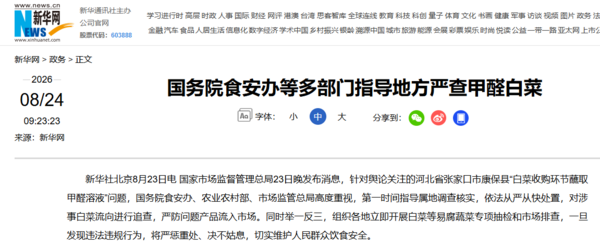
China's official Xinhua News Agency reported on the 24th that "the incident began when video footage shot in Kangbao County, Zhangjiakou City, Hebei Province, on the 22nd spread rapidly across the internet," causing widespread shock. The footage showed cabbages being dipped into a liquid before being loaded onto trucks, and containers labeled formaldehyde were discovered at the scene.
Xinhua further reported, "The Kangbao County government immediately launched an investigation and officially confirmed that the actions depicted in the video were true." According to Chinese authorities, it was an illegal act committed by certain buyers aimed at preserving freshness during transport, and public security agencies have taken coercive measures against the individuals and vehicles involved.
Xinhua noted, "As the situation escalated, the State Council Food Safety Office, the Ministry of Agriculture and Rural Affairs, and the State Administration for Market Regulation stepped in." The central government ordered authorities to trace the distribution channels of the compromised cabbages while conducting special random sampling and market inspections for cabbages and other perishable vegetables nationwide.
[A More Serious Problem… ‘Formaldehyde Cabbage’ Is Not the First Time]
What is even more notable is that this incident is not an entirely new category of food safety failure.
Local Chinese media, including Xinhua, reported that "issues regarding so-called 'formaldehyde cabbage' have been raised multiple times over the past decade." Critics pointed out that despite this history, formaldehyde had not been incorporated into routine, standardized testing items for vegetables.
Xinhua added, "Following the incident, Chinese authorities back-traced the distribution channels and identified that some of the compromised cabbages had moved to Anhui and Jiangsu Provinces." This indicates that the problem was not confined to local consumption around Kangbao County, but had entered long-distance supply networks reaching other regions.
This widespread risk explains why China's central government mandated nationwide special inspections: there was a pressing need to determine whether the issue was an isolated violation by a few buyers or a systemic, illegal treatment practiced elsewhere to maintain produce freshness.
[Why Korea Cannot Help But Be Anxious… Overwhelming Reliance on Chinese Imported Kimchi]
South Korea cannot easily dismiss this situation as mere internal Chinese news due to its high dependency on Chinese food products. Notably, the overwhelming majority of kimchi imported into South Korea originates from China. Due to price competitiveness, Chinese kimchi is extensively served across restaurants and food service providers.
Singapore's The Straits Times also covered the incident on the 26th, reporting that "the South Korean government has tightened inspections on Chinese cabbage and kimchi." The report emphasized that "this supply chain structure is precisely why a food safety incident in a single region of China instantly metastasized into an imported food safety concern for South Korea."
However, a clear distinction must be made. The fact that Chinese products account for the dominant share of South Korea's imported kimchi does not automatically mean that the contaminated cabbages from Kangbao County were exported to South Korea. To date, no evidence confirming such an export has been identified.
[Not Just Korea… Taiwan Instantly Traces Chinese Kimchi]
South Korea is not the only country reacting sensitively to the fallout. The Taipei Times reported that "Taiwanese food and drug authorities also audited import records for Chinese cabbages and kimchi." Taiwanese officials announced on the 25th that "no evidence was found indicating that kimchi made from the formaldehyde-treated cabbages in question had been imported into Taiwan."
Taiwan's swift response demonstrates that the incident has transcended a localized Chinese agricultural issue, evolving into a broader food safety challenge for neighboring countries that import Chinese agri-food products.
[Korea Tightens Testing After News Breaks… 8 Recent Batches Test 'Negative']
South Korea's Ministry of Food and Drug Safety (MFDS) also intensified testing on imported Chinese cabbages after the incident came to light in China. On the 26th, reassuring preliminary results were announced: testing on eight shipments of Chinese cabbages declared for import on the 24th and 25th yielded zero detections of formaldehyde.
The MFDS is expanding its testing protocol beyond raw Chinese cabbages to include Chinese kimchi and salted cabbages. Based on currently verified facts, there are no grounds to conclude that cabbages from Kangbao County entered South Korea. Therefore, asserting that 'formaldehyde cabbage has reached Korean dinner tables' exceeds the established facts.
[Yet a Question Remains… Why Inspect Only After the Incident Breaks Out in China?]
This is the central point that demands scrutiny. While it is undoubtedly fortunate that formaldehyde was not detected in the eight recent shipments of imported Chinese cabbage, the fact that "none was detected this time" is fundamentally distinct from claiming that "South Korea's import surveillance system operated proactively."
South Korean authorities did not uncover this incident independently. The issue was exposed through video leaks in China, admitted by local Chinese government entities, and addressed via nationwide special inspections ordered by Beijing before South Korea intensified its own testing of Chinese cabbages. This specific timeline warrants careful attention.
[Korea Is Not Devoid of Management Systems]
Of course, this does not mean the South Korean government imports Chinese kimchi and produce without regulatory oversight. The MFDS actively collects foreign food hazard intelligence, conducts customs clearance inspections on imported food, and operates an overseas manufacturing facility inspection system. Mandatory Hazard Analysis and Critical Control Point (HACCP) management systems have also been strengthened for overseas facilities exporting kimchi to South Korea.
Therefore, concluding that "the South Korean government does not manage Chinese food imports" based on this incident is inaccurate. Instead, the inquiry must move to the next logical tier: With various systems already in place, why failed South Korea to independently identify and add emerging hazards—frequently raised within China—to its testing parameters prior to an official outbreak?
[Why Times Insight]
The most critical fact in this 'formaldehyde cabbage' incident is that no formaldehyde was detected in the eight batches of Chinese cabbages recently tested in South Korea. Yet, this does not resolve the underlying controversy. Instead, the event poses a fundamental question to South Korea's imported food safety policy: Should testing occur reactively after an incident erupts in China, or should risks be identified proactively before an outbreak occurs?
For a nation like South Korea, which maintains a substantial import volume of Chinese agri-food products and kimchi, standard customs clearance checks are insufficient. The safety architecture must independently intercept emerging risk signals across the production, sourcing, processing, and transportation stages within China. Given that local Chinese media had repeatedly reported similar 'formaldehyde cabbage' practices over the past decade, this incident serves as an imperative to re-evaluate how proactively South Korea's overseas food hazard monitoring framework operates.
The government's task is not to assume that all Chinese food products are inherently unsafe, nor is it to rest easy simply because a limited number of test samples yielded clean results. What is required is a proactive management chain: Continuous Monitoring of Overseas Hazard Data → Early Risk Signal Capture → Immediate Integration into Test Protocols → Precise Border Inspection → Traceability Back to Supply Networks Upon Issue Identification.
Ultimately, the core of this incident extends beyond whether 'formaldehyde cabbages entered South Korea.' If South Korea remains locked in a pattern of launching reactive inspections whenever a food safety scandal breaks in China, the system functions as 'crisis response' rather than 'prevention.' Given its reliance on imported Chinese food, South Korea must move beyond verifying safety after the fact and advance toward a system capable of detecting risks before they explode.

- TAG