


추부길 whytimespen1@gmail.com
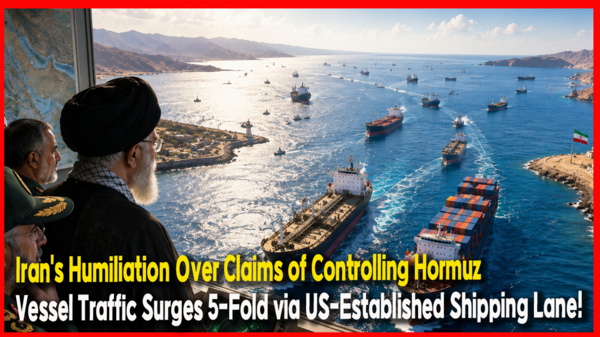
[Claims of a “Hormuz Blockade” Persist, Yet Ship Traffic Surges 5-Fold in Just 2 Weeks]
The United States and Iran have presented diametrically opposed narratives regarding the Strait of Hormuz. While US President Donald Trump has asserted that the strait is already open and that the United States is effectively guaranteeing safe passage, Iran has maintained that control over the strait remains in its hands and that US claims of dominance are false.
However, recently published vessel transit data is shifting the momentum of this debate. Despite Iran claiming that "Hormuz is closed" and the Islamic Revolutionary Guard Corps (IRGC) continuing its attacks on vessels, actual commercial ships have resumed movement, utilizing US-backed shipping channels along the coast of Oman. This indicates that while the IRGC retains the capability to pose a threat in Hormuz, it is losing the power to arbitrarily open or close the waterway at will.
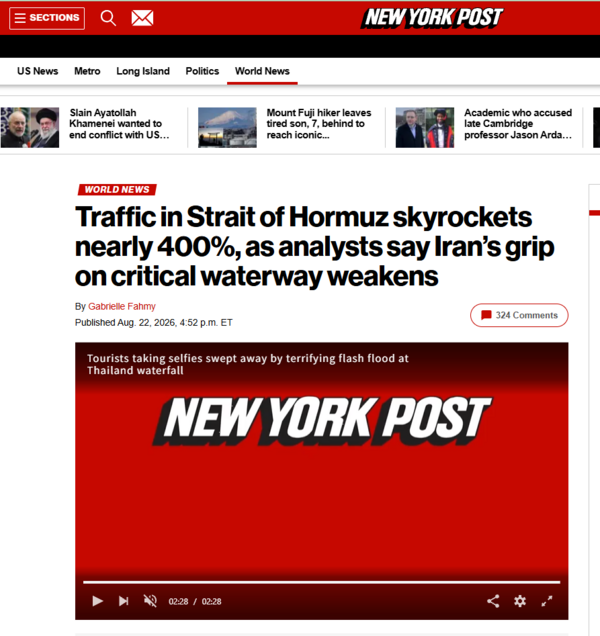
The New York Post reported on August 23, "The most dramatic change in Hormuz recently is the volume of transit." According to data cited from the UK Maritime Trade Operations (UKMTO), vessel transits through Hormuz rose to approximately 200 ships over the past week. This represents nearly a 5-fold—or almost 400%—increase in just two weeks, compared to approximately 150 ships the previous week and roughly 40 ships two weeks prior.
The report noted, "Looking strictly at the past week, 103 vessels entered the Persian Gulf and 89 departed. This represents roughly a 27% increase compared to the previous week's 76 entries and 75 departures, making the shift even more pronounced when compared to two weeks prior (18 entries and 21 departures)."
It further observed, "While it remains premature to call this a full normalization of Hormuz—given that recent traffic stands at roughly 20% of pre-conflict levels—the trajectory is more critical than absolute figures. Despite Iran's claims of control, maritime transit is recovering rapidly."
[The Shocking ‘80%’ Figure… Vessels Move Outside Iran's Control Network]
What merits even greater attention is the exact route these vessels are navigating.
Citing data from maritime intelligence firm Kpler, reports reveal that over 80% of liquid cargo passing through Hormuz in the past two weeks utilized US-backed shipping lanes along the coast of Oman or transited with Automatic Identification Systems (AIS) turned off ("dark transits"). This confirms that a significant portion of commercial shipping is operating independently of Iran's asserted maritime order.
The Joint Maritime Information Center (JMIC) issued an official advisory on August 18, stating that "Hormuz is now open." The advisory specifically noted that "because mine risks persist along conventional Traffic Separation Schemes (TSS), vessels are advised to avoid them. The southern route along Omani territorial waters has been confirmed clear of mines and is the recommended transit lane."
The JMIC went so far as to instruct vessels seeking safe transit details to liaise directly with the Naval Cooperation and Guidance for Shipping (NCAGS) under US Naval Forces Central Command (NAVCENT). Official documentation thus corroborates that the US plays a critical role in managing maritime security.
[Trump’s Assertion “Hormuz is Open”… Shipping Data Begins to Align]
President Trump has repeatedly emphasized that Hormuz is open and functioning normally. Iran counter-argued that it retains control over the waterway and dismissed US assertions. However, developments on the water show that the debate is no longer a simple binary of "open vs. closed." The crux of the issue is who is enabling physical transit.
If commercial vessels are successfully navigating via US-supported safe corridors along Oman while Iran declares the strait closed, there is solid ground to assess that practical operational control over Hormuz is shifting substantially from Tehran to the US-Oman axis.
That said, complete normalization has not been reached. Reuters reported on August 21, citing Kpler tracking data, that only 7 commodity carriers transited on August 20—down from 14 the previous day—with zero Very Large Crude Carriers (VLCCs) or LNG tankers recorded. Rather than framing the situation as a "complete US military occupation," it is more accurate to describe it as an "emerging US-led transit management regime."
[IRGC Retains Attack Capabilities, But Cannot Block the Strait at Will]
A distinction must be drawn regarding the current capabilities of the Islamic Revolutionary Guard Corps. Iran retains the capacity to threaten or strike individual commercial vessels passing through Hormuz, as evidenced by recent maritime attack incidents. It would be premature to assume Iran's naval, missile, drone, or mining capabilities have been neutralized.
However, the ability to attack individual ships is fundamentally different from controlling a crucial global maritime choke point. Reuters noted that if the US and Oman establish safe lanes and commercial shipping utilizes them without Iranian intervention, the IRGC's core strategy faces a critical flaw—its leverage to hold Hormuz as a "strategic hostage" against the global economy becomes severely degraded.
Reuters added that Saudi Aramco resumed crude loading onto large tankers at terminals inside the Gulf in mid-August. While far from full recovery, it demonstrates that global maritime traffic does not grind to a halt solely on Iran's blockade declarations.
[Rhetoric Grows Harsh… “Earthquake-Like Retaliation Against US Allies”]
In contrast to its diminishing control at sea, rhetoric from Iranian hardliners has grown noticeably sharper. Mohsen Rezaei, Secretary of Iran's Expediency Discernment Council, warned on August 22 of "earthquake-like" retaliation against further US pressure. He explicitly cautioned neighboring nations that participating in US economic coercion would invite strikes against their economic interests.
This implies Iran could target alternative oil transport infrastructure beyond Hormuz. However, the gap between aggressive rhetoric and tangible reality on the water continues to widen. While Tehran threatens the US and regional states verbally, it remains unable to halt shipping along US-supported channels.
[The Significance of Pezeshkian’s Call to “End the War”]
Against this backdrop, recent statements by Iranian President Masoud Pezeshkian carry significant weight. Pezeshkian stated on August 21 that the conflict with the United States must end eventually, arguing that "it is better to end it now" while Iran still retains "strength and dignity."
On August 23, he reiterated that pursuing a Memorandum of Understanding (MOU) with the US offers the best exit path from a protracted conflict, acknowledging that Iran is currently trapped in a state of "neither war nor peace."
Pezeshkian's stance cannot be viewed solely through the lens of Hormuz; the primary driver is Iran's deteriorating economy. The Institute for the Study of War (ISW) analyzed that Iranian leadership is split between "pragmatists" (including Pezeshkian and Parliament Speaker Mohammad Bagher Ghalibaf) who favor ending the war due to severe economic strain, and hardliners who oppose concessions.
[The Onset of Trump’s ‘Economic Warfare’]
Compounding Tehran's predicament, incoming pressures are set to escalate. US Treasury Secretary Scott Bessent announced that the United States is preparing the "most stringent sanctions in history" against Iran, with details to be unveiled on August 24. Washington's strategy combines maritime leverage with financial and trade restrictions to simultaneously squeeze Iranian crude exports and foreign exchange access.
Bessent publicly called for cooperation from China—Iran's largest customer, which purchased over 80% of its exported crude prior to the conflict. Should Washington disrupt Beijing's Iranian oil procurement networks, the impact on Tehran will be severe. For Pezeshkian, time is clearly not on Iran's side: its primary strategic lever (Hormuz) is losing efficacy, crude exports have plummeted, and further US economic measures are imminent.
[Why Times Insight — IRGC Can Threaten, But Can No Longer Close Hormuz at Will]
This crisis should not be reduced to a simplistic narrative of "the US won" or "Iran lost." The fundamental takeaway is that the mechanics of power in the Strait of Hormuz are undergoing a structural shift.
Tehran's core strategy was clear: by controlling Hormuz—the arterial choke point for global oil and LNG—it could force Washington, Beijing, Europe, and Gulf oil producers to yield to its demands.
However, the United States avoided playing by Iran's rules. Instead of directly confronting Iranian claims along traditional shipping lanes, the US supported a safe transit corridor through Omani territorial waters, utilizing mine clearance and maritime intelligence to restore traffic flow. The formal recommendation of the southern Omani route by the Joint Maritime Information Center (JMIC) and direct coordination via US NAVCENT reflect this structural change.
The resulting 5-fold surge in shipping over two weeks underscores this reality. Iran asserts dominance over the strait, yet commercial vessels continue to move—predominantly along US-backed Omani routes. The most accurate characterization is not "a complete US military conquest of Hormuz," but rather the "establishment of a US-led, practical transit management system."
For Iran, this is a severe setback. It has lost not physical territory, but the viability of Hormuz as a strategic bargaining chip.
This context explains Pezeshkian's push for an MOU. Faced with a degrading leverage in Hormuz, collapsing crude exports, foreign currency shortages, and incoming US sanctions, his rationale that "it is better to end the conflict now" becomes clear.
Conversely, IRGC hardliners continue to resist concessions. Reports from ISW and CTP confirm a deepening rift between pragmatists and hardliners over the economic costs of prolonged conflict.
Ultimately, actual ship movements—not political rhetoric—define the reality in Hormuz. The IRGC retains the capability to strike vessels and create local hazards. However, its ability to deny access to non-compliant vessels and open or shut the strait to the global economy at will has effectively eroded.
The very card Iran drew to pressure Washington has instead highlighted its own strategic limits. While the IRGC claims control, commercial fleets navigate under US-supported pathways—marking the true shift of power currently unfolding in the Strait of Hormuz.
- TAG