


추부길 whytimespen1@gmail.com
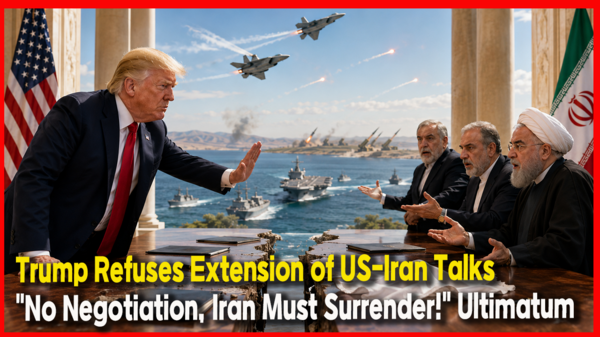
[Trump Directly Blocks Possibility of Extending Talks as 60-Day Diplomatic Deadline Expires]
U.S. President Donald Trump has firmly rejected any further extension of the 60-day negotiating deadline with Iran, demanding that Tehran "wave the white flag of surrender". Having given Iran two months to accept a final agreement, Trump issued an ultimatum, signaling he will no longer allow Tehran to buy time after failing to back down on its nuclear program and control over the Strait of Hormuz. Trump’s statements are not merely tactical posture; they reflect a shift in U.S. policy toward Iran from "inducing an agreement" to "forcing a capitulation". The concern is that with Iran also threatening to shift to an offensive posture, the expiration of the negotiation window could directly trigger a resumption of hostilities.
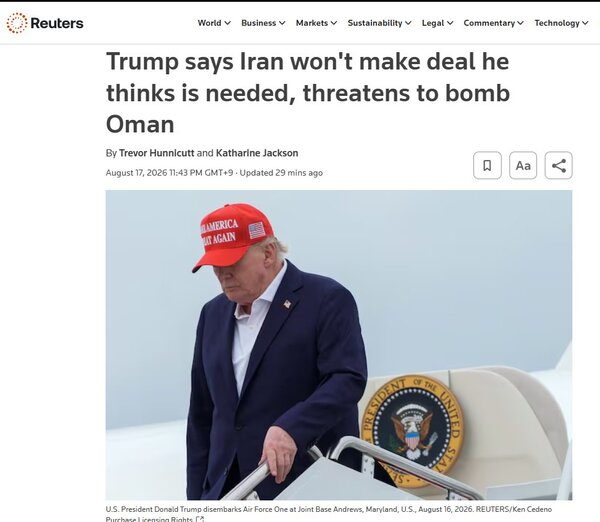
Reuters reported on August 18 that "the Memorandum of Understanding signed by the U.S. and Iran in June provided a 60-day diplomatic timeline to achieve a permanent deal. However, both sides spent this period accusing each other of violating commitments, failing to reach a breakthrough on Straits of Hormuz transit protocols, sanctions relief, and the handling of Iran's nuclear program. As the deadline approached, Pakistani officials claimed both sides agreed to an extension, but a senior Iranian official countered that 'no extension talks ever took place.' Ultimately, President Trump explicitly ruled out an extension, effectively eliminating the prospect for further talks."
In an interview with Fox News, President Trump demanded that Iran "put up the white flag of surrender". Simultaneously, he noted, "I don't set a clock, and I'm not in a hurry." While seemingly contradictory, his core message is clear: the United States will not rush into a compromise and will maintain maximum pressure until an economically and militarily isolated Iran surrenders first. His remark that "they are great poker players, but they are dying" underscores Trump’s view that Tehran is bluffing with a hand far weaker than it projects.
[Why Did Trump Refuse the Final Extension?]
Why did President Trump refuse to extend the truce? Fox News noted that "the primary reason is Washington's assessment that Iran is using negotiations not as a vehicle for compromise, but as a tactic to buy time." Indeed, President Trump stated, "They want to make a deal, but they are not going to make the kind of deal that I feel is necessary."
Fox News added that "while the U.S. demands an agreement that structurally blocks Iran's potential to acquire nuclear weapons, Iran insists on immediate sanctions relief and the removal of the U.S. military blockade. Tehran's stance—keeping the negotiation table open while refusing to abandon its nuclear/missile capabilities or control over Hormuz—exhausted Trump's patience."
Furthermore, Fox News highlighted that "the second reason is that Iran effectively holds the Strait of Hormuz hostage as a bargaining chip. Although Iran and Oman agreed in principle on new navigational route maps for vessels, they failed to settle specific transit conditions and operational authority. Iran insists the U.S. lift its blockade and sanctions first, whereas the U.S. refuses to accept an outcome where Iran retains control over the strait." Ultimately, in Trump's view, Omani mediation risked turning into a process that granted Iran new administrative control rather than restoring rapid normalization.
"Third, the Iranian military continued provocations that ran counter to the diplomatic climate," Fox News noted, pointing out that "Amir Hatami, Chief of Staff of the Iranian Armed Forces, announced a bounty program offering $30,000 for anyone who kills or captures U.S. troops, doubling the amount if executed by a woman." While diplomatic channels were exchanging messages via mediators, the military posted bounties targeting Americans, prompting the Trump administration to question whether a unified, credible authority capable of executing a final decision even exists in Tehran.
[Trump Confident in "Iran’s Capitulation"... Economic Blockade Forms the Basis]
Reuters reported that "underpinning Trump's lack of fear regarding a collapse in talks is the assessment that the economic blockade has already pushed Iran to its limits. The U.S. has effectively blocked Iranian oil exports and is preparing additional sanctions."
Reuters added that "meanwhile, maritime traffic through the Strait of Hormuz has plummeted, and Brent crude has surpassed $90 per barrel. Trump believes that while the U.S. and major oil producers can manage the shortfall of Iranian crude, Iran—with its export routes choked—cannot endure long-term."
If these calculations hold, Iran will face a compound crisis over time: foreign currency shortages, skyrocketing inflation, difficulty funding its military, and mounting public discontent. In particular, a prolonged closure of Hormuz may drive up global oil prices, but it simultaneously cuts off Iran's own crude exports and maritime trade with its allies. The very leverage Tehran used to pressure the global community could turn into a chokehold that asphyxiates its own economy.
[However, Iran Will Not Back Down... Risk of Severe Conflict]
The problem is that Trump’s strategy of "forcing surrender" may strengthen the Islamic Revolutionary Guard Corps (IRGC) and hardliners rather than empowering moderates in Tehran. A senior Iranian official warned, "If the U.S. fails to implement the agreement within a few weeks, we will launch timely and precise military action to break the naval blockade." Tehran claims it can transition from a defensive posture to an offensive one. If the U.S. demands capitulation and Iran declares an offensive shift, both sides enter a structural trap where neither can retreat due to domestic political pressure.
Iran has three remaining options: First, a virtual surrender by accepting U.S. demands to abandon its nuclear program and open the strait. Second, a delay tactic of enduring sanctions and the blockade while offering new terms via mediators. Third, re-escalating into full-scale war by attacking U.S. forces or shipping in Hormuz. The first option threatens regime legitimacy; the second has already been rejected by Trump; and the third endangers the survival of the regime itself. None of these paths offer Iran a safe exit.
[Threatening Even Oman... Mediation Diplomacy Is No Longer Sacred]
Trump’s use of extreme rhetoric—suggesting he would "bomb Oman if it interferes"—signals that the U.S. will no longer unconditionally respect the neutrality of mediating nations. However, since Oman is a long-standing security partner rather than an adversary, this is more reasonably interpreted as aggressive leverage to stop Muscat from pushing a Hormuz management plan favorable to Iran, rather than a literal notice of military action. Describing this as a definitive decision to bomb Oman would be an exaggeration. The key takeaway is that Trump is now willing to impose costs not only on Iran but also on mediators he perceives as contributing to delay.
[Pressure on South Korea Follows Same Pattern: "No Support for US Means No Alliance Benefits"]
Trump’s frustration has also extended to South Korea. Stating that "South Korea rejected U.S. requests for assistance regarding the Iran issue," he instructed a scale-back of joint U.S.-ROK military exercises. Commenting on this, the Associated Press noted, "While Trump touted his 'very good relationship' with Kim Jong Un, the key takeaway is that he publicly tied South Korea's non-cooperation on Iran to the reduction of military drills." This demonstrates that Trump does not compartmentalize alliance issues; instead, he bundles cooperation with U.S. demands and defense commitments into a single transaction.
The core issue here is not South Korea's specific decision, but rather that Trump has begun linking support for his Iran campaign directly to the perceived value of the U.S.-ROK alliance.
[Why Times Insight]
Trump’s refusal to extend the truce is less a declaration of an immediate return to war than a declaration that the U.S. will offer no further concessions. Believing the Iranian economy will collapse first, he sees no reason to negotiate unless it results in a U.S.-dictated deal that includes nuclear dismantlement and the full opening of the Strait of Hormuz. Iran hoped to buy time and exchange sanctions relief for transit management, but Trump cut off that timeline, narrowing Tehran's choices to "surrender or catastrophe".
However, negotiations that leave an opponent with no path of retreat may hasten victory, or they may ignite an explosive war. If surrendering threatens the survival of the Iranian regime due to pushback from internal hardliners and the IRGC, Tehran may choose a dangerous military gamble over a rational compromise. Whether Trump’s pressure brings Iran to the negotiating table or plunges the Strait of Hormuz and the broader Middle East back into conflict will become clear in the coming weeks.
- TAG