


추부길 whytimespen1@gmail.com
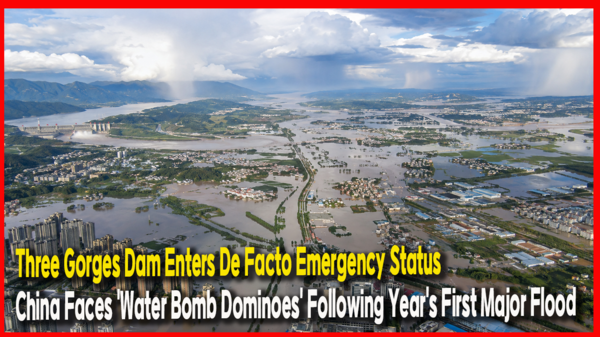
[24-Hour Emergency Response Triggered as Inflow Soars to 38,000㎥]
The Three Gorges Dam, the ultimate stronghold of China’s flood control system, has effectively entered an emergency response posture. As water rushing from the upper reaches of the Yangtze River pushed inflow to 38,000 cubic meters per second (㎥/s)—triggering the year's first 30,000 ㎥/s-level flood—dam operators effectively declared a state of emergency by initiating 24-hour flood control shifts and daily revisions of discharge plans.
Compounding the crisis, Typhoon White Dolphin (Baidolgoerae), after inundating Zhejiang and Jiangsu, has pushed deep inland toward Hubei, Henan, and Beijing. China is now caught in a multi-front flood battle, forced to simultaneously defend the upper Yangtze River, the East China economic belt, and the central inland regions.

Late on the night of August 10, Xinhua News Agency reported that "the Three Gorges Dam, China's last line of defense in the Yangtze River flood control system, has entered a de facto emergency status," adding that "dispatchers have shifted to 24-hour shifts as inflow surged to 38,000 ㎥/s."
Xinhua further noted that "the combination of 24-hour dispatch operations, expanded forecasting meetings, and daily rewrites of flood information and discharge plans represents a de facto emergency response that goes far beyond routine operations. Furthermore, while the Three Gorges Dam confronts its first major flood of the year, Typhoon White Dolphin struck East China and moved toward the central and northern regions, plunging China into a complex flood scenario where it must concurrently defend the upper Yangtze, Lake Taihu, and the Huai, Yellow, and Hai River systems."
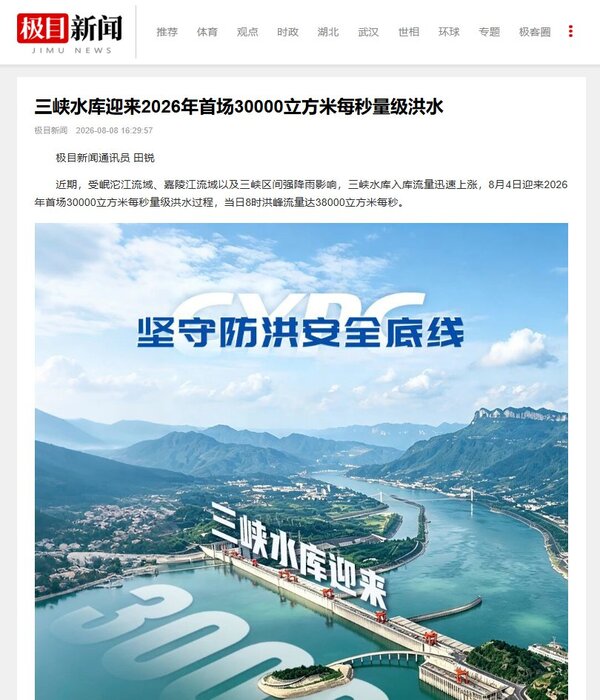
Hubei’s prominent local outlet, Jimu News, reported that "on August 4, the Three Gorges Dam faced its first major flood exceeding 30,000 ㎥/s in 2026," noting that "at 8:00 AM that day, the peak inflow reached 38,000 ㎥/s."
Jimu News pointed out that "while 38,000 ㎥/s does not approach the structural threshold of the dam, as the first 30,000 ㎥/s-scale flood of the year, it presented a critical situation requiring operators to sharply escalate their response level. Under directives from the Yangtze River Water Resources Commission, China Yangtze Power—the dam's operator—has incrementally raised the average daily discharge from 14,000 ㎥/s to 19,000 ㎥/s since July 28."
"Through these proactive discharges, operators secured approximately 1.386 billion cubic meters (㎥) of flood storage capacity in advance," Jimu News explained. "This was a preemptive measure to empty reservoir space before the flood arrived, anticipating large-scale inflows from the upper Yangtze."
"What is even more notable," Jimu News highlighted, "is that dispatch personnel initiated 24-hour shifts once the flood arrived. Operators held three intensive forecasting sessions within a week alongside the Yangtze River Basin Meteorological Center and the Yangtze River Hydrological Bureau to continuously reassess incoming flood conditions."
Jimu News added, "Furthermore, flood data and reservoir regulation plans are being rewritten and submitted daily to account for changing rainfall and upstream inflows. Taken together, while the formal title of 'State of Emergency' has not been officially declared, the dam's actual operations have effectively transitioned to an emergency response mode."
[The Flood Control Dilemma: Catching Water Is Risky, Releasing It Is a Burden]
The core challenge facing the Three Gorges Dam is not unverified rumors of "dam collapse," but rather the delicate flood control balance required between water storage and discharge. Xinhua pointed out that "retaining too much upstream water raises the reservoir level, reducing the remaining capacity to absorb subsequent floods. Conversely, rapidly increasing discharge to lower water levels places an immense burden on dikes and downstream cities such as Yichang, Jingzhou, and Wuhan."
Jimu News similarly noted that "the decision by operators to increase discharge by approximately 5,000 ㎥/s before the flood hit was strictly aimed at securing space to absorb the coming deluge. Ultimately, the Three Gorges Dam is in a highly complex situation where discharge volumes must be recalculated daily, factoring in upstream inflows, downstream water levels, and incoming rainfall forecasts."
[Amid Three Gorges Emergency, 74 Rivers in East China Reach Danger Levels]
While the Three Gorges Dam absorbs the floods of the upper Yangtze, Typhoon White Dolphin opened a second flood front in East China. Reuters reported that "White Dolphin made landfall near Yuhuan in Zhejiang Province on August 9 with maximum wind speeds of 151 km/h," adding that "ahead of landfall, over 1 million people were evacuated from high-risk areas across Zhejiang, Shanghai, Fujian, and Jiangsu."
According to Xinhua, "China's Ministry of Water Resources assessed that because White Dolphin made landfall with high intensity and carried vast amounts of water vapor, its operational scope, duration, and disaster risks are exceptionally high." The ministry reported that "74 rivers in the Lake Taihu basin and eastern coastal Zhejiang exceeded warning water levels, with 37 exceeding safety threshold levels that govern the stability of key dikes and infrastructure."
Xinhua further highlighted that "five rivers recorded their largest floods on record, while the Yongjiang and Zaojiang rivers experienced officially designated 'Numbered Floods.' This indicates that East China's river, dike, and reservoir defense networks are under simultaneous pressure, far exceeding simple urban street flooding."
[35 Reservoirs in Hubei Hit Danger Levels… Flood Front Pushes North to Beijing]
A greater concern is that Typhoon White Dolphin did not dissipate in East China, but instead maintained a massive vapor corridor as it moved into the Chinese interior. Reuters reported that "in Xiangyang, Hubei Province, water levels at 35 reservoirs exceeded flood control thresholds, forcing the evacuation of over 9,700 people. In parts of Henan Province, red alerts—the highest level for rainstorms—were issued with forecasts of up to 350 mm of heavy rainfall."
Reuters added that "Beijing is also preparing for the potential arrival of rainfall equivalent to one-third of its average annual precipitation within a 24-hour window, as tropical moisture supplied by the typhoon collides with cold northern air masses."
Xinhua anticipated that "the residual circulation of White Dolphin moving northward will unleash widespread torrential rain across Zhejiang, Shanghai, Jiangsu, Anhui, Hubei, Henan, and Hebei." China’s Ministry of Water Resources has included major river systems—including the Yangtze, Huai, Yellow, Hai, and Liao rivers—in the typhoon's follow-up impact zone. As a result, China has entered an unprecedented multi-basin defense effort to simultaneously manage flood control at the Three Gorges Dam, over-threshold water levels in the Lake Taihu basin, overflow risks at central reservoirs, and heavy rainstorms in North China.
[Why Times Insight]
The most striking aspect of this situation is that key facilities in China’s Yangtze River flood control system, including the Three Gorges Dam, have shifted to 24-hour dispatch operations and daily revisions of discharge plans. While Chinese authorities have avoided using the official moniker of an "emergency declaration," operational measures executed on the ground confirm that the Three Gorges Dam has entered a de facto emergency management stage.
The fact that 74 rivers in East China and 35 reservoirs in Hubei breached danger levels at the precise moment the Three Gorges Dam confronted its first 30,000 ㎥/s-level flood of the year demonstrates that China’s flood crisis has escalated beyond a localized disaster.
Moving forward, the critical variables will be how long high inflows from the upper Yangtze persist, whether operators can maintain sufficient flood storage capacity while mitigating downstream damage, and how well the Three Gorges Dam endures these compound pressures. That the Three Gorges Dam—the ultimate symbol of China's water management capabilities—has entered a de facto emergency state serves as a stark warning signal that China's 'water bomb dominoes' have reached its primary line of defense.

- TAG