


추부길 whytimespen1@gmail.com
[Collision Between 10,000 Robots and 20% Youth Unemployment… Technological Hegemony Shakes Regime Stability]
China’s high-speed push for AI and robotics to catch up to the United States has begun to strike the most vulnerable parts of Chinese society. As youth unemployment again threatens to breach the 20% mark and hundreds of millions rely on fragile platform and flexible employment markets, Beijing is pursuing a goal to deploy over 10,000 humanoid robots into industrial sites by the end of 2026. Slowing down AI adoption risks falling behind in the tech hegemony race with the US, while pushing forward means risking job destruction and the loss of public support. The very AI chosen by the Chinese Communist Party (CCP) as a breakthrough for growth is turning into a dangerous political detonator testing regime stability.
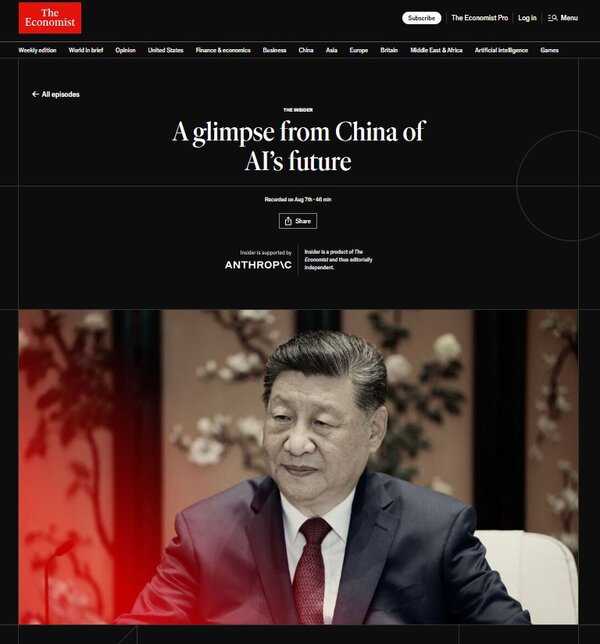
On the 9th, the British economic weekly The Economist analyzed, “To avoid lagging behind the US in the AI race, China is rapidly accelerating automation. However, as the likelihood grows that its fragile labor market cannot absorb the shock, Beijing has fallen into a severe policy dilemma.”
The Economist continued, “Despite US advanced semiconductor export controls, China has expanded its AI application scope through increased domestic AI chip production, open-weight models, and massive power and data center infrastructure. Although limitations remain in cutting-edge extreme ultraviolet (EUV) lithography equipment and high-performance semiconductors, China is seeking technological workarounds through overseas data center leasing and building a domestic ecosystem centered around Huawei.”
The Economist pointed out, “The problem is not the advancement of AI technology itself, but the pace of its rollout in industrial fields. Beijing is driving a goal to deploy over 10,000 humanoid robots across more than 100 industrial sites by the end of 2026, driven by local governments and state-owned enterprises (SOEs). As target sectors expand beyond manufacturing and logistics to video production and various service industries, AI is moving past assisting human labor and increasingly threatening to directly replace existing jobs.”
According to The Economist, China’s original calculation was clear: since the working-age population is projected to shrink by about 25% by 2050, AI and robotics were intended to supplement the labor shortage. In actual industrial fields, however, the pace of automation is moving far faster than demographic decline. A technology introduced to prepare for future labor shortages has created a paradox—pushing today's youth and low-skilled workers out of the labor market first.
Bloomberg also noted last February that “President Xi Jinping’s AI ambitions are colliding with a fragile employment market.” It highlighted, “Just days after robots demonstrated martial arts on stage for a Lunar New Year performance, a small research firm rattled US markets by warning that labor displacement from automation could trigger a broader economic death spiral. A similar risk is lurking in China, home to the world’s largest workforce.”
[Automation Shock Explodes in Front of 20% Youth Unemployment]
According to The Economist, China’s job market was already in a precarious state before the AI shock hit in earnest. Youth unemployment (ages 16–24, excluding students) once surged to 18.9% even in official statistics. As a record number of college graduates enter the labor market, some project that the youth unemployment rate could again threaten the 20% threshold.
The RAND Corporation pointed to structural labor market mismatches as the backdrop of China’s youth employment crisis. While the number of university graduates has skyrocketed, sectors that previously absorbed them—such as real estate, finance, and tech—have contracted due to economic downturns and regulatory shocks. On top of this, as AI begins replacing entry-level tasks such as data compilation, translation, customer service, design, and content creation, fresh graduates and low-skilled workers are most likely to bear the brunt of the initial shock.
Bloomberg similarly diagnosed that “Xi’s AI ambition is on a direct collision course with a vulnerable job market.” It noted, “While China’s overall urban unemployment rate remains relatively stable, risks are distinctly concentrated among youth and new job seekers.” HSBC analysts evaluated that “China’s pace of AI adoption is among the highest in Asia and faster than the US in certain sectors.”
An estimated 300 million participants in the platform and flexible employment sectors are not safe either. Working in food delivery, transport, online services, and simple office jobs, these individuals have low levels of social security protection and are highly vulnerable to the early shocks of unmanned automation and AI expansion. Without a sufficient safety net, even a partial loss of jobs among this group could trigger a chain reaction of contracting consumption, household insecurity, and spreading social discontent.
[Beijing Begins to Fear ‘AI Unemployment’: The Communist Party Trapped in a Dilemma]
Chinese leadership is not unaware of these risks. Lawfare, an American legal and national security outlet, analyzed that “Chinese policymakers have begun treating ‘employment stability’ as a core constraint on AI expansion to prepare for AI-driven labor market shocks.”
Liu Qingfeng, a deputy to the National People’s Congress and founder of iFlytek, proposed the need for dedicated funds and the introduction of ‘AI unemployment insurance’ to protect jobs at high risk of displacement. The State Council of China also emphasized in its ‘AI+ Action’ guidelines that authorities must “assess employment risks arising from AI applications and direct innovation resources into sectors with high job-creation potential.”
Cai Fang, president of the China Society of Labor Economics, advocated for ‘human-machine collaboration,’ asserting that “the level of automation must be adjusted within bounds that do not compromise employment stability.” Others suggest that “SOEs must act as a social buffer to absorb surplus labor and mitigate AI-driven employment shocks.”
Some economists have offered even more specific redistribution plans. Li Jia, Dean at Singapore Management University, and Zhang Dandan, Associate Dean at Peking University, proposed an ‘AI Employment Compensation Fund’ financed by fiscal support, unemployment insurance surpluses, corporate contributions, and levies on data and computing profits. The mere fact that discussions have emerged within China to redistribute a portion of AI-generated profits to displaced workers highlights Beijing’s growing sense of crisis.
[Neither Able to Slow Down AI Nor Push Straight Ahead]
However, President Xi Jinping has historically maintained a negative stance toward Western-style large-scale welfare expansion, arguing that excessive welfare strains national finances and weakens the public’s work ethic. For this reason, Beijing appears to weigh re-training, job reassignment, and labor absorption via SOEs more heavily than direct cash transfers like universal basic income.
Yet this approach has clear limitations. Pressuring enterprises to retain employees increases cost burdens and weakens incentives for AI investment. Conversely, allowing corporate automation unchecked may boost productivity, but it accelerates job losses among youth and low-skilled workers. Slowing down AI means falling behind in the technology race with the US, while accelerating it threatens domestic employment and regime stability—a true dilemma.
Furthermore, relying on SOEs to absorb surplus labor may help suppress official unemployment figures, but it risks degrading corporate efficiency and worsening fiscal health. It remains doubtful whether the Chinese economy—already struggling under a real estate slump, local government debt, and sluggish domestic demand—can sustain large-scale inefficient employment. Ultimately, the CCP finds itself trapped in a position where it cannot choose between technological supremacy and social stability.
[Why Times Insight]
China’s AI dilemma is not merely an industrial policy issue; it directly links to the CCP’s governance legitimacy. Since the Reform and Opening-up era, the CCP has maintained its one-party rule in exchange for providing economic growth and job stability to its citizens. However, AI is a technology that, while defending growth by boosting productivity, simultaneously cannibalizes youth and low-skilled jobs first—striking both pillars of Communist Party rule at once.
Beijing is preparing for the shock by reviewing AI unemployment insurance, employment compensation funds, job risk assessments, human-machine collaboration, and labor absorption through SOEs. Yet, driven by the urgency not to fall behind in the strategic competition with the US, the pace of technology rollout is outstripping the buildout of a social safety net. As the gap between sophisticated policy design and hasty field deployment widens, social costs will inevitably balloon.
If the rollout of AI and humanoid robots accelerates while youth unemployment threatens the 20% mark, the job crisis could emerge as the most sensitive social detonator of the Xi Jinping era. If the 2022 White Paper Protests originated from anger over excessive pandemic controls, future discontent may well stem from the frustration of a young generation that feels its future was stolen by the state’s technological speed war.
The ultimate success or failure of China’s AI rise will no longer be determined solely by model performance or chip computing speeds. The real test is how stably Beijing can manage the employment shocks created by AI. The AI card, drawn to catch up with the United States, is turning into a boomerang that threatens the regime stability of the Chinese Communist Party itself.

- TAG