


추부길 whytimespen1@gmail.com
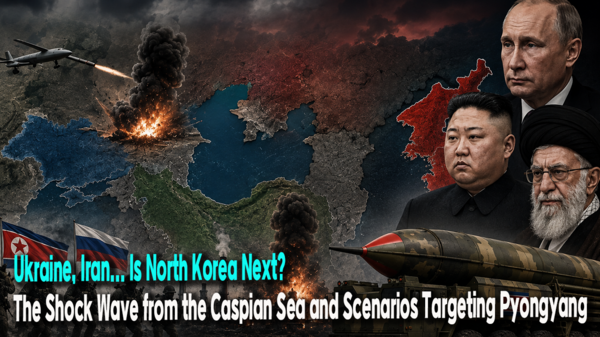
[Drone Strike in the Caspian Sea: "Russia's Allies Are No Longer in the Safe Zone"]
The boundaries of the war in Ukraine are eroding rapidly. Just five days after a Ukrainian drone strike sank an Iranian cargo ship in the Caspian Sea, North Korean ballistic missiles struck civilian areas in Ukraine, reinforcing the perception of Russia, Iran, and North Korea operating as a single wartime axis. Amid these developments, a former British diplomat raised a bold scenario: Could Ukraine directly target North Korea next? While currently a hypothesis, it serves as a symbolic warning that the conflict may no longer remain confined within Ukraine's borders.
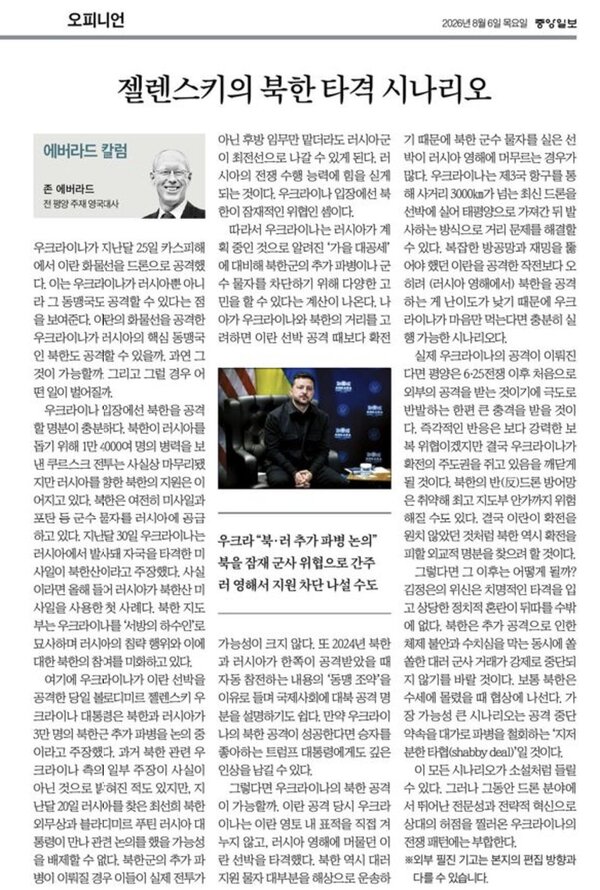
In an op-ed published on August 5, John Everard, former British Ambassador to Pyongyang, highlighted: "Ukraine attacked an Iranian cargo vessel in the Caspian Sea with a drone on July 25". He added, "This demonstrates that Ukraine can strike not only Russia, but also its allies. Having attacked an Iranian ship, could Ukraine also strike Russia’s key ally, North Korea? Is that feasible, and if so, what would happen?"
This startling analysis ties directly into the overlapping conflict in the Caspian Sea. According to CNBC, on July 25 (local time), Ukrainian forces struck the Iranian-flagged cargo ship Ana near Astrakhan, Russia, using long-range drones. The attack resulted in one death and three injuries among the crew, marking the first time a Ukrainian operation caused Iranian casualties. The Security Service of Ukraine (SBU) announced that alongside the Iranian cargo ship, the Russian missile corvette Molniya and the sanctioned cargo vessel Begey were also hit. Ukrainian President Volodymyr Zelensky praised the operation, stating they achieved "very strong results in the Caspian Sea."
Ukraine asserted that these vessels were actively transporting military supplies between Russia and Iran. Iran strongly protested, calling it an attack on a civilian commercial vessel. Iranian Foreign Minister Abbas Araghchi declared the incident "cannot go unaddressed" and announced plans to consult with Russia and European nations on a response.
However, the significance of the strike goes beyond the destruction of a single vessel. Previously, Ukraine’s deep-strike strategy focused on military targets inside mainland Russia. The Caspian Sea operation represents the first instance where Ukraine expanded the operational theater to hit key Russian allies, sending a clear global message: countries supporting Russia's war effort are no longer in a safe zone.
[Why Target North Korea? "Pyongyang Might Be Easier Than Tehran"]
This brings former Ambassador John Everard's central question into focus. Writing in his column on August 5, he asked: "If Ukraine can attack an Iranian cargo ship, can it also strike North Korea, Russia's key ally?" Surprisingly, he noted that striking North Korean targets could be technologically simpler than operations against Iran.
The rationale lies in Ukraine's rapidly expanding long-range drone capabilities. President Zelensky disclosed in June that Ukraine deployed new long-range drones with an operational range of 3,000 km, while the Main Directorate of Intelligence (GUR) noted that select models can reach up to 3,500 km.
Everard emphasized that a vast amount of North Korean military hardware shipped to Russia travels via maritime routes to Russian ports. Applying the tactic used in the Caspian Sea—launching close-range drone attacks on vessels after staging from third-country ports—could theoretically be replicated against North Korea-linked shipping.
He specifically analyzed: "While Iran possesses multi-layered air defense networks and sophisticated electronic warfare systems, North Korea-linked vessels are likely far more vulnerable. From a purely technical standpoint, the difficulty level could actually be lower."
Naturally, this scenario remains the projection of a former diplomat. To date, there is no official or unofficial evidence that the Ukrainian government is actively preparing direct strikes on North Korean assets.
[How North Korea Became a Key Axis of the Conflict]
The emergence of such scenarios stems from the rapid acceleration of military cooperation between Pyongyang and Moscow. On July 25, President Zelensky revealed that "Russia is preparing to receive an additional 30,000 North Korean troops." He stressed that "Russia is providing North Korean soldiers with modern warfare experience while helping them improve weapon performance. This is no longer just Ukraine's problem."
Japan's NHK, citing Russian diplomatic sources, reported that while the actual numbers discussed are closer to 20,000, discussions regarding additional troop deployments are indeed ongoing. Shortly after, on July 30, North Korean KN-23 ballistic missiles reappeared on the Ukrainian battlefield for the first time in nearly a year.
Reuters reported that North Korean missiles were likely utilized in a Russian overnight airstrike that tragically killed a family of six, including three children, in a village within the Dnipropetrovsk region. Vladyslav Vlasiuk, Ukraine’s sanction policy commissioner, subsequently confirmed that wreckage from a second KN-23 missile had been identified. Providing both personnel and ballistic missiles, North Korea is increasingly seen as a direct participant in Russia's war effort.
[Russia, North Korea, and Iran: Two Wars Merging into One]
Recent high-level talks in Moscow between President Vladimir Putin and North Korean Foreign Minister Choe Son-hui further illustrate this alignment. Putin publicly expressed gratitude for Pyongyang’s sustained support during the war, while Choe conveyed Kim Jong-un’s commitment to expanding strategic cooperation between the two nations.
NPR analyzed that this meeting—coinciding with North Korean Premier Pak Thae-song’s visit to China and Chinese Politburo Standing Committee member Wang Huning’s visit to Pyongyang—reflects a broader trilateral consolidation among Moscow, Pyongyang, and Beijing.
From Kyiv's perspective, Russia, Iran, and North Korea are no longer isolated actors, but an interconnected military coalition operating along a unified front.
[Why Times Insight]
The core takeaway of this debate is not whether Ukraine will launch an immediate strike against Pyongyang. The critical shift occurred the moment an Iranian vessel was struck in the Caspian Sea: the international community began openly discussing the reality that the spatial boundaries of this war can expand far beyond Russian territory to encompass its strategic allies.
The Caspian Sea ship strike, discussions of additional North Korean troop deployments, and the battlefield return of KN-23 ballistic missiles are not isolated events. They are linked indicators that Moscow, Tehran, and Pyongyang are operating as a singular military axis.
To be sure, direct strikes on North Korea remain a theoretical scenario proposed by security analysts rather than an official plan by the Ukrainian government. Furthermore, because North Korea is a nuclear-armed state, the political and military risks far exceed those involved with Iran.
Yet one reality stands firm: Ukraine has established a precedent of striking a key ally of Russia. This serves as a stark warning that states backing Moscow can no longer consider themselves safe zones. The real question moving forward is not simply "Will Ukraine hit North Korea?" but rather "How quickly will Russia's allies be drawn directly into the target zone of this war?"

- TAG