


추부길 whytimespen1@gmail.com
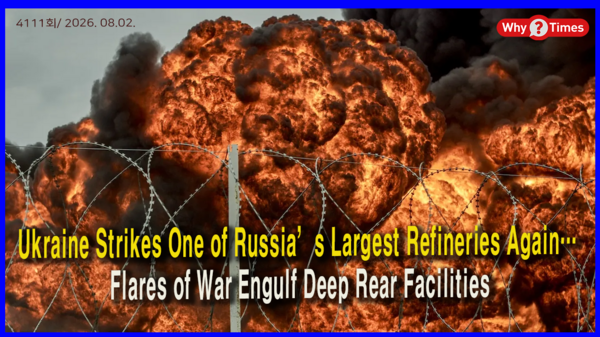
[From Oil Refineries to E-Commerce Logistics: Ukraine Expands Deep Rear Operations]
Ukraine's long-range drones have targeted two vital arteries sustaining Russia's war economy simultaneously. Following a massive fire at the Volgograd Oil Refinery—one of the largest in southern Russia—drone warnings and explosions shook Tatarstan, where major logistics hubs for Wildberries and Ozon are concentrated. The targets lie up to $1,300text{ km}$ inside Russian territory from the Ukrainian border. The once "safe rear" beyond the frontline is rapidly vanishing.
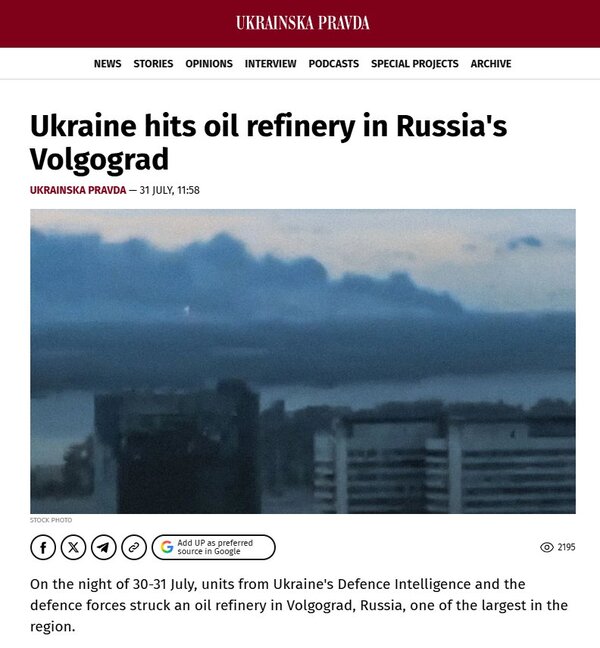
Ukrainian news outlet Ukrainska Pravda reported that the Main Directorate of Intelligence (GUR) of the Ministry of Defence of Ukraine and the General Staff confirmed an overnight strike on Lukoil's "Lukoil-Volgogradneftepererabotka" refinery in Volgograd Oblast. Multiple large-scale fires broke out across the facility.
Processing approximately $14.8text{ to }15text{ million metric tons}$ of crude oil annually, this refinery is the largest in Russia’s Southern Federal District. It serves as a critical supply hub producing gasoline, diesel, and aviation fuel for both southern Russia and military units. Ukraine’s intelligence agency noted that "refinery infrastructure deep inside Russia was struck once again," emphasizing that the attack was part of a systematic campaign to degrade Russia's fuel production capacity rather than an isolated incident.
[Simultaneous Strikes on Volgograd Refinery and Logistics Hubs]
NASA’s FIRMS thermal monitoring system detected multiple fire hotspots across the refinery grounds. Local footage captured massive flames and plumes of black smoke billowing into the sky. While the precise scale of damage and operational downtime remain unconfirmed, repeated strikes continue to place severe operational burdens on Russia's refining sector.
In Volgograd, a logistics center operated by Russia’s largest e-commerce platform, Wildberries, was also hit. Media reports indicated that a residential building was damaged during the drone attack, leaving one woman dead and several injured. However, officials clarified that the fatality was a civilian located in the rubble of the damaged home rather than a warehouse employee, and Wildberries reported no casualties among its staff.
Ukrainian President Volodymyr Zelensky stated that logistics hubs in Sarapul, Kazan, and Volgograd, alongside maritime terminals in Krasnodar Krai, were targeted simultaneously. He emphasized that these targets were situated between $500text{ and }1,300text{ km}$ from the Ukrainian border.
This signals that Ukraine has progressed beyond targeting ammunition depots or military bases near the frontlines. By striking oil refineries, sea terminals, and commercial supply nodes concurrently, Kyiv aims to impose multi-layered strains on military fuel supplies, troop equipment routing, and civilian commercial networks.
[Drone Threat Spreads to Tatarstan Logistics Parks]
On the same day, Ozon—Russia’s second-largest e-commerce retailer—announced that a drone alarm forced the evacuation of staff at its Zelenodolsk warehouse in the Republic of Tatarstan. Video footage verified by news agencies showed white smoke rising near the facility.
However, there is no direct evidence confirming that the Ozon warehouse itself was hit. The company stated that the evacuation ended within minutes and normal operations resumed without facility damage. Because warehouses for both Ozon and its rival Wildberries sit adjacent to each other within the same industrial park, the precise intended target remains unclear.
Robert "Madyar" Brovdi, commander of Ukraine's Unmanned Systems Forces, posted an enigmatic message on Telegram hinting that "Ozon levels have exceeded critical thresholds." While widely interpreted as an indirect acknowledgment of the operation, it did not confirm precise impact locations. Reports also indicated that a Wildberries logistics hub in Nizhnekamsk, Tatarstan, was targeted, though verified damage reports have not been released.
Regardless, the strikes demonstrate that Russian e-commerce supply chains have emerged as a primary focus of Ukrainian long-range strikes. Over the past two weeks, Ukraine has reportedly targeted or disrupted operations at roughly 10 Wildberries-related facilities. This follows a major fire at a massive distribution center in Elektrostal, Moscow Oblast, in mid-July.
Kyiv maintains that these warehouses are utilized not only for consumer goods but also to store and ship dual-use hardware, including drone components and electronics. While the Kremlin denies this, separating nationwide corporate logistics infrastructure from wartime military supply chains remains difficult during total conflict.
[Severing Two Vital Arteries: Refineries and Supply Chains]
The strike on the Volgograd refinery marks one of several attacks on the facility this year. It underscores Kyiv's shift toward treating industrial strikes as a continuous strategy rather than sporadic retaliation. In late July, the Ryazan refinery—which accounts for nearly 5% of Russia’s total refining capacity—was also hit and forced to partially suspend operations.
Even if an air strike does not completely destroy a refinery, damaging critical distillation or cracking units requires lengthy repairs. Striking these facilities repeatedly as repairs near completion prevents refining capacity from recovering, forcing Moscow to disperse its limited air defense systems to protect industrial assets deep in the interior.
Accumulated damage has pushed Russia's crude processing volumes down to multi-year lows, resulting in localized gasoline and diesel shortages. Government restrictions on petroleum exports and directives prioritizing domestic supply reflect the combined pressure of reduced refining capability and seasonal demand spikes.
Targeting large-scale fulfillment hubs amplifies these costs. The destruction of a single warehouse causes cascading overheads—inventory redistribution, rerouted shipping lanes, higher insurance premiums, increased freight rates, and added facility security. Kyiv's strategy is not to collapse the Russian economy instantly, but to systematically accumulate wartime costs across the entire country.
[No Drones Arrived, But Fear Reached Vladivostok]
In Vladivostok, located in Russia’s Far East, a major fire erupted at a distribution warehouse owned by electronics retailer DNS. Social media posts quickly spread claims that "Ukrainian drones reached the Russian Far East."
However, no evidence supports the claim of a Ukrainian drone attack in Vladivostok. The distance from the Ukrainian border to Vladivostok exceeds $6,500text{ km}$, far beyond the operational range of Ukraine’s known long-range unmanned aerial vehicles. Representatives from DNS stated that while the cause of the fire is under investigation, an external strike is highly unlikely.
The key takeaway is how rapidly such rumors gain traction. Incidents once dismissed as routine industrial fires now trigger immediate panic over potential Ukrainian strikes. Repeated long-range attacks in Volgograd and Tatarstan have fostered a psychological shift across Russia: the feeling that nowhere is entirely safe.
[Why Times Insight]
kraine's strategic objective extends beyond damaging a single oil refinery or a few fulfillment centers. It aims to reinforce the reality that fuel production, military supply lines, and commercial logistics remain vulnerable even within areas long considered safe rear zones.
If dual strikes against refining capacity and e-commerce supply chains persist, Russia will face compound costs beyond physical destruction—including stretched air defenses, rising transport overhead, inventory shortfalls, and widespread public unease. While Ukraine may not crumble Russia’s war economy overnight, it is cracking the perception of a "secure rear" that Moscow has sought to project.
Ukrainian drones did not fly to Vladivostok, but the anxiety reached $6,500text{ km}$ across the continent regardless. Though physical combat lines have not expanded to every region, the psychological front line of the war has moved all the way to the Far East.

- TAG