


추부길 whytimespen1@gmail.com
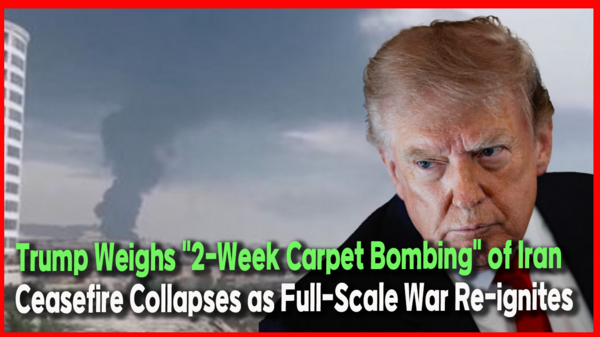
[CENTCOM Commander Submits 10–14 Day Intensive Strike Plan to Decimate Iranian Missile Capabilities]
The fragile window of diplomacy that had barely opened between the United States and Iran slammed shut after just five days. Following Iran's launch of ballistic missiles toward a U.S. military base in Jordan, President Donald Trump immediately declared, "Now it's our turn," and U.S. Central Command (CENTCOM) launched a massive retaliatory airstrike across southern Iran just hours later. Furthermore, it has been revealed that CENTCOM Commander Brad Cooper submitted a high-intensity, 10-to-14-day intensive airstrike proposal to President Trump, designed to effectively paralyze Iran’s missile and drone capabilities. If Trump approves the plan, the conflict will transcend limited retaliation and enter a new phase: destroying Iran's capacity to wage war altogether.
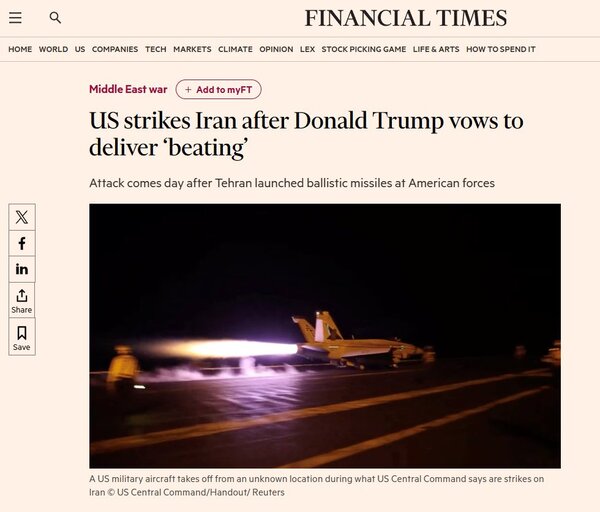
The Financial Times (FT) reported on the 31st that "U.S. Central Command announced it struck dozens of targets tied to the Islamic Revolutionary Guard Corps (IRGC) over approximately two hours starting at 8:00 p.m. Eastern Time the previous evening." In a statement, CENTCOM explained, "Strikes hit multiple targets, including IRGC command-and-control centers, missile and drone facilities, coastal surveillance and defense sites, and naval assets," adding that "the objective is to further degrade threats posed by Iran and its proxies against U.S. forces, commercial vessels, and neighboring Gulf nations."
[“Now It’s Our Turn”… Barely Had the Words Been Spoken When Bombs Rain Down on Southern Iran]
The U.S. airstrikes were executed immediately after Iran fired ballistic missiles at U.S.-related facilities in Jordan. Although direct damage was limited thanks to interceptions by U.S. and Jordanian forces, President Trump defined the act of launching missiles at a U.S. military base as a major provocation, regardless of whether the interception succeeded.
"They caught us off guard. Now it's our turn," Trump stated, adding, "They know what's coming." He then warned that Iran would be "hit very hard." Indeed, shortly after Trump's warning, a massive U.S. airstrike commenced. Action demonstrated the principle of overwhelming retaliation: if Iran fires missiles, the U.S. will simultaneously eliminate dozens of command, missile, and naval targets.
Local Iranian media reported that Abadan, Shadegan, Arvandkenar, and Ahvaz in Khuzestan Province, as well as the strategic Qeshm Island in the Strait of Hormuz, were bombarded. The IRGC claimed three of its personnel were killed in the strikes. The IRGC immediately warned of further retaliation, declaring, "With the help of God, the aggressors will be punished."
Ultimately, the conditional ceasefire proposal—under which the U.S. would halt airstrikes if Iran ceased its attacks—collapsed within five days. Iran miscalculated the pause in U.S. attacks as weakness and launched missiles, whereas Trump viewed the action not as a bid to expand diplomatic leverage, but as a provocation testing American deterrence. The brief pause in airstrikes turned out to be not a gateway to peace, but merely a pause to catch its breath before a larger collision.
[Commander Cooper’s ‘High-Intensity Strategy’… Concentrated Destruction of Missile Capabilities Over 10–14 Days]
What warrants even greater attention is the possibility that this two-hour airstrike was merely the prelude to a much larger operation. The Wall Street Journal (WSJ) reported that "CENTCOM Commander Cooper prepared a 10-to-14-day intensive airstrike plan to neutralize Iran's missile capabilities."
This plan has not yet received final operational approval from President Trump. However, it holds significant weight as a "high-intensity" option designed to break the war's stalemate by systematically destroying Iran's ballistic missile launchers, underground storage sites, drone production and operation facilities, and command-and-control networks, moving well beyond simple punishment.
Commander Cooper’s logic is clear: allowing Iran to continuously launch missiles and drones while defending against them with expensive interceptor missiles is an unfavorable war of attrition for the United States. Therefore, rather than merely intercepting missiles after they are launched, the U.S. must proactively destroy launchers and storage facilities on the ground first. The calculation is that destroying offensive capabilities at the source will ultimately reduce the defense burden and interceptor consumption for U.S. forces.
If Trump approves this proposal, the objective of the U.S. will shift. It will move beyond proportional retaliation against specific Iranian provocations toward crippling Iran's military capabilities altogether, preventing it from attacking U.S. bases and Gulf nations over the long term.
[Patriot Stocks Plummet... "Even Capabilities Against China Threatened"]
However, the U.S. is not in a position to expand airstrikes indefinitely. The most serious issue is the dwindling inventory of Patriot and THAAD interceptor missiles required to defend against Iranian ballistic missiles.
The Center for Strategic and International Studies (CSIS) noted, "U.S. Patriot interceptor missile inventories, which stood at around 2,330 right before the outbreak of hostilities, have now dropped to between 759 and 827," adding that "this leaves roughly one-third of pre-war stockpiles, with THAAD interceptor inventory estimated to have fallen to around 250 rounds."
CSIS emphasized that "this depletion of stockpiles is not merely a Middle Eastern operational issue," pointing out that "Patriot and THAAD are indispensable weapons needed to counter Chinese ballistic missile attacks in the Western Pacific. Continuous consumption of interceptors in a war with Iran could weaken U.S. response capabilities in the event of a crisis in the Taiwan Strait or around the Korean Peninsula."
Ironically, this reality lends further weight to Commander Cooper's argument for an intensive campaign. For the U.S., carrying out an overwhelming offensive in a short period to eliminate launch capabilities from the outset may prove more economical than fighting a defensive battle intercepting Iranian missiles one by one. However, if a two-week large-scale bombing campaign further provokes Iranian retaliation, the U.S. risks falling into a vicious cycle of consuming even more interceptor rounds.
[Netanyahu’s New Card: Blocking Iran's Overland Routes After Maritime Blockade]
Meanwhile, The Telegraph reported, "Following the July 28 meeting between Trump and Netanyahu, Vice President JD Vance and Prime Minister Netanyahu also held talks at the White House," adding that "the two engaged in candid discussions on issues where they had previously held differing views."
Regarding this, Reuters noted that "President Trump is weighing three options: reaching a negotiated settlement, maintaining the maritime blockade alongside intensified economic pressure, or launching large-scale military strikes, all of which were discussed in detail during the meetings."
Axios also reported that "an Israeli official stated that even within Iranian leadership, there is a rift between factions concerned about economic collapse and hardliners who believe everything will be fine as long as they maintain control over weapons and their support base." Axios added, "It was confirmed that the Israeli side also presented a concept to blockade Iran's overland routes by leveraging the seven countries sharing borders with Iran (Turkey, Turkmenistan, Afghanistan, Iraq, Pakistan, Azerbaijan, and Armenia)." The logic is that since Iran, cut off from sea trade, is acquiring goods and foreign currency through these adjacent nations, pressuring land routes as well is necessary to achieve a complete economic strangulation effect.
However, persuading all seven neighboring countries to actively participate in a blockade operation is practically difficult. Thus, it is more realistic to view this not as a completed operational plan, but as a concept designed to drastically inflate Iran's indirect trade costs by combining financial sanctions, customs controls, transport company sanctions, and border surveillance.
[Red Sea and Suez Shaken... Spreading Beyond Regional War to Global Logistics Crisis]
The flames of escalation have already spread beyond mainland Iran and the Strait of Hormuz to the Red Sea and the area surrounding the Suez Canal. In the Egyptian port of Damietta, a U.S.-owned gas storage vessel and a Greek-owned cargo ship caught fire following an attack by unidentified drones. Although Egyptian authorities have not officially identified the perpetrator, the simple fact that ships near the Suez Canal were attacked delivered a fresh shock to global shipping markets.
Reuters analyzed that "this attack could also pose a threat to major Saudi Arabian crude oil transit routes connected to the Suez Canal." With Houthi rebels also threatening to blockade Saudi ports, the simultaneous instability across Hormuz, the Red Sea, and Suez risks elevating this war beyond a regional military conflict into a global energy and logistics crisis.
[Why Times Insight]
The core of this situation is not merely the "resumption of U.S. retaliatory airstrikes." The essence lies in the fact that the Trump administration has entered a phase of unifying four major pressure tactics—military strikes, maritime blockades, land trade cutoffs, and internal rift exploitation—to force Iran into submission.
Commander Cooper’s 10–14 day intensive airstrike proposal remains an option, not a finalized operation. However, the moment Iran launched missiles toward a U.S. military base again, the political threshold for Trump to approve this plan dropped significantly. While the recent two-hour airstrike was a warning, the next attack could turn into a full-scale war of destruction aimed at paralyzing Iran’s missile capabilities over the long term.
The problem is that time is not on the side of the U.S. either. Washington must break Iran’s attack capabilities before interceptor stockpiles run out, but expanding airstrikes will inevitably draw stronger retaliation from Iran, the Houthis, and pro-Iranian armed groups. The "two-week campaign" under review by Trump could prove to be a winning card that finishes Iran, or a dangerous gamble that drags the U.S. deeper into a prolonged war of attrition. Right now, the Middle East stands not at a fork between ceasefire and war, but on the razor-thin line between limited conflict and all-out war.
- TAG