


추부길 whytimespen1@gmail.com

["Overwhelming Reliance on Nvidia" — Liang Wenfeng Admits Computing Power Gap]
The leaked internal meeting minutes of DeepSeek—a company heavily promoted by Beijing as a global shockwave—have laid bare the stark reality of China’s AI industry. While publicly touting low-cost, high-efficiency proprietary innovation, internal discussions focused on procuring massive quantities of Nvidia chips, cloning the CUDA ecosystem, and leveraging this foundation to pivot toward Huawei platforms. This has reinforced growing suspicions that China’s rapid AI growth stems not from purely independent technological breakthroughs, but from circumventing restrictions to secure and replicate U.S. semiconductors and AI tools.
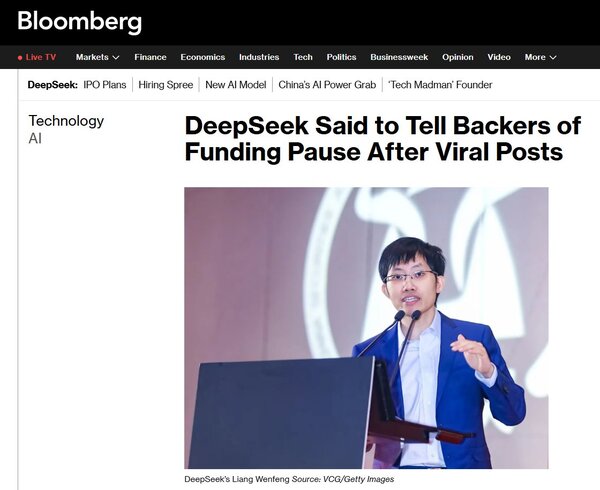
According to multiple industry sources, Chinese AI startup DeepSeek verbally notified investors it would temporarily freeze the signing of investment agreements for its second funding round. The massive fundraising effort—targeting a valuation of approximately $71 billion (approx. 98 trillion KRW)—ground to a halt immediately following the leak of remarks made by founder Liang Wenfeng during a closed-door investor pitch.
The leaked document details a four-hour investor presentation across 118 items. While DeepSeek has not officially confirmed the document's authenticity, the market leans heavily toward viewing the transcript as authentic due to the high level of detail and Liang’s distinct speaking style. Kyle Chan, a tech policy researcher covering China at the Brookings Institution, posted on social media that while he was initially skeptical, "the descriptions of Huawei collaboration, chip production bottlenecks, and the erosion of the CUDA moat are far too detailed, significantly increasing its credibility".
[“The Problem Isn't Talent, It's Compute Resources”… Liang Wenfeng's Confession]
The most striking revelation in the transcript is Liang Wenfeng’s tacit admission of the computing capability gap between China and the United States. He reportedly stated that the divide between the two nations lies not in talent, but in computational resources, noting that the volume of Nvidia GPUs a company secures ultimately dictates the frequency of experiments and the scale of models that can be trained.
In particular, the transcript reportedly reveals that DeepSeek’s current compute resources leave a significant gap compared to top-tier U.S. models, though the firm has secured roughly 20,000 units of "H-equivalent" compute resources. Most of these were reportedly brought in over the past one to two months, with plans for additional large-scale acquisitions in the pipeline.
If true, this indicates that DeepSeek’s rapid rise was fueled by large-scale procurements of advanced U.S. chips rather than domestic Chinese semiconductor breakthroughs. While Beijing hailed DeepSeek as a "miracle of homegrown AI" that pierced U.S. export controls, internally, the shortage of Nvidia chips was recognized as the firm's single greatest vulnerability.
The unusually fast procurement speed, willingness to pay premium prices, and concentration of deliveries within a short window align closely with "red flags" monitored by the U.S. Department of Commerce’s Bureau of Industry and Security (BIS) to identify potential regulatory evasion. Even if advanced chips are installed in third-country data centers, they remain subject to U.S. export licensing requirements if the ultimate end-user is a Chinese entity.
[Bypassing Sanctions for U.S. Chips, Distilling and Cloning U.S. AI]
U.S. frustration with Chinese AI firms extends beyond semiconductor procurement. Industry figures and government officials suspect Chinese firms are systematically engaging in "distillation"—extracting massive volumes of outputs from top-tier U.S. models to train their own domestic models. In effect, Chinese companies are seen as copying U.S. models and tools developed at immense expense and re-releasing them as low-cost alternatives.
U.S. Treasury Secretary Scott Bessent warned of potential sanctions against distillation practices, noting they may constitute intellectual property theft. This reflects a shift in Washington, where Congress and the executive branch increasingly view Chinese AI not merely as commercial competition, but as a national security threat growing by absorbing American technology.
Similar suspicions surround China’s Moonshot AI. Official accounts indicate that Michael Kratsios, Director of the White House Office of Science and Technology Policy (OSTP), alleged Moonshot AI accessed export-restricted Nvidia GB300 chips via infrastructure in Thailand, potentially using them to train its "Kimi K3" model. It was further noted that the BIS has launched an investigation into whether Chinese firms are using overseas subsidiaries and third-country cloud infrastructure to bypass semiconductor regulations.
A consistent pattern has emerged across China's AI sector: acquiring advanced U.S. chips through overseas infrastructure and circumventive channels, distilling and imitating U.S. AI models and software, and branding the final product as "independent Chinese innovation".
[‘De-CUDA-nization’ Is Cloning, Not Innovation]
The transcript’s emphasis on a "De-CUDA-nization" strategy is less a demonstration of technological self-reliance and more an attempt to replicate the U.S. software ecosystem and port it onto Huawei's platform.
Liang reportedly stated that while DeepSeek used Nvidia chips to train its V3 model, it barely relied on CUDA, having rewritten operators using its in-house language, TileLang. He added that AI-assisted coding is lowering the cost of replicating the CUDA ecosystem, causing CUDA's competitive moat to erode rapidly. This implies that CUDA's vendor lock-in and high barriers to entry—which long anchored Nvidia’s dominance—are weakening.
However, this does not mean China has leapfrogged American technology. Rather, it represents a strategy of using Nvidia chips to train models, replicating the functionality of U.S. software, and transferring the results to Huawei chips. In short, American technology is being used as both a stepping stone and a blueprint for replication.
Furthermore, Liang reportedly estimated that four Huawei chips equal the performance of a single Nvidia chip, acknowledging a raw performance gap of about two years. While expressing optimism about Huawei’s "950 Supernode," he conceded a substantial gap at the individual chip level. Contrary to propaganda claiming Chinese AI has replaced U.S. technology, on the ground, multiple Chinese chips must be stacked together just to match a single Nvidia processor.
[U.S. Probe Expands Across the Chinese AI Sector]
The fallout from this leak is unlikely to remain isolated to DeepSeek. In April, the U.S. House Committee on Homeland Security and the Select Committee on Strategic Competition between the U.S. and the CCP launched a joint investigation into national security risks posed by low-cost, open-weight Chinese AI models, including those from DeepSeek, Alibaba, Moonshot AI, and MiniMax.
U.S. lawmakers are particularly concerned by a structure in which Chinese firms leverage U.S. chips and models to boost performance, then release them as open-source software to expand their global influence. If cheap Chinese models dominate the market, user data could flow to China, spreading CCP censorship standards and values throughout the global AI ecosystem.
The Center for a New American Security (CNAS) similarly warned of security vulnerabilities in major Chinese AI firms and their potential use in cyber operations. Against this backdrop, the leaked transcript connects several long-held suspicions—chip evasion, model distillation, CUDA cloning, migration to Huawei's ecosystem, and influence expansion via open source—into a single coherent narrative.
[Why Times Insight]
The core issue raised by this leak goes beyond whether every figure in the DeepSeek meeting minutes is accurate. While the exact details require further verification, the structural reality described in the document aligns precisely with the allegations Washington has leveled against Chinese AI firms for years.
Beijing packaged DeepSeek as a symbol of self-reliant AI that triumphed over U.S. tech blockades. Yet the leaked document reveals a cold reality: without Nvidia chips, competing with top-tier U.S. models remains nearly impossible, and without cloning the U.S. software and model ecosystem, transitioning to Huawei's platform is unfeasible.
The DeepSeek affair does not mean Chinese AI isn't growing rapidly. The real question is the foundation on which that growth rests. Securing U.S. chips through indirect routes, distilling U.S. models, and cloning U.S. software ecosystems—only to market the result as "Chinese-style innovation"—points to technological free-riding rather than genuine independence.
Ultimately, the leaked meeting minutes reveal anxiety rather than confidence within China's AI sector. A pervasive sense of crisis runs through the document: the realization that while China remains reliant on U.S. technology, it must rapidly clone the U.S. ecosystem to transition to an independent system. Should the U.S. expand restrictions beyond semiconductors to cloud access, model distillation, and software porting, China’s "AI Rise" will face an unprecedented test.
- TAG