


추부길 whytimespen1@gmail.com
[The CCP-Style Semiconductors All-Out Mobilization: The Reality of AI Hegemony Was Far Colder Than Expected]
As Huawei breaks through U.S. sanctions to sequentially achieve milestones in AI semiconductor development, evaluations have emerged claiming that China's 'semiconductor rise' is bearing fruit. In fact, China's reliance on foreign AI chips is rapidly declining, and Huawei's latest AI chip is even evaluated as being capable of replacing Nvidia products in certain fields. However, taking a closer look at the country's overall AI competitiveness reveals a completely different story. Despite launching an all-out national mobilization, China's AI computing power was revealed to stand at a mere 14% level compared to that of the United States. This once again confirms that individual product successes and national-level technology hegemony are two entirely different matters.
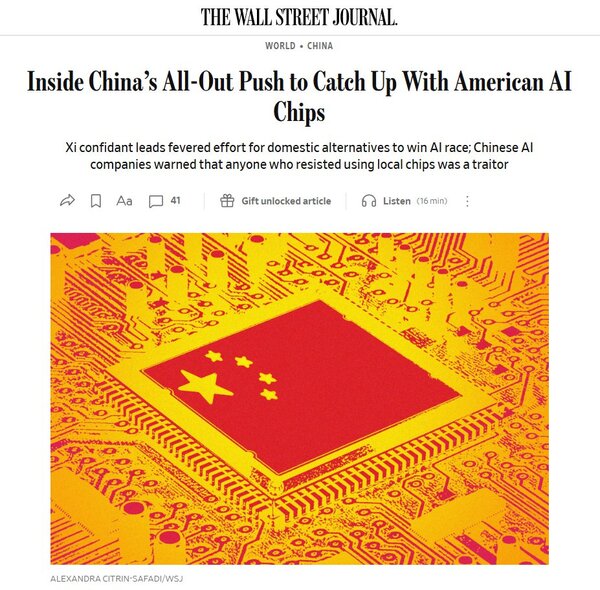
The U.S. Wall Street Journal (WSJ) reported on July 24: "Last summer, Huawei Technologies held a closed-door briefing for Vice Premier Ding Xuexiang—a close confidant of Chinese President Xi Jinping and the official overseeing technology—presenting a blueprint for artificial intelligence (AI) semiconductors to rival America's Nvidia, stating that self-reliance in key AI domains would be possible within three years." WSJ noted: "Following this briefing, Vice Premier Ding invoked the all-out mobilization model used in the 1960s during the Sino-Soviet split when China developed atomic bombs, hydrogen bombs, and satellites, initiating an all-out effort to establish domestic alternatives. However, the results were dismal."
WSJ pointed out that "Ding Xuexiang went so far as to issue warnings to China's largest AI-consuming enterprises that refusing to use domestic chips would be treated as treason, yet reality completely failed to back up those intentions."
[Huawei Certainly Achieved Results, But...]
National support did produce results to a certain extent. According to Morgan Stanley, China's reliance on foreign-made AI chips dropped from approximately 90% in 2021 to below 60% this year. Huawei expressed confidence that "it can reduce this reliance to around 25% within the next five years." It is an undeniable fact that despite strict U.S. export controls, China has established a substantial foundation for AI semiconductor self-reliance.
A representative example is Huawei's latest AI chip, the 'Ascend 950'. As Chinese AI firms, including DeepSeek, participated in software optimization, evaluations emerged that it could largely replace Nvidia products in the field of inference. While a gap remains in the training phase where AI models are developed, competitiveness in the inference phase—where pre-trained models provide actual operational services—is improving rapidly.
However, that was the limit. Limitations immediately surfaced in actual operational environments. When demand for AI services surged, Chinese AI startup Moonshot AI had to temporarily suspend new subscriptions for its premium services because computing resources could not keep pace. This exposed the reality that producing a good chip and stably supplying it to large-scale data centers are entirely separate challenges.
Similar results were observed in smartphone semiconductors. U.S. semiconductor analysis firm TechInsights assessed: "An analysis of the Kirin 9030 Pro embedded in Huawei's Mate 80 Pro showed that while certain process metrics approached levels comparable to Intel's latest processes, significant gaps remained in transistor density and actual performance." This demonstrates a structure identical to the AI chip field: improvements in specific technical metrics do not automatically translate into comprehensive competitiveness.
[The Real Gap Lies Not in the ‘Chip’ Itself, but in National AI Infrastructure]
This is the most critical aspect to observe. WSJ cited a Bernstein report pointing out that "As of 2025, China's total AI computing power stands at approximately 14% of the United States." The report noted that "This is not a comparison of a single AI chip, but the result of comparing national AI infrastructure as a whole, including data centers, AI servers, and GPU clusters."
Even when narrowing the scope down to individual chips, the situation is not vastly different. The Bernstein report stated that "Nvidia's top-tier AI chip delivers approximately four times higher computing performance than Huawei's best product," forecasting that "Although China is aggressively expanding data centers and scaling up domestic chip production, this gap will remain largely intact through 2030."
An interesting finding is that market share and technological competitiveness do not necessarily move in the same direction. Media reports projected that "In the Chinese AI chip market, Nvidia and Huawei each held about a 40% market share in 2025, but in 2026, Huawei's share will rise to about 50%, whereas Nvidia's will drop to around 8%."
In other words, "While Huawei may sell more chips within the Chinese market, the United States still maintains an overwhelming advantage in actual computing power that drives the broader AI industry." This highlights that sales volume and technological hegemony are entirely distinct concepts.
For this reason, Chinese AI enterprises continue to risk everything to secure Nvidia GPUs. Over the past six months, smuggled Nvidia chip prices have more than doubled, and some companies are making up for deficient computing capacity by renting AI compute power from overseas data centers or acquiring Blackwell GPU clusters. This explains why China aggressively adopts Huawei chips while simultaneously being unable to abandon Nvidia.
[Ultimately, the Showdown Will Be Decided by EUV Technology]
In May, Huawei unveiled a new architectural design that vertically stacks circuits instead of competing in fine-process nodes, claiming it could develop world-class semiconductors by 2031. However, Bernstein semiconductor analyst Quan-Yuan Lin assessed that "This is closer to a defensive measure to prevent the gap from widening further rather than a strategy to overtake the United States."
What experts identify as the ultimate battleground is, in the end, EUV lithography equipment. This is because acquiring proprietary EUV technology is essential for stably producing advanced AI chips. SemiAnalysis projected that "It could take China at least 10 years, and as long as 50 years, to build an independent EUV ecosystem." Chris Miller, a professor at Tufts University and author of Chip War, also evaluated that "Semiconductor manufacturing is a far more difficult industry than developing nuclear weapons," calling it "one of the most complex manufacturing technologies in the world."
This also explains why the national mobilization approach that succeeded in atomic bomb development in the 1960s does not work seamlessly in today's AI semiconductor competition. AI hegemony is not an industry determined solely by the success of a single company or governmental willpower; it is an industry possible only when an entire ecosystem—comprising equipment, fabrication processes, software, data centers, and power grids—advances together.
[Why Times Insight]
The core takeaway from these reports is not Huawei's failure, but the fact that Huawei's success alone cannot complete China's AI hegemony. In reality, Huawei enhanced AI chip performance despite heavy U.S. sanctions and achieved significant results in sharply reducing China's dependence on foreign AI chips. However, the nation's overall AI computing power remains at just 14% of the United States, and its top-performing AI chips still exhibit a substantial gap compared to Nvidia.
Ultimately, the competition for AI hegemony does not end with the performance of a single chip. National competitiveness is finalized only when advanced EUV equipment, semiconductor manufacturing capabilities, hyper-scale data centers, vast power infrastructure, and an AI software ecosystem are constructed together. While the AI chips created by Huawei clearly serve as a major milestone in China's semiconductor drive, data once again shows that the technological hegemony race against the United States is only just beginning.
- TAG