


추부길 whytimespen1@gmail.com
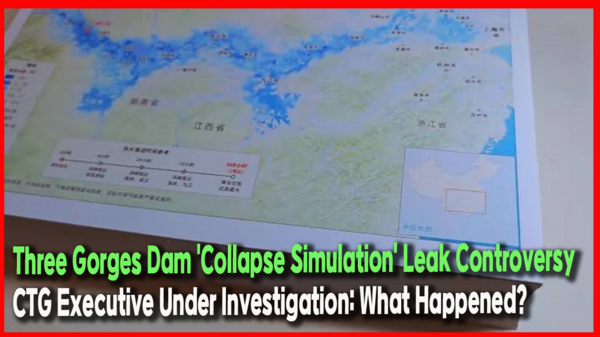
[Wu Qiren, General Manager of CTG Guangxi Branch, Under Investigation for "Serious Violations of Discipline and Law"]
As Wu Qiren (吴启仁), General Manager of the Guangxi Branch of China Three Gorges Corporation (CTG), came under investigation for discipline violations, allegations connecting his fall to a leaked "collapse simulation" of the Three Gorges Dam have been spreading rapidly across overseas Chinese-language platforms. While no objective evidence supporting this link has yet been verified, critics point out that the Chinese authorities' opaque information disclosure practices are fueling various speculations. Ultimately, the core issue of this controversy is not whether the Three Gorges Dam will actually collapse, but how much Chinese society trusts official government announcements.
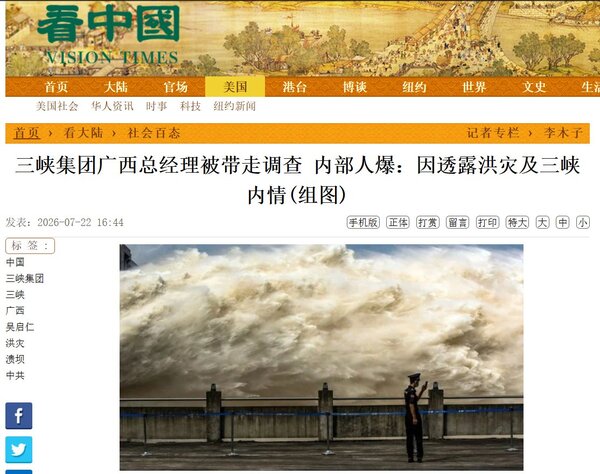
On July 21, China's Central Commission for Discipline Inspection (CCDI) and the National Supervisory Commission announced that Wu Qiren is being investigated by the CCDI discipline inspection team dispatched to CTG and the Changsha Supervisory Commission of Hunan Province for suspected "serious violations of discipline and law." While authorities did not disclose specific reasons for the violation, public records show that Wu served as Deputy General Manager of CTG Renewables before transferring in October 2023 to serve as General Manager of CTG's Guangxi Branch and Secretary of the Party Branch at CTG Renewables Guangxi Branch.
The investigation was initiated immediately following severe flooding in the Guangxi region, creating a coincidence in timing that has spawned various speculations.
[Allegations of Three Gorges Dam Secret Leak… Source Remains an 'Anonymous Whistleblower']
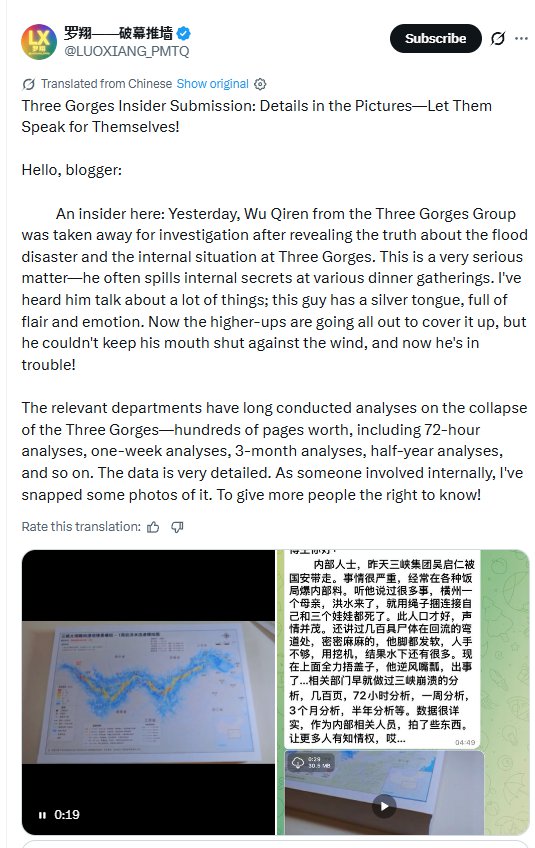
The claim connecting Wu Qiren's downfall to the actual flood casualties in Guangxi and leaked secrets regarding the Three Gorges Dam originates solely from an anonymous account on X (formerly Twitter) citing an "internal insider."
The whistleblower revealed that Wu Qiren was heard describing conditions in the disaster area on multiple occasions. For instance, he reportedly stated, "At a single river bend where floodwaters backflowed, hundreds of bodies floated down together. They couldn't all be retrieved manually, so excavators were brought in. Even then, it was discovered that many more bodies remained under the water."
Furthermore, Wu reportedly disclosed that the status of the Three Gorges Dam is also extremely precarious, and that an actual collapse would trigger a vastly more catastrophic disaster. He stated, "Relevant departments completed analysis on a potential Three Gorges Dam collapse long ago. The documentation spans hundreds of pages with highly detailed data, including 72-hour, 1-week, 3-month, and 6-month models. As an insider, I took photos of a few items." The whistleblower also attached video footage showing a stack of hundreds of pages resting on a desk, with the top few pages labeled "Simulation Map of Instantaneous Three Gorges Dam Collapse." This material included maps such as "1-Week Inundation Range Map," "1-Week Flood Flow Velocity Simulation Map," "1-Week Impacted Population Heatmap," and "1-Week Transport Paralysis Map."
According to the "Simulation Map of Instantaneous Three Gorges Dam Collapse," 6 hours after a collapse, the flood crest would reach the vicinity of Yichang, Hubei Province; after 24 hours, it would reach Jingzhou and Wuhan; after 72 hours, it would reach Anqing in Anhui Province and Jiujiang in Jiangxi Province; and after 168 hours (1 week), the inundation range would reach its maximum extent.
At the bottom left of the map is a water depth chart, where the darkest areas indicate depths exceeding 10 meters, followed by 5–10m, 2–5m, 0.5–2m, and under 0.5m. Among these, cities such as Yichang, Jingzhou, Shishou, Honghu, Wuhan, Ezhou, Huangshi, Jiujiang, Anqing, Tongling, and Wuhu, along with areas surrounding Dongting Lake and Poyang Lake, are marked in relatively darker shades.
Based on this, areas with water depths exceeding 10 meters are concentrated primarily near the collapse site, along the main stem of the Yangtze River, and in adjacent low-lying banks, spanning an estimated area of approximately 15,000 to 25,000 km². The 5–10m depth range is even broader, encompassing plains on both sides of the main stem, surrounding areas of certain lakes, and middle-to-lower reach expansion zones, covering roughly 20,000 to 35,000 km². Combining all depth tiers, the total estimated area reaches approximately 150,000 km².
The "1-Week Flood Flow Velocity Simulation Map" divides flow velocity into 6 tiers: maximum velocity exceeding 10 m/s, relatively fast velocity of 5–10 m/s, intermediate velocity of 2–5 m/s, relatively slow velocity of 0.5–2 m/s, slow velocity of 0.1–0.5 m/s, and stagnant/micro flow under 0.1 m/s.
According to the velocity descriptions, speeds exceeding 10 m/s represent the main flood current, generating intense erosion with extreme destructive power that leaves structures unlikely to survive. Velocities of 5–10 m/s remain very strong, causing distinct erosion capable of breaching levees or destroying bridges. An intermediate velocity of 2–5 m/s can transport large drift debris and cause structural damage. Speeds of 0.5–2 m/s are relatively mild, primarily causing submergence damage in flooded zones. Slow flows of 0.1–0.5 m/s cause long-term inundation leading to secondary disasters, while stagnant or micro flows under 0.1 m/s result in large-scale standing water.
Judging by the displayed colors, flow velocities exceeding 10 m/s or between 5–10 m/s would appear across various points along the Yangtze River basin from Yichang in Hubei Province to Wuhu in Anhui Province.
The "1-Week Impacted Population Heatmap" records the affected population across at least 29 cities along the Yangtze River. This includes 21,000 people in Zigui County and 18,000 in Xingshan County upstream of the dam, as well as downstream populations such as 830,000 in Yichang, 670,000 in Jingzhou, 7.24 million in Wuhan, 1.07 million in Ezhou, 750,000 in Huangshi, 540,000 in Jiujiang, 520,000 in Anqing, 1.37 million in Wuhu, 9.31 million in Nanjing, 500,000 in Chaozhou, 810,000 in Jinjiang, 560,000 in Jinhua, 9.31 million in Changzhou, 500,000 in Ganzhou, 11.94 million in Hangzhou, 12.74 million in Wuxi, 450,000 in Jiaxing, 570,000 in Shaoxing, 710,000 in Taizhou, and 24.87 million in Shanghai.
According to the map, the total affected population after 1 week reaches approximately 132 million, with 63.2 million facing severe damage from water depths exceeding 2 meters, 48.6 million
[A Recurring Collapse Narrative — Pattern Continuing Since 2014]
This is not the first time rumors of a Three Gorges Dam collapse have surfaced; rumors regarding the potential collapse of the dam circulated repeatedly in 2014, 2016, and 2019. The 2020 case is structurally most similar to the current situation, when satellite images captured from Google Earth made the dam's structure appear warped, sparking widespread rumors of an imminent collapse.
Chinese official media and state entities have strongly refuted such claims each time, arguing that prior claims regarding collapse risks, induced earthquakes, and worsening floods have all proven groundless, asserting that "distortion rumors" belong to the same category of exaggerated hearsay. During the 2019 controversy, the China Aerospace Science and Technology Corporation released high-resolution images taken by the Gaofen-6 satellite to counter the rumors, demonstrating that the dam was structurally intact.
[Structural Risks Have Long Been Raised]
At the same time, concerns regarding the Three Gorges Dam cannot be dismissed entirely as mere conspiracy theories. Germany-based hydrologist Wang Weiluo (王维洛) is an identifiable critic with a verified track record who directly participated in the feasibility study for the Three Gorges Project in the 1980s. In recent commentary, he noted that "since the Three Gorges Dam began operating at its normal reservoir level of 175 meters, large-scale flooding and geological hazards in the Chongqing reservoir area have noticeably increased." He highlighted specific years when real risks emerged, citing 2010, 2012, 2014, 2018, 2020, 2021, 2023, and 2024. During the major 2020 floods, he similarly warned of structural risks stemming from rising water levels.
However, Wang Weiluo's analysis reflects an expert opinion on the long-term, structural risks of the Three Gorges Dam and does not serve as evidence supporting the recently circulated specific collapse simulation timeline or massive casualty figures. These two sets of claims differ fundamentally in character and credibility.
It is crucial to distinguish between structural warnings issued by named, credentialed experts and specific disaster scenarios circulated by anonymous social media accounts, as they operate on entirely different levels of reliability.
[Guangxi Floods Expose Deeper Issues… Distrust Over Information Disclosure]
What can be verified far more clearly than the Three Gorges Dam simulation rumor is the governance problem surrounding the Guangxi floods themselves. Heavy downpours brought by Typhoon Maysak caused near-breach damage to the embankment of the Liulan Reservoir in Hengzhou City, Guangxi, on July 6. While the Hengzhou Municipal Emergency Management Bureau claimed it was a localized defect rather than a full dam collapse, state television coverage from the scene on July 8 indicated that damage to the main embankment of the Liulan Reservoir was "extremely severe," with floodwaters washing away the earth-rock dam and destroying the hydrological monitoring station, rendering it out of operation. This contrast between local government explanations and state-run field reports is unusually stark.
Controversy over casualties also persisted. While Nanning City officially announced 39 dead and 9 missing, official channels subsequently refrained from commenting on additional casualties, fueling public distrust.
As opaque announcements regarding disaster information recur, public confidence in official Chinese government statements has eroded, creating an environment where official explanations regarding the Three Gorges Dam are also met with skepticism.
[Why Times Insight]
The key analytical takeaway in this case is not whether the Three Gorges Dam will actually collapse, but why this narrative is continuously reproduced almost every flood season. The underlying structural background lies in the Chinese authorities' opacity regarding information. The practice among state-owned enterprises and local governments of selectively releasing disaster-related information while keeping the reasons for official investigations secret creates a vacuum that unverified whistleblower narratives naturally fill. In Wu Qiren's case, the failure of authorities to state specific grounds for his investigation has served to inflate the credibility of speculative narratives, regardless of their actual truth.
However, this does not render long-term warnings by experts like Wang Weiluo regarding the structural risks of the Three Gorges Dam meaningless. Distinguishing between real risk signals (sediment accumulation, aging, and economic bias in reservoir management priorities) and unverifiable apocalyptic disaster scenarios remains the single most important criterion when analyzing this issue.
- TAG