


추부길 whytimespen1@gmail.com
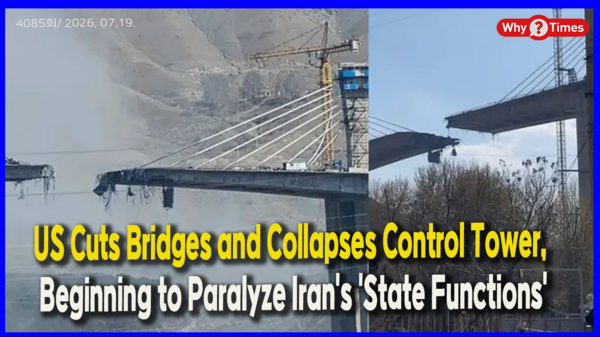
[From Nuclear Facilities to Infrastructure: US Military Strategy Shifts from 'Destruction' to 'Isolation']
The US military operation against Iran has entered a new phase. Moving beyond its previous focus on precision strikes against nuclear facilities, missile bases, and Islamic Revolutionary Guard Corps (IRGC) assets, the US military has begun dismantling Iran's core national infrastructure—including bridges, railways, ports, and power grids. This shift is interpreted as a strategy not merely to weaken military capability, but to systematically paralyze Iran’s capacity to wage war and function as a state.
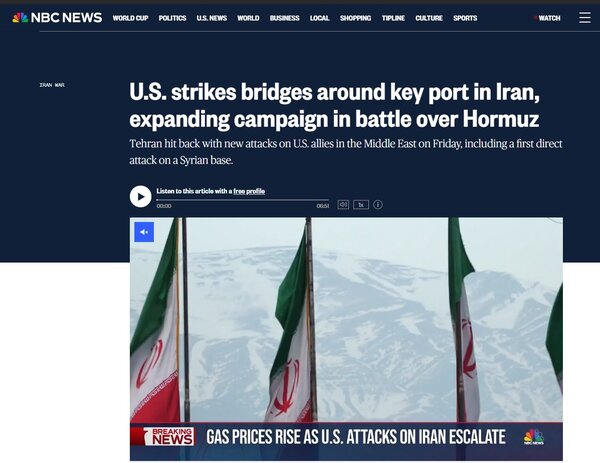
Recent concentrated US strikes have targeted Bandar Abbas and Chabahar, both critical strategic hubs in southern Iran. Bandar Abbas is Iran’s largest commercial port and a primary base for the IRGC Navy, while Chabahar serves as a strategic port bypassing the Strait of Hormuz. Squeezing both hubs simultaneously signals that the objective of the US airstrikes has expanded from "destroying individual facilities" to enforcing "total state isolation."
On July 19, NBC News reported, “Today's strikes came as an extension of a seven-day consecutive aerial campaign by the US military, following the effective collapse of the ceasefire and memorandum of understanding (MOU) reached in June.” The report added, “US Central Command (CENTCOM) announced it destroyed at least six bridges in the Bandar Khamir region of Hormozgan Province, while Iran’s state-run IRIB news agency reported that a railway junction west of Bandar Abbas was also struck.” Iranian state television confirmed that at least seven people were killed in the attacks.
According to NBC News, “The destruction of these bridges aligns with the long-held US military objective to eliminate Iran’s capability to threaten the Strait of Hormuz.” The network explained, “The targeted bridges are located along the critical highway network linking Bandar Abbas to Central Iran via Shiraz—a vital chokepoint housing the IRGC Naval Command.” A runway near Iranshahr Airport was also hit during the operation.
Indeed, the destroyed bridges serve as the primary transport veins connecting Bandar Abbas to the Iranian mainland. Bandar Abbas is not only the economic heart where the vast majority of Iran's imports and exports are concentrated, but it is also the home port of the IRGC Navy. By targeting these routes, the US has begun severing the logistical arteries connecting the city to the outside world. With the concurrent strike on the Iranshahr Airport runway, Iran's land, rail, and air transport networks are facing synchronized pressure.
Compounding the crisis, power facilities in the south were hit, prompting the Iranian Ministry of Energy to officially acknowledge damage to electricity infrastructure for the first time and urge citizens to ration power usage. Consequently, Bandar Abbas has plunged into a state of functional isolation, with its logistics, power, and communications simultaneously destabilized.
NBC News further noted, “On the same day, the maritime control tower at the Shahid Kalantari port in Chabahar, located along the coast of the Gulf of Oman, collapsed.” The report highlighted that “While Chabahar sits outside the Strait of Hormuz, it is a strategic hub jointly operated with India as a gateway to Central Asia. This strike demonstrates that the scope of US targets has expanded well beyond the immediate vicinity of the strait.”
This specific attack carries significant symbolic weight. Chabahar is Iran’s strategic alternative port outside the Strait of Hormuz. Developed in partnership with India, it serves as a crucial bridgehead to Central Asia and, from Tehran's perspective, represents virtually the only viable alternative route to maintain international maritime trade if the Strait of Hormuz is blockaded.
By neutralizing this bypass route, the United States has demonstrated that its ultimate goal is not just hitting a single port, but completely choking off Iran’s maritime logistics network.
[The Ceasefire is Over… Trump Declares "The War Has Resumed"]
These airstrikes signal the definitive collapse of the US-Iran ceasefire agreement brokered in June. Commenting on the escalation, ABC News reported, “This offensive is the direct result of the de facto termination of the US-Iran memorandum of understanding (MOU), which had been mediated by Pakistan in June.” The network pointed out that “President Trump officially declared the ceasefire 'over' during the NATO summit in Ankara, Türkiye, on the 8th, while launching a scathing rhetorical attack against the Iranian leadership.” ABC News added, “The US military launched simultaneous strikes across five cities in southeastern Iran—Iranshahr, Bandar Abbas, Konarak, Chabahar, and Bushehr—as well as Aq Qala in the northeast.”
The Council on Foreign Relations (CFR) evaluated the situation, stating, “The ceasefire signed in June was effectively pronounced dead just four weeks after its inception.” When the IRGC resumed attacks on commercial vessels transiting the Strait of Hormuz, the US military launched large-scale retaliatory airstrikes, and President Trump reportedly notified Congress that the United States had returned to a "state of war."
Washington is no longer limiting itself to proportional, localized retaliation. Instead, it is fundamentally shifting its strategy toward permanently eradicating Iran’s capacity to threaten the Strait of Hormuz.
[US Military Prepares for Escalation, Deploying Large Contingent of Aerial Refueling Tankers to Israel]
US investigative media outlet Axios reported, “The US administration has notified Israel of its decision to deploy dozens of additional aerial refueling tankers to the region.”
Aerial refueling tankers are a cornerstone of modern air power. Increasing the number of available tankers extends the loiter time of fighter jets and significantly expands their operational strike radius. It enables aircraft to hit far more targets per sortie and facilitates long-range, nighttime deep-strike missions.
The Jerusalem Post reported, “The impending deployment will restore the number of US tankers stationed in Israel to levels seen at the beginning of the war.” This serves as a clear indicator that Washington is digging in for a protracted campaign rather than a short-term bombing blitz. Reports that further strikes are being considered against power stations, nuclear sites, and underground facilities align with this long-term outlook.
[Iran’s Retaliation Widens the Front, Extending to Gulf Allies]
Tehran is also escalating its response. CNN reported that Iran has expanded its missile and drone strikes targeting countries hosting US military forces, including Jordan, Qatar, Kuwait, and Iraq. The IRGC claimed it struck a US military base in Jordan and destroyed American aircraft, though Washington has not officially confirmed the claim.
Iran’s objective is clear: prevent the war from being contained within its own borders and instead spread the conflagration across the wider Middle East. Despite these efforts, the volume of shipping transiting the Strait of Hormuz dropped to its lowest level in three weeks. Even without a total, physical closure of the strait, maritime logistics in the region have already been severely crippled.
[Iran’s National Economy Begins to Crumble]
The shocks of the war are reverberating violently through Iran's economy. According to Fox News, the Iranian rial plummeted to a historic low on the black market, trading at 1.918 million rials per US dollar.
Global crude oil prices spiked by more than 9% in a short period. Wells Fargo projected that if instability in the Strait of Hormuz persists, elevated energy prices and global inflationary pressures will endure over the long term. The ongoing conflict is no longer just depleting military assets; it has begun to unravel the fabric of Iran's national economy.
[Why Times Insight]
The destruction of the bridges in Bandar Abbas and the collapse of the control tower in Chabahar carry implications that go far beyond standard airstrikes. The United States has transitioned from conducting precision strikes on a handful of nuclear facilities to a broader strategy of systematically dismantling the foundational infrastructure that allows Iran to sustain a war effort.
The tactic of cutting off bridges, paralyzing railways, and squeezing ports and power grids mirrors the concept of "Strategic Paralysis" (removing the adversary's capability to sustain war), which was previously deployed during air campaigns in Iraq and Serbia. The objective is not to engage and defeat enemy troops in the field, but to render the state system itself structurally incapable of functioning.
When factoring in the massive influx of US aerial refueling tankers and the potential for subsequent strikes on power grids and nuclear facilities, the Trump administration appears to be setting the stage for a prolonged, high-pressure campaign rather than a temporary punitive action. Conversely, Iran is pushing back by widening the theater of conflict toward surrounding US bases and Gulf allies, ensuring that the geographic scope of the confrontation continues to widen.
Ultimately, the true significance of this operation does not lie in the specific bridges destroyed. The critical takeaway is that the United States has fundamentally redefined the nature of the conflict, shifting its paradigm from "bombing nuclear facilities" to "paralyzing state functions."

- TAG