


추부길 whytimespen1@gmail.com
[The Shocking Reality of the Russian Navy Confirmed in Joint Drills with China]
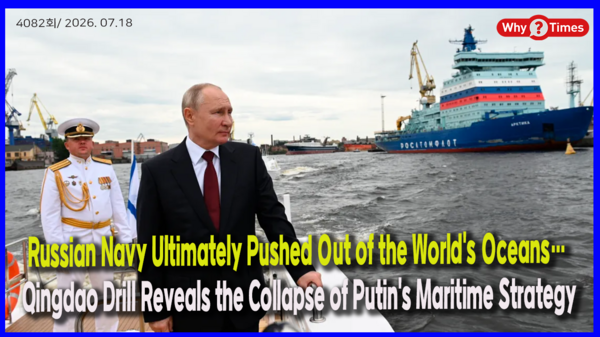
The war in Ukraine has not merely depleted the Russian Army. One of the military branches to undergo the most drastic transformation over the past four years of conflict is the Russian Navy. At the onset of the invasion, Russia held total dominance over the Black Sea, successfully imposing a maritime blockade on Ukraine. Buoyed by its pride as the world's second-largest navy, Russia was widely ranked alongside the United States and China as one of the top three global naval powers.
Today, the reality of the Russian Navy tells a completely different story. In the Black Sea, it has effectively lost command of the sea after being pushed back by Ukrainian drone and missile strikes. In blue-water operations, it has lost strategic flexibility, to the point where its remaining forces are tied down protecting the crude oil tankers that sustain the national economy. This paradigm shift was starkly illustrated during "Joint Sea-2026," a joint naval exercise between China and Russia that concluded on July 13.
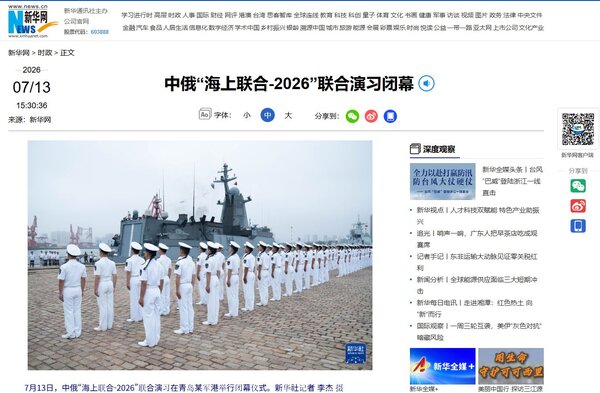
China’s state-run Xinhua News Agency reported on July 13 that "the Chinese and Russian navies' 'Joint Sea-2026' drills began in Qingdao, Shandong Province on July 6 and concluded on July 13 after a seven-day schedule." The report noted that both sides conducted live-fire exercises encompassing reconnaissance, air and missile defense, anti-ship strikes, and submarine rescue, with select forces subsequently deploying to the Pacific Ocean for joint patrols.
On the surface, it appeared to be a standard bilateral exercise. However, a closer look at the participating assets reveals that the reality facing the Russian Navy is far more severe than previously estimated.
[China Deployed an Ocean-Going Manever Fleet, But Russia Managed Only Four Vessels]
For this exercise, Russia deployed a mere four vessels: the Slava-class cruiser Varyag (the flagship of the Pacific Fleet), the Steregushchiy-class corvette Rezkiy, the Kilo-class submarine Ufa, and the rescue ship Igor Belousov. In stark contrast, China assembled a comprehensive ocean-going maneuver task group centered around the Type 055 destroyer Anshan (boasting a full-load displacement of 13,000 tons), flanked by a Type 052D destroyer, a Type 054A frigate, an integrated replenishment ship, a submarine rescue support ship, and a submarine.
This disparity goes beyond mere numbers. While China fielded a modern flotilla capable of sustained blue-water operations, Russia scraped together just a handful of core capital ships. This imbalance gave rise to assessments that the exercise functioned primarily as a showcase for China rather than Russia.
The presence of the Russian flagship Varyag carries heavy symbolic weight. The vessel is a Project 1164 Slava-class cruiser—the exact same class as the Moskva, which was sunk by Ukrainian Neptune anti-ship missiles in 2022.
The sinking of the Moskva was not just the loss of a single warship; it symbolized the shattering of Russia's surface fleet prestige, a legacy retained since the Cold War. Russia has since been unable to acquire new large surface combatants to replace it, leaving its remaining sister ships to operate as the final, aging symbols of Russian naval power.
[Why Could Russia Only Send Four Vessels?]
The restricted scale of Russia's participation was the most telling aspect of the drill. Russia is the largest nation on Earth by landmass, boasting the Northern, Pacific, Baltic, and Black Sea Fleets, alongside the Caspian Flotilla. In the past, a strategic joint exercise with China would have seen Moscow commit a far more formidable armada.
The current strategic environment, however, permits no such luxury. The Black Sea Fleet has sustained continuous attrition from the war with Ukraine, leaving a significant portion of its remaining ships bottled up in the region. The Northern Fleet, which operates Russia’s strategic nuclear submarines, cannot easily abandon its core mission of protecting the Arctic. Similarly, the Baltic Fleet must maintain a constant state of high alert due to its direct proximity to NATO member states.
Consequently, Moscow could only pull assets from the relatively unburdened Pacific Fleet, resulting in this meager four-ship deployment. Analysts note that this was not a deliberate choice by Russia to minimize its footprint, but rather a reflection of a severely diminished capacity to project and sustain a large fleet over long distances under its current strategic constraints.
[The Era of the Russian Navy in the Black Sea Has Already Ended]
The crisis facing the Russian Navy did not suddenly materialize in Qingdao; the tide of war in the Black Sea has been turning against Russia for some time. Ukrainian President Volodymyr Zelensky declared during a Ukrainian Navy Day ceremony on July 4, "Russia no longer dominates the Black Sea. We are reclaiming it." While laced with political rhetoric, the actual situation on the ground makes it difficult to dismiss this claim as entirely baseless.
The Ukrainian Ministry of Defense announced that "since the start of the war, 4 out of 33 major combat ships of the Russian Black Sea Fleet have been sunk and 8 damaged, while 15 out of 34 landing ships have been sunk and 10 damaged." While these figures originate from the Ukrainian government and lack independent verification, the UK Ministry of Defence and US think tanks largely agree that the Russian Black Sea Fleet has lost the operational freedom it enjoyed during the initial stages of the war.
In fact, Russia has been dispersing the core assets of its Black Sea Fleet away from Sevastopol to eastern coastal bases like Novorossiysk, and the activity of its large surface combatants has drastically declined. This pressure has been sustained despite Ukraine lacking a traditional navy, achieved instead through a novel doctrine combining maritime drones and long-range missiles.
More recently, Ukraine’s Unmanned Systems Forces (USF) have launched large-scale drone operations across the Sea of Azov and the Black Sea, targeting Russia's maritime supply lines. According to Ukrainian announcements, 136 vessels—including oil tankers and cargo ships—were targeted within a roughly ten-day period starting in early July. While the exact scale of damage requires further verification, the international shipping industry is treating the situation with utmost seriousness.
Thomas Alexander, a senior analyst at maritime security firm Ambrey, evaluated the situation, noting that "finding an instance in modern naval warfare where this volume of shipping was attacked in such a short window is exceptionally rare."
The methodology of the attacks warrants close attention. Rather than aiming to completely sink the vessels, Ukraine is actively employing precision strikes against crew quarters, fuel transfer piping, and steering equipment to paralyze the ships' operational capacities. This represents a new form of maritime warfare that disrupts an adversary's logistics network over an extended period at a fraction of the cost.
As a result, the Crimean Peninsula is facing significant disruptions in fuel and military logistics, and Russian grain exports through the Sea of Azov are feeling the impact. Russian Foreign Minister Sergey Lavrov vehemently condemned these actions as "acts of international terrorism," but Ukraine maintains its offensive, asserting full military justification.
[Even in Blue-Water Operations, the Russian Navy is Tethered to Defense Over Offense]
Pushed back in the Black Sea, the Russian Navy is also failing to project its historical presence in blue-water environments. A prime example is its involvement with the so-called "Shadow Fleet," used to transport crude oil in circumvention of Western sanctions.
European nations have significantly tightened their crackdown on Russia's shadow fleet this year. France, Germany, the United Kingdom, and Belgium have repeatedly seized or detained tankers suspected of sanctions violations. In response, Russia has resorted to deploying Grigorovich-class frigates from its Black Sea Fleet to directly escort these tankers through the English Channel.
This visual is highly symbolic. During the Cold War, the Soviet Navy aspired to be a "blue-water navy," projecting power and competing directly with the US Navy across the Atlantic and Pacific. Today, instead of expanding its sphere of influence, the Russian Navy is forced to burn precious operational readiness simply to protect the oil exports that keep its wartime economy afloat.
According to the International Energy Agency (IEA), crude oil exports remain the primary revenue stream sustaining Russia's war economy. In essence, the Russian Navy has no choice but to prioritize defensive missions geared toward economic survival over the projection of global military influence.
[The Student Has Become the Master: China’s Naval Ascension]
The joint drills in Qingdao carry historical weight for another reason. Barely two decades ago, the Chinese Navy was the student, and Russia was the master. China initiated its naval modernization by purchasing large volumes of Russian hardware, including Sovremenny-class destroyers and Kilo-class submarines, making Moscow China's most vital technological supplier.
Today, that dynamic has been completely inverted. Leveraging the world's largest shipbuilding capacity, China has steadily churned out aircraft carriers, Type 055 destroyers, and Type 052D destroyers, evolving into a blue-water navy second only to the United States. Conversely, hampered by the prolonged war in Ukraine, economic constraints, and a stagnant domestic shipbuilding industry, Russia’s construction of new large surface combatants has ground to a near-halt.
While the exercise was staged to project bilateral cooperation, it paradoxically served as a symbolic confirmation that Russia—once the mentor—has been relegated to a supporting role, merely bearing witness to the growth of the Chinese Navy.
[Why Times Insight]
It remains an exaggeration to claim the Russian Navy has completely collapsed. Russia still retains a formidable nuclear submarine fleet, maintains its strategic nuclear deterrent, and commands significant military influence in the Arctic and parts of the Pacific.
However, when isolating conventional surface combatants, the trajectory is unmistakable. In the Black Sea, Ukraine has disrupted traditional naval concepts using drones and missiles, forcing Russia to withdraw its fleet to the rear after failing to maintain sea control. In blue-water operations, defensive escort duties for oil tankers have become the top priority, and joint exercises with China have exposed a widening gap in naval capability that can no longer be concealed.
Most importantly, the Qingdao drills demonstrate that the war in Ukraine is not merely grinding down the Russian Army; it is fundamentally eroding Russia's long-standing status as a global maritime power maintained since the Cold War. Whether Russia can eventually rebuild its Black Sea Fleet and restore its blue-water capabilities remains highly uncertain. Yet, the current trend is clear: the center of gravity in global naval power is rapidly shifting toward Beijing, leaving Russia not as a driver of the maritime order, but as a state forced to adapt to a new reality.

- TAG