


추부길 whytimespen1@gmail.com
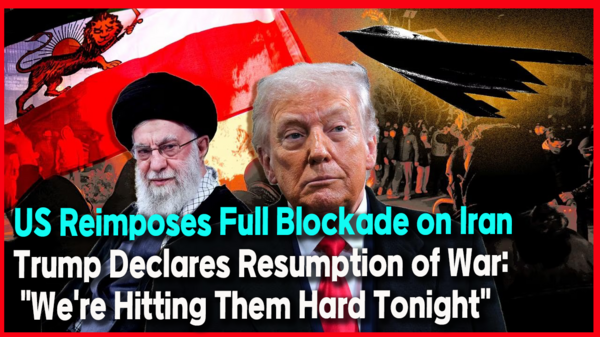
[Return of the Naval Blockade… US Opts for a 'War to Dismantle the Economy First' ]
'The United States has ultimately moved to choke off Iran's economic lifeline. Less than a month after a Memorandum of Understanding (MOU) for a ceasefire was signed, the US has reinstated a naval blockade against Iran. This measure extends far beyond simple military retaliation. Recognizing that airstrikes alone are insufficient to force Iran's capitulation, Washington has shifted to a strategy aimed at severing maritime logistics and crude oil exports—the absolute backbone of the Iranian economy.
This signals a fundamental evolution in the nature of modern warfare. Rather than prioritizing the bombardment of military installations as seen in past conflicts, the primary focus has shifted to dismantling the economic architecture that sustains the state. In short, the objective is not merely to defeat the Iranian military on the battlefield, but to neutralize the regime's capacity to wage prolonged warfare.
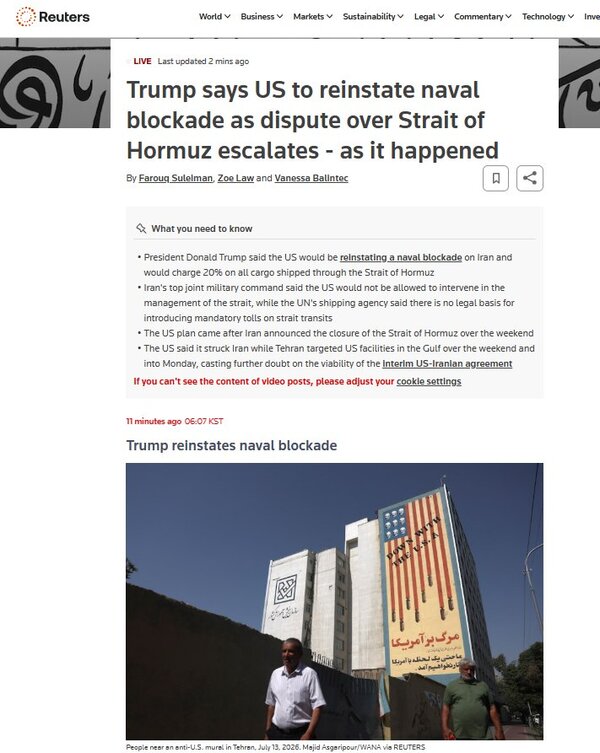
Reuters reported on the 14th (local time) that US Central Command (CENTCOM) announced, "Under presidential directive, a blockade on maritime traffic entering or departing Iranian ports will resume effective 4:00 PM Eastern Time on the 14th (5:00 AM on the 15th, KST)". President Donald Trump concurrently declared on Truth Social, "We are reinstating the Iranian blockade," officially signaling the onset of a new military phase.
The crux of this operation lies in the economy rather than the geography of the sea. Iran's economy is overwhelmingly dependent on crude oil exports, the vast majority of which must transit the critical bottleneck of the Strait of Hormuz. Furthermore, a significant volume of military hardware and strategic supplies flows through these same maritime routes. The US is striking precisely at this structural vulnerability.
A naval blockade is not merely about stopping a few ships. It is a multi-pronged assault designed to simultaneously drain oil revenues, choke off foreign currency inflows, restrict military imports, and degrade the maritime supply lines of the Islamic Revolutionary Guard Corps (IRGC). Consequently, the economic burden on Tehran will compound exponentially the longer the conflict drags on. The US has repeatedly deployed this playbook—leveraging intense economic coercion to establish a platform for military dominance, as seen in the Iraq War and previous iterations of the maximum pressure campaign against Iran.
["Hitting Them Hard Tonight and Tomorrow"… The Message Dropped by Trump ]
Concurrently, kinetic military operations are escalating rapidly. CENTCOM recently disclosed that US forces struck over 300 targets within a three-day window, concentrating on missile and drone facilities, naval bases, ammunition depots, command-and-control nodes, and coastal surveillance networks. In southern Iran, the death of a naval air defense officer marked the first publicly named Iranian military casualty since this latest round of escalation began.
However, the political rhetoric from President Trump carries far greater strategic weight. In an interview with conservative talk-show host Hugh Hewitt, Trump declared, "We're going to hit them very hard tonight and we're going to hit them hard tomorrow." This is not mere political bluster; it serves as public confirmation that Washington has committed to a sustained, high-intensity campaign rather than a brief, transactional retaliatory strike.
Trump further asserted, "There's not a damn thing they can do about it," while explicitly signaling an intention to neutralize "Pickaxe Mountain"—a heavily fortified underground Iranian nuclear facility. This implies that Washington's military objectives have transcended reactive deterrence and are now zeroing in on Iran's broader nuclear infrastructure.
[Control of the Seas Supersedes Supercarriers ]
The United States has deployed a massive naval armada to the Middle East, including two aircraft carriers and over a dozen destroyers. While public attention often fixates on the number of carrier strike groups, the true strategic asset is absolute maritime dominance. By establishing total operational control over the Strait of Hormuz, the Gulf of Oman, and the Arabian Sea, the US gains the leverage to monitor, intercept, and divert any vessel trading with Iran.
Therefore, this massive naval buildup is less about providing close air support for airstrikes and more about secure maritime interdiction. It sends an unequivocal message to the international community: if Iran attempts to weaponize the Strait of Hormuz, the United States will simply assume full administrative and operational control over the waterway.
[Heads of State Now Publicly Threaten Each Other's Lives ]
This standoff features a highly unusual and volatile characteristic that deviates sharply from past Middle Eastern conflicts: both leaders have begun to openly target each other's survival. President Trump warned that any assassination attempt plotted against him would trigger catastrophic, large-scale missile strikes across the Iranian mainland.
In response, Tehran’s top leadership has publicly vowed to exact definitive retribution for any hypothetical elimination of Supreme Leader Ali Khamenei. Such explicit, overt threats directed at the personal survival of sovereign heads of state remain exceptionally rare in contemporary international relations.
Far from being a simple psychological operation, this rhetoric functions as a dual-purpose political and military signal—designed to consolidate nationalistic support domestically while projecting an absolute refusal to blink first on the global stage.
[Oil Markets are Already Reacting ]
The markets moved well ahead of the military maneuvers. As tensions flared across the Strait of Hormuz, international crude prices spiked immediately. Given that a massive percentage of global seaborne crude flows through this narrow corridor, instability here translates directly into macroeconomic volatility worldwide.
Surging oil prices threaten to reignite global inflationary pressures, driving up interest rates and exacerbating volatility across financial markets. Ultimately, this Middle Eastern crisis is rapidly spilling beyond a bilateral confrontation between Washington and Tehran, evolving into a systemic risk that the global economy must collectively bear.
[A Presidential Address to the Nation Could Mark a New Watershed ]
Washington insiders and media outlets are focusing heavily on an upcoming address to the nation by President Trump. With the intensity of military operations compounding daily, the speech is widely expected to lay out concrete parameters for additional airstrikes and articulate the long-term trajectory of the administration's anti-Iran strategy.
Should the US formally escalate its objectives beyond a maritime blockade to launch systemic, kinetic strikes against Iran's core nuclear facilities or its supreme military command structure, the geopolitical landscape of the Middle East will irrevocably shift into entirely uncharted territory.
[Why Times Insight ]
The reimposition of the naval blockade by the United States is a grand strategic move rather than a mere tactical operation. While casual observers remain fixed on the spectacular visuals of airstrikes, Washington's true target is the economic engine and structural viability of the Iranian state. Warfare cannot be sustained by military doctrine alone; it requires capital, uninterrupted crude exports, and a steady influx of strategic materiel. The United States has begun to systematically dismantle these exact linkages.
As a result, this blockade may prove far more devastating than conventional bombardment. As time progresses, oil revenues will dry up, foreign reserves will deplete, and Iran's domestic military supply chains and industrial output will simultaneously fracture. In essence, the US has adopted a strategy designed not just to win tactical battles, but to strip Iran of the foundational capacity to remain a combatant.
All eyes now turn to President Trump's next moves. While the prospect of expanded airstrikes remains critical, the defining factor will be how precisely Washington fuses economic warfare with military coercion to fracture the regime's stability from within. If executed fully, this crisis will cease to be a localized regional conflict and will instead become a defining showdown over the very survival of the Iranian regime.
- TAG