


추부길 whytimespen1@gmail.com
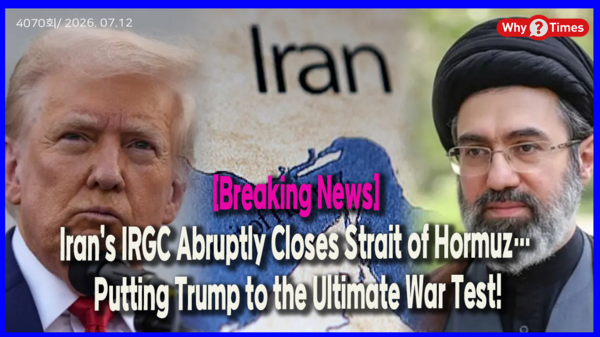
Iran Plays the Hormuz Closure Card Once Again
The world's most critical maritime artery has begun to shake once more. Immediately following the conclusion of the funeral procession for Supreme Leader Ayatollah Ali Khamenei, Iran’s Islamic Revolutionary Guard Corps (IRGC) made the aggressive move of declaring full control over the Strait of Hormuz. Analysts note this timing is by no means a coincidence. It is interpreted as a strategic display of solidarity by the new leadership, sending a clear message to the U.S. and the international community that Iran’s foreign policy stance remains unwavering.
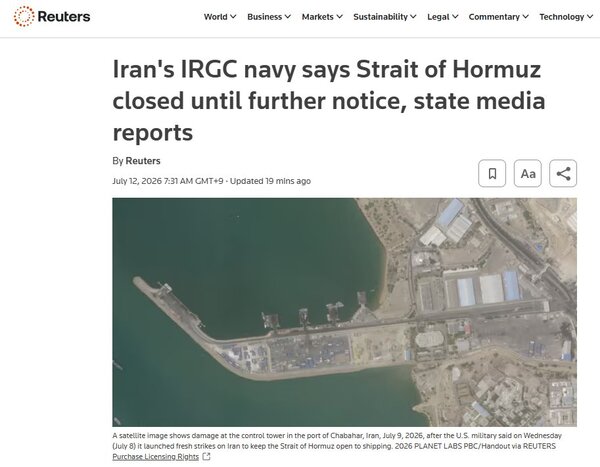
On July 12, Reuters reported, "The IRGC Navy announced early Sunday (local time) that it has closed the Strait of Hormuz 'until further notice,' plunging Middle Eastern geopolitics into a volatile new phase." The report detailed that the IRGC declared control over the waterway after firing warning shots at a foreign vessel it claimed was navigating outside designated shipping lanes. While the United States immediately pushed back, stating that the strait actually remains open and commercial shipping continues, the mere declaration caused an instant reaction in international crude prices, forcing global shipping industries and energy markets into emergency response mode.
The Strait of Hormuz is the literal lifeline of global oil transportation. Roughly 20% of the world's seaborne crude passes through this narrow passage, and the vast majority of Qatari liquefied natural gas (LNG) relies on this route. Furthermore, oil exports from Gulf producers like Saudi Arabia, the UAE, Kuwait, and Iraq are practically entirely dependent on the strait.
Consequently, if transit is restricted for a prolonged period or if shipping lines begin avoiding the route, it will trigger a simultaneous surge in international oil prices, ocean freight rates, and marine insurance premiums. Several shipping companies are already reassessing their voyage plans, and markets are deeply rattled by the prospect of a major spike in crude prices.
Ultimately, Hormuz is not just a shipping lane—it is the cardiovascular system of the global economy. The moment these vessels are blocked or destabilized, the economic shockwave will rapidly ripple past the Middle East, striking Europe, Asia, and the United States all at once.
[Iran Targets the Global Economy, Not the U.S. Military]
This brings us to the core of the current crisis. Iran understands better than anyone that it cannot win a head-to-head military conflict against the United States. Engaging in a prolonged war against the U.S. Fifth Fleet and its carrier strike groups is logistically untenable. Instead, Tehran chose a far more effective lever: targeting the global economy at its most vulnerable pressure point.
When the situation in Hormuz deteriorates, the U.S. feels the blow, but China, Japan, South Korea, and Europe are hit simultaneously. In other words, Iran's strategy is not merely about pressuring Washington; it is about holding the entire global economy hostage to drag the international community to the negotiating table. This marks the onset of full-scale "Economic Warfare," where supply chains and energy resources are weaponized rather than raw military muscle—a shift that carries grave implications.
[The United States Put to the Test]
This crisis presents a critical test for U.S. President Donald Trump. For decades, the United States has upheld the "Freedom of Navigation" as a foundational pillar of the international rules-based order. If Washington appears to passively tolerate Iran's declaration of control, America's maritime hegemony and deterrent credibility will suffer a severe blow. Conversely, if the U.S. deploys military force to forcefully reopen the strait, the risk of a direct, catastrophic clash with Iran becomes almost unavoidable.
The Trump administration now faces a high-stakes dilemma: it must protect the international order without stumbling into an all-out war. Moving forward, Washington's response will serve as a definitive barometer not just for its Middle East policy, but for the endurance of American global leadership.
[China on High Alert, While Russia Stands to Gain Windfall Profits]
The nation watching this unfold with the highest anxiety is China. Beijing relies heavily on Middle Eastern crude imports. If supplies through Hormuz face long-term disruptions, China will simultaneously grapple with surging manufacturing costs and a sharp economic slowdown. For a Chinese economy already struggling under stagnant domestic demand and a prolonged real estate crisis, this could prove to be another massive blow.
Conversely, Russia stands positioned to reap substantial benefits from skyrocketing oil prices. Higher crude prices translate directly into increased energy export revenues, providing Moscow with expanded financial runway to sustain its war in Ukraine.
South Korea is equally exposed. Given its high dependency on Middle Eastern oil imports, rising international crude prices are bound to strain the domestic refining and petrochemical industries, while driving up overall manufacturing and logistics costs across the economy.
[Why Times Insight]
The true nature of this Hormuz crisis extends far beyond a simple maritime blockade. Iran has made a high-stakes geopolitical gambit, squeezing the global economy to test America’s strategic resolve. The primary question for the international community is no longer "How long will Iran attempt to control the strait?" but rather "When and how will the United States restore the freedom of navigation?" Hormuz is no longer just a narrow waterway in the Middle East—it has become the defining battleground for global hegemony and the future of the international order.
- TAG