


추부길 whytimespen1@gmail.com
[Russia’s ‘Safe Rear’ is Disappearing]
The fundamental paradigm of the war is undergoing a profound shift. Historically, warfare dictated committing more troops to the frontlines to push back the enemy. Today, however, Ukraine has pivoted toward a strategy aimed not at individual forces, but at dismantling the very system that enables the Russian state to sustain its war effort. By crippling refineries, severing gas pipelines, sinking fuel tankers bound for the Crimean Peninsula, and launching drone strikes deep over Moscow, Kyiv is shattering the psychological comfort zone of the Russian leadership. The theater of war has expanded from the immediate frontlines to the entirety of the Russian mainland—a shift vividly demonstrated by a series of recent strikes.
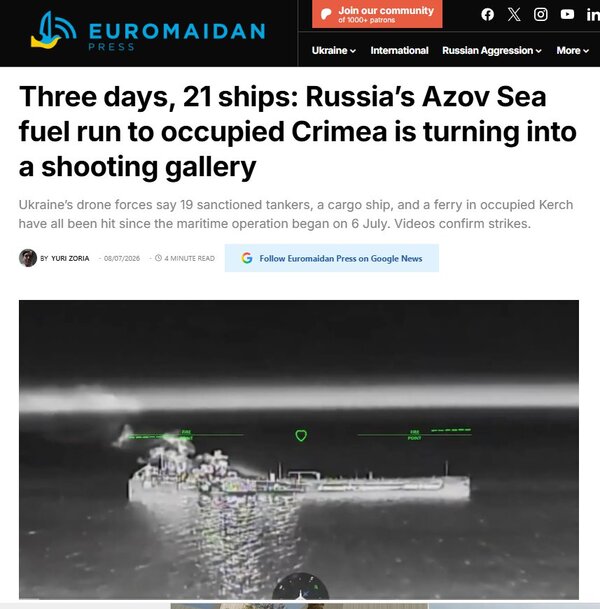
The most symbolic of these operations unfolded off the coast of the Crimean Peninsula. According to Euromaidan Press, a local Ukrainian media outlet, “Ukraine’s Unmanned Systems Forces launched a massive, coordinated assault targeting Russia’s so-called ‘Shadow Fleet’ starting July 6.” The outlet reported that “the offensive was far more potent than anticipated. On the opening night alone, the 'Khairos' unit under the 414th Independent Marine Strike UAV Battalion ('Madyar’s Birds') struck eight tankers alongside cargo ships and ferries. The onslaught persisted, and by July 8, a total of 21 vessels were either sunk or severely disabled within just three days.”
Euromaidan further noted, “Nineteen of these vessels were oil tankers belonging to Russia’s shadow fleet, which operates under international sanctions. While the strikes targeted ships on the surface, Ukraine’s actual objective was not the vessels themselves, but the entire fuel supply architecture of the Russian military.”
Crimea currently serves as the logistical linchpin for Russia’s southern front. Cutting off the fuel flowing into the peninsula inevitably paralyzes tanks, armored vehicles, military transport, and power generation facilities simultaneously. In fact, this operation is a direct extension of a week-long campaign during which Ukraine launched consecutive strikes against over 40 energy infrastructure sites across Crimea and occupied southern territories. Local assessments already indicate worsening fuel shortages. This proves that Ukraine’s strategy has evolved past merely targeting frontline troops, progressing to a phase that severs the logistical and supply lifelines driving the war effort.
[The Russian Energy System Shaken to its Core]
After disrupting the fuel transport network feeding Crimea, Ukraine immediately expanded its cross-border strike radius to energy infrastructure deep within the Russian mainland. Rather than just applying pressure on the frontlines, Kyiv began systematically targeting the entire "production-transportation-supply" lifecycle required to sustain the conflict.
The initial shockwave reverberated through Belgorod, a region bordering Ukraine. Ukrainian forces executed a precision strike on a main gas pipeline management facility (LPUMG) operated by Gazprom, triggering a massive blaze. The attack knocked out power and water supplies across several districts, forcing Russian authorities to acknowledge damage to their energy infrastructure. While border-zone energy sites have been targeted multiple times since the outbreak of the war, recent strikes represent a strategic departure from past incidents; they are no longer isolated disruptions but a concerted campaign designed to induce permanent paralysis in the energy supply chain.
An even greater shock, however, occurred far beyond the borderlands, deep in Siberia. Ukraine’s Special Operations Forces (SSO) deployed long-range drones to strike the Omsk Refinery, Russia's largest oil refining facility. Located approximately 3,000 kilometers from the Ukrainian border and boasting an annual processing capacity of roughly 22 million tons, this facility stands as a core pillar of Russia’s domestic fuel supply system.
The General Staff of the Armed Forces of Ukraine announced, “The strike successfully damaged primary crude distillation units. With this operation, all 11 of Russia's major gasoline-producing refineries have now been targeted since the start of the invasion.” Reuters corroborated the development, reporting that “the Omsk Refinery has faced operational disruptions following the attack, which threatens to significantly exacerbate Russia's domestic fuel supply constraints.”
The critical takeaway here lies not in the immediate damage to individual facilities, but in the total evolution of Ukraine's targeting methodology. Where the objectives were once localized ammunition depots or command posts, they have shifted to a systemic dismantlement of the energy infrastructure supporting both the Russian economy and its military machine. Halting refineries curbs production, cutting pipelines destabilizes distribution, and sinking the shadow fleet chokes off transport to Crimea. This marks the full mobilization of a "systemic paralysis strategy" pressing down on all three pillars of production, transit, and supply.
This strategic pivot was explicitly echoed by President Volodymyr Zelenskyy. During the NATO Summit, he declared, “We have stripped Russia of the very notion that it possesses a strategic rear.” He directly challenged the Kremlin leadership, adding, “Today it is 100 drones, but the day will come when 1,000 drones are heading toward Moscow.”
This statement transcends mere political rhetoric. Advances in drone technology are transforming Russia's vast geography—historically regarded for centuries as its ultimate strategic asset—into a profound vulnerability. In past eras, establishing factories beyond the Ural Mountains guaranteed security, and storing fuel deep within Siberia insulated assets from enemy reach. The advent of long-range drones capable of traversing thousands of kilometers has shattered this formula. The overarching message Ukraine is delivering through these operations is clear: no corner of Russian territory can claim absolute immunity as a safe rear.
[NATO’s Choice: Amplifying Ukraine’s Long-Range Strike Capabilities]
Ukraine’s strategic evolution is not the product of self-reliance alone; it is underpinned by a fundamental shift in Western strategy toward long-term commitment. At the recent NATO Summit, allies moved beyond incremental weapon deliveries, announcing initiatives designed to help Ukraine build its own domestic defense industrial base for advanced weaponry.
The most symbolic development involves technical cooperation regarding the Patriot air defense system. Participation in the production of these cutting-edge defense systems—historically restricted to an exclusive tier of nations—has been extended to Ukraine. Over the long term, this is poised to vastly upgrade not only Kyiv's air defense capabilities but its domestic manufacturing capacity for advanced munitions.
Complemented by expanded joint long-range missile production between Germany’s Rheinmetall and America’s Lockheed Martin, tens of billions of dollars in defense contracts, and billions of euros in fresh military aid, Western strategy has decisively shifted. The goal is no longer merely "sustaining Ukrainian endurance," but rather forcing a "long-term strategic attrition of Russia."
This trajectory presents a grim outlook for Vladimir Putin. Instead of the "Western donor fatigue" the Kremlin had banked on, the international community is doubling down, steering toward a continuous fortification of Ukraine's long-range strike capabilities.
[The True Danger: Economic Exhaustion Outpacing Frontline Warfare]
Parallel to the military escalation, Russia faces a compounding economic crisis. Recent studies by Western research institutes suggest that while Russia has managed to buoy its economy through "Military Keynesianism," the sustainability of this model is rapidly decaying.
The Kiel Institute for the World Economy observed that “the liquid assets of Russia’s National Wealth Fund have plummeted from over 6% of GDP at the onset of the war to around 2% recently.” The Hudson Institute assessed that “this year’s fiscal deficit has already vastly outpaced the Kremlin's annual targets,” while Fortune highlighted surging corporate debt loads and mounting technical defaults.
Predictably, Moscow denies these assessments, and a segment of independent experts argue that Western analyses consistently underestimate the resilience of the Russian economy. It remains premature to predict an imminent economic collapse. However, one reality is undeniable: as Ukraine sustains its campaign against refineries and energy infrastructure, Moscow must shoulder staggering economic costs alongside its military burdens. The Kremlin must reallocate scarce air defense systems to secure its sprawling interior, divert massive state funds to rehabilitate ruined facilities, and absorb ballooning logistical costs to maintain military supply lines. Consequently, the compounding financial strain of the war is highly likely to bleed deep into the broader Russian economy over time.
[Why Times Insight]
The significance of Ukraine's recent wave of coordinated strikes extends far beyond the raw tally of destroyed Russian military assets. The profound takeaway is the fundamental redefinition of the objectives of modern warfare. Traditional conflicts were decided by the volume of enemy manpower and hardware attrited on the battlefield. In the 2020s, defined by the rapid evolution of drone warfare and precision-strike technology, the premier strategic doctrine has become the preemptive neutralization of the adversary's state-level war-sustaining systems.
Every recent attack engineered by Ukraine converges on this single objective: choking production via refinery strikes, disrupting distribution by severing pipelines, strangling logistics by sinking Crimea-bound tankers, and eroding the psychological security of the Russian leadership by penetrating Moscow's airspace. This is a sophisticated strategy engineered to hollow out the foundational architecture that allows Russia to function as a warring state.
As a consequence, Russia now bears the exhausting burden of defending not just a static frontline, but the entirety of its immense homeland. Conversely, Ukraine is successfully operationalizing a new doctrine of warfare, leveraging asymmetric capabilities to exert constant, systemic pressure across the depth of Russian territory.
Ultimately, this conflict offers a defining lesson for 21st-century warfare: victory is no longer dictated simply by who seizes territory first. The vanguard of modern strategic dominance belongs to the nation that can first paralyze the integrated war-fighting ecosystem of its adversary—encompassing its energy, logistics, industrial capacity, financial structures, and collective psychology.

- TAG