


추부길 whytimespen1@gmail.com
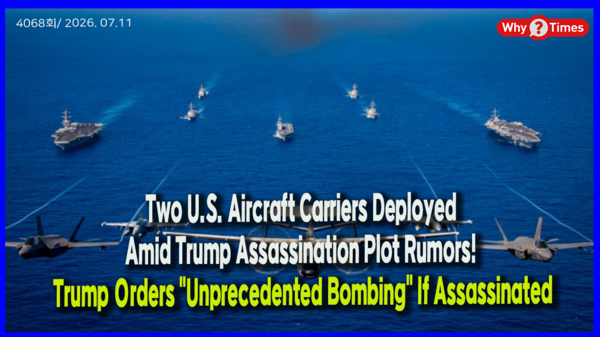
[Trump Discloses Directives for "Unprecedented Bombing" If Assassinated]
As the ceasefire between Iran and the United States has virtually collapsed, the fallout surrounding Iran's alleged plot to assassinate President Trump is intertwining with comprehensive U.S. military and economic pressure, pushing Middle East geopolitics into deeper turmoil. Following President Trump's declaration last week that the ceasefire was "over" in response to attacks on commercial vessels in the Strait of Hormuz, the U.S. has ramped up pressure by deploying over 20 warships, including two aircraft carriers, to Middle Eastern waters and announcing sanctions against close aides of Iran's new Supreme Leader. Amid these developments, reports that Israel passed intelligence to the U.S. regarding a new Iranian plot to assassinate Trump are shifting the military tension into a matter of the President’s personal security. Iran has vowed retaliation against Trump for years since the 2020 killing of Commander Qasem Soleimani, and U.S. authorities previously thwarted two related plots in 2024. Consequently, debate is growing over the authenticity and significance of this latest intelligence.
The New York Post reported on the 11th that "President Trump stated in an interview with the New York Post, 'I have already left instructions that if I am murdered, they are to bomb them to an unprecedented level.'"
President Trump actually stated, "I’ve been on Iran's list for a long time. That is the reality we are dealing with," adding, "The only thing is, I’ve left instructions that if anything happens, they are to bomb them to an absolute unprecedented level." He then added a humorous remark, saying, "I hope you all miss me."
However, President Trump drew a clear line regarding reports that Israel recently delivered information about a new Iranian assassination plot. "No, Israel didn't find anything," he said. "I've been number one [on Iran's hit list] for a long time, and that's life." In short, while acknowledging that Iran has long targeted him, he dismissed claims of intelligence pointing to an imminent new threat.
[Fallout Over Israel's Intelligence via WSJ... CNN Notes "Unverified Information"]
The trigger for the current controversy was a report by The Wall Street Journal (WSJ) on the 9th (local time). Citing sources familiar with the matter, the WSJ reported that "Israel delivered intelligence to the U.S. this week indicating that Iran recently established a new plan to assassinate President Trump." CNN’s political unit confirmed the same details, citing two separate sources, with one source stating that "this warning was newly delivered this week."
However, a cautious approach is required regarding the credibility of this information. CNN noted that "the U.S. has not independently verified this information from Israel, nor was it tracking this specific threat prior to Israel's warning," adding that "multiple U.S. officials suggested the Israeli report could be part of a broader effort by Israel to influence President Trump's decision on whether to escalate military action against Iran."
This aligns with the backdrop of friction between the two leaders over Israeli military operations in Lebanon, as Israeli Prime Minister Benjamin Netanyahu has long expressed deep skepticism regarding Trump's diplomatic efforts toward Iran. Netanyahu's office stated that the two leaders agreed to maintain cooperation during a phone call on the 9th.
["Let’s Kill Trump" Banner at Khamenei’s Funeral... Exceptionally Tightened Security]
The impact of this situation was amplified as it coincided with the funeral procession for Iran's Supreme Leader, Ali Khamenei. The Jerusalem Post reported that "during the funeral processions for the late Supreme Leader Khamenei held across Iran from the 5th to the 9th, mourners displayed large banners reading 'Let’s Kill Trump' alongside posters depicting President Trump’s face framed in a sniper's crosshairs." It added, "According to the WSJ report cited by multiple outlets, mourners also carried placards calling for the assassination of high-ranking U.S. officials, including President Trump and Vice President JD Vance."
Amid this atmosphere, unusual security measures were observed during President Trump's travels for the NATO Summit. France 24 reported that "President Trump traveled to Ankara, Türkiye, on the 7th to attend the NATO Summit aboard a new private jet gifted by Qatar, but switched back to the older Air Force One for his return flight." The report added that "this swap was a 'security precaution' requested by the U.S. Secret Service." The White House reportedly explained the move as a "deliberate deception tactic in response to potential threats."
On the 8th, Trump told reporters in Ankara, "They want to eliminate the American leader, meaning me," adding, "I am on all of their lists. I checked this morning. I've been lucky so far, but that might not last long." He then launched a fierce verbal attack against the Iranian regime, calling them "vicious, sick people" and stating, "Cancer must be cut out early. That is my view."
[Iran's History of Repeated Assassination Attempts... "This Time, the Nature Could Be Different"]
Allegations of Iranian plots to assassinate President Trump are not new. In November 2024, the U.S. Department of Justice disclosed that "Farhad Shakeri, an Afghan national, was tasked by the Islamic Revolutionary Guard Corps (IRGC) to devise a plan to assassinate Trump, who was then a presidential candidate." According to the DOJ, an IRGC official told Shakeri that "money is no object" when ordering the plan. When Shakeri failed to deliver a plan within the timeline, he was instructed to "postpone the assassination until after the election, assuming Trump would lose and his security details would be diminished."
In July of the same year, Asif Merchant, a Pakistani national, entered the U.S. after receiving assignments from an IRGC operative to assassinate U.S. politicians and steal documents. He was arrested after contacting undercover FBI agents posing as hitmen. Merchant was convicted in March on charges of murder-for-hire and attempted acts of terrorism. Attorney General Pam Bondi stated at the time, "This man stepped onto U.S. soil with the hope of killing President Trump, but instead faced the full might of U.S. law enforcement."
In an interview with Newsweek, Arie Perliger, a professor and terrorism expert at the University of Massachusetts Lowell, explained, "State-sponsored assassination plots are typically top-down, cautious, and well-resourced, but they leave behind footprints—such as communications, fund transfers, and recruitment contacts—that U.S. intelligence can capture." He diagnosed the core question of the current intelligence: "The key issue is whether Iran, which is now in an active state of combat, has abandoned this cautious, deniable approach and shifted to a more direct method. If so, it signifies a meaningful escalation in terms of intent and risk tolerance, if not necessarily capability."
[Assassination Outcry Overlaps with All-Out Military and Economic Pressure]
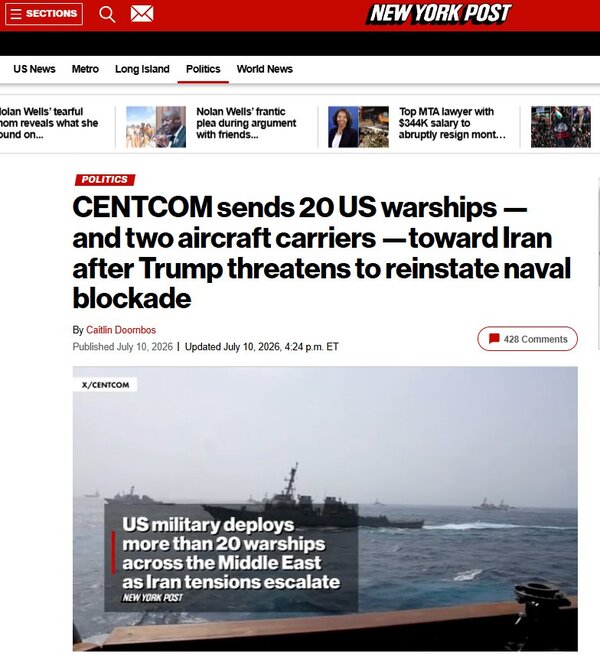
The current assassination plot controversy precisely overlaps with separate, ongoing U.S. military and economic pressure against Iran. Following Iran's attacks on three commercial vessels in the Strait of Hormuz, President Trump declared the ceasefire "over" on the 8th and launched large-scale retaliatory strikes against Iranian military facilities. The U.S. Central Command (CENTCOM) announced on the 10th that it had deployed over 20 warships, including the aircraft carriers USS Abraham Lincoln and USS George H.W. Bush, to Middle Eastern waters. Military experts analyzed this as a preparatory step to resume a maritime blockade that previously crippled Iran's economy. On the same day, the U.S. Department of the Treasury announced sanctions against Ali Ansari, an Iranian financier acting as a key funding source for close associates of the new Supreme Leader, Mojtaba Khamenei.
However, it is worth noting that no official causal link has been confirmed between the reports of the assassination plot and the military pressure measures. CENTCOM’s warship deployment and the Treasury's sanctions were announced in response to the attacks on commercial ships in the Strait of Hormuz, while the assassination plot intelligence was disclosed through a separate channel. Nevertheless, given that both matters surfaced intensively within three days of President Trump's declaration to scrap the ceasefire, analysts suggest that tensions between Washington and Tehran are escalating simultaneously across multiple dimensions, including military, economic, and personal security domains.
Iran has continuously vowed revenge since the 2020 U.S. drone strike authorized by President Trump that killed Qasem Soleimani, the commander of the IRGC's Quds Force. President Trump also survived a previous assassination attempt in July 2024, when a bullet grazed his ear during a campaign rally in Butler, Pennsylvania.
[Why Times Insight]
The key takeaway in this situation lies less in the actual authenticity of the assassination plot reports and more in the way they are being disseminated and consumed. Even though President Trump himself denied the new threat, stating that "Israel didn't find anything," the White House did not bother to refute the leak, choosing instead to respond with the ultra-hardline message of a "bombing order." This indicates that even unverified threat intelligence is already functioning effectively to shape hawkish public opinion against Iran. The point raised by CNN regarding the possibility of an "intentional intelligence leak by Israel" ties into suspicions that the Netanyahu government is attempting to inject military justification into Trump's diplomatic calculus.
At the same time, the two plots thwarted in 2024 demonstrate that Iran's assassination attempts are a structured state project rather than isolated threats. However, as Professor Perliger pointed out, Iranian threats up to this point have followed a "top-down, cautious" pattern that leaves traces of communication, funding, and recruitment. If this latest intelligence truly indicates that Iran is breaking away from this cautious pattern amid an active combat phase, it should be read as a signal that the Iranian leadership's risk tolerance itself has shifted. The military clashes in the Strait of Hormuz, financial sanctions on Khamenei's inner circle, and the assassination threat targeting the President personally—these three tracks emerged via different announcement channels, but they all converged within three days of Trump’s declaration that "the ceasefire is over." This implies that the calculations of Washington and Tehran have now expanded beyond military victories and defeats to include the most acute variable: the personal safety of the President.
- TAG