


추부길 whytimespen1@gmail.com
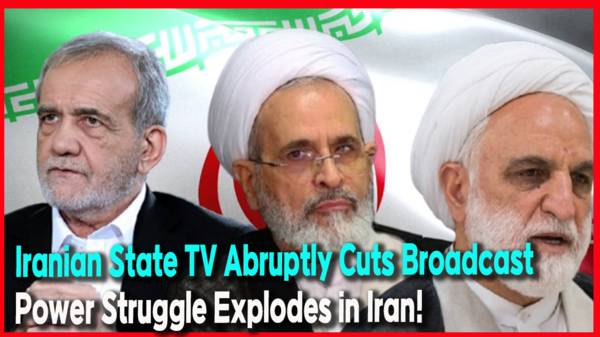
[IRIB Live Broadcast Interruption: A Signal of Power Realignment Behind the Clerical Regime?]
An unprecedented incident occurred when Islamic Republic of Iran Broadcasting (IRIB), Iran’s state-run television network, abruptly cut off a live interview with Parliament Speaker Mohammad Bagher Ghalibaf midway through transmission. While this might appear on the surface to be a matter of routine broadcast editing or censorship, Middle East experts view the incident not as simple media control, but as a glimpse into subtle shifts taking place within the inner chambers of Iran's power structure. In particular, the recent consecutive deletion or interruption of remarks by figures with vastly different political stances indicates that this is not a targeted strike against a specific political faction, but rather a sign that the core leadership is significantly tightening its grip over sensitive national agendas.
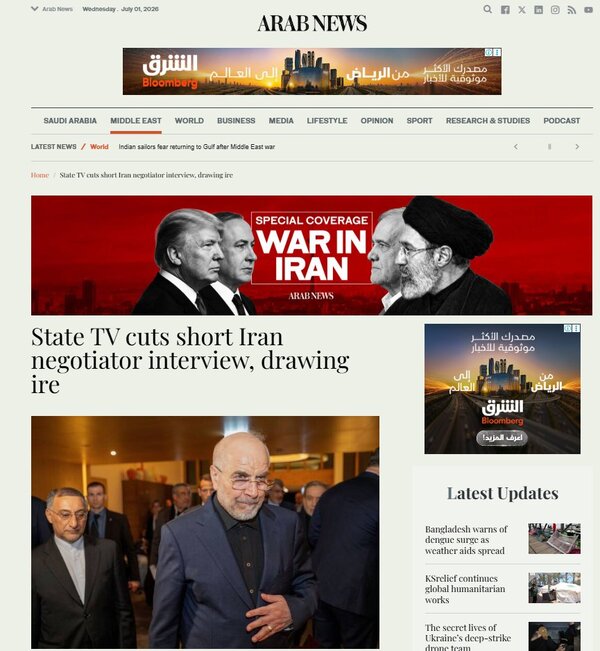
On July 1, Arab News, a leading Middle East English-language outlet based in Saudi Arabia, cited an announcement from the Iranian Parliament Media Center, reporting, "Iran's state broadcaster (IRIB) abruptly cut off an interview with Parliament Speaker Ghalibaf during a live broadcast on the 30th of last month." The report added, "The expunged content included remarks regarding International Atomic Energy Agency (IAEA) inspections, frozen foreign assets, and reconstruction financing."
The crucial issue lies less in the content of the censored remarks and more in the question of why the broadcast had to be severed in the middle of a live airing. Standard media censorship could easily have been handled through post-broadcast editing or by modifying reruns. Cutting off a live broadcast implies that the remarks were deemed so sensitive that their disclosure—even for a moment—posed a severe risk of political fallout. In other words, this incident suggests that the core leadership was intent on blocking the very dissemination of specific messages at all costs.
What makes this even more noteworthy is that it is not an isolated event. Arab News highlighted, "Recently, Mehdi Navabian, a hardline lawmaker, also faced a broadcast interruption while mentioning sensitive details regarding the Supreme Leader." The outlet pointed out, "Ghalibaf and Navabian stand on considerably different political wavelengths; one is evaluated as a pragmatist emphasizing external negotiations and a realistic approach, while the other represents an uncompromising, ultra-conservative stance." Arab News further noted, "The fact that both figures were pulled off the air indicates that the benchmark for censorship has shifted from 'hardliner vs. pragmatist' to whether or not the core leadership desires the information to be public."
It is precisely at this juncture that the incident transcends a mere technical glitch and takes on profound political significance. IRIB is distinct from typical public broadcasters. Since the Islamic Revolution, IRIB has served as a pivotal apparatus for state propaganda and the molding of public opinion, functioning as an integral part of the governing system tied directly to the Supreme Leader. Consequently, Middle East experts universally agree that a live broadcast cutoff can hardly be dismissed as an internal editorial decision by the station; rather, it heavily reflects the mandate of the ruling elite.
What, then, is the Iranian leadership most concerned about? The core issue likely stems from the exposure of the policymaking process itself rather than the specific rhetoric. Iran is simultaneously navigating critical crossroads that will define its national trajectory—including nuclear negotiations with the United States, sanctions relief, the unfreeening of foreign assets, and economic recovery strategies. Under these circumstances, if negotiating strategies or internal debates are leaked to the public, the rifts within the leadership will be exposed, dealing a significant blow to both external negotiating leverage and domestic political stability.
Indeed, Al Jazeera analyzed that "tensions have persisted within Iran recently between hardline factions and those favoring a more pragmatic approach." However, the network cautioned that "interpreting this immediately as an impending regime collapse or civil war is premature," evaluating that "it is more reasonable to view the current situation as an ongoing process of internal calibration and maintaining a balance of power to preserve the existing system."
This point is the crux of the matter. Observers often jump to the conclusion that a live broadcast cutoff means "the regime is crumbling." Yet, international geopolitics rarely moves in such a simplistic manner. Conversely, the more stable a regime's power base, the more sophisticated its control over information becomes. What matters is not the mere fact that censorship occurred, but who possesses the authority to dictate censorship, and by what metrics.
Ultimately, this incident is not just about Ghalibaf as an individual; it provides an occasion to re-examine the shifting dynamics of Iran's power structure. In particular, the Islamic Revolutionary Guard Corps (IRGC), which has rapidly expanded its influence across the military, security, and intelligence sectors in recent years, is emerging as a critical variable in understanding this realignment. While the clerical regime remains intact on the surface, this incident underscores the necessity of investigating where actual policymaking, security, and economic clout are drifting.
[How the Revolutionary Guards Became a 'State Within a State']
To understand this latest censorship saga, one must first look into Iran's unique governance model. Nominally, Iran is a state run by a president, parliament, and judiciary, with the Supreme Leader sitting at the apex of power. In reality, power operates through a far more intricate web. Over the four decades following the revolution, a distinct power structure has taken root—a triangular framework where the clerical establishment, the government bureau, and the IRGC check and balance one another while coexisting.
Among these entities, the IRGC has undeniably expanded its influence at the fastest pace. Originally founded immediately after the 1979 Islamic Revolution to safeguard the newborn revolutionary regime, today's IRGC is far more than a conventional military outfit. It commands its own independent security apparatus comprising ground, naval, and air forces, alongside missile strategic units, drone fleets, the Quds Force for extraterritorial operations, and its own intelligence branches. This is precisely why geopolitical experts refer to the IRGC not as a 'military within a military,' but as a 'state within a state.'
Even more striking is its economic dominion. As protracted U.S. and Western sanctions choked the Iranian economy, the country became increasingly reliant on state-controlled mechanisms over normal market forces. In that vacuum, IRGC-affiliated conglomerates deeply penetrated core national industries, including shipping ports, energy, construction, telecommunications, and finance. Consequently, the organization built formidable economic muscle alongside its military might. An entity that simultaneously controls security, financing, and intelligence naturally secures an absolute veto power over state policy decisions.
In such a framework, even if a president or parliament speaker holds a strong political mandate, it is virtually impossible to sideline the IRGC on matters of existential national importance, such as national security or international diplomacy. Therefore, many observers interpret this live broadcast cutoff not as an isolated media decision, but as a power play over who controls the messaging on highly sensitive national issues.
Here, the profile of Mohammad Bagher Ghalibaf becomes critical. He is no ordinary politician. As a former commander of the IRGC Air Force, former chief of the national police, and former mayor of Tehran, he is a premier heavyweight currently holding the gavel as parliament speaker. Experienced in the military, politics, and administration, Ghalibaf is viewed as one of the few figures capable of bridging disparate power factions.
Western analysts often classify Ghalibaf not as an ideological zealot, but as a political realist. While maintaining an unyielding stance on national security, he has publicly voiced the necessity of economic revitalization, sanctions relief, and engagement with the international community. Against this backdrop, the fact that his voice was silenced mid-broadcast indicates the presence of a delicate friction within the Iranian leadership regarding negotiation strategies and the boundaries of public information.
Another dimension worth noting is that the individuals targeted by recent censorship do not share the same political alignment. The fact that both a hardline ideologue and a pragmatist faced identical muzzling suggests that the regime is tightening the reins on information management across the board, rather than executing a purge against a specific faction.
Recent analyses by major think tanks, such as the Hudson Institute and the Brookings Institution, have consistently focused on this "shift in the gravity of power" within Iran. However, interpretations regarding its ultimate direction vary. While some project that the IRGC's dominance will continue to swell, others argue that because the clerical establishment still retains institutional legitimacy, the two sides are bound to maintain a certain equilibrium.
Ultimately, the pivotal question is not whether the IRGC will completely supplant the clerical hierarchy. A more realistic question is to track toward which axis the actual weight of critical decision-making is gradually shifting. This is why the live broadcast cutoff has captured global attention. On the surface, it is media censorship; beneath it, it signals that micro-adjustments within the Iranian power architecture are actively underway.
[What Deserves More Attention Than Regime Collapse Is the 'Quiet Shift of Power']
Does this censorship episode foreshadow the imminent collapse of the Iranian regime? The consensus among a majority of Middle East experts is that such a conclusion is premature. In a recent analysis, Al Jazeera noted, "While internal friction and power rivalries certainly exist within Iran, there are no verified indications linking this to a breakdown of military command or the outbreak of civil war." The network added, "Because Iran's political system is a multi-layered structure where the clerical hierarchy centered around the Supreme Leader, the IRGC, and the state bureaucracy operate in tandem, the likelihood of a sudden regime collapse triggered by a single event remains low."
A far more plausible scenario is a silent migration of power—one where the nominal regime appears unchanged on the outside, but the center of gravity regarding actual policy formulation shifts decisively toward military and security organs. GlobalSecurity.org, a U.S.-based military and security research organization, pointed out in a recent brief, "While hardline factions emphasize the ideological continuity of the regime, more pragmatic factions believe a certain level of political compromise is necessary for economic recovery and social stability." The brief noted that "in this process, the role of the Revolutionary Guards is highly likely to expand further."
This dynamics extends beyond Iranian domestic politics; it is the exact focal point that Western nations, including the United States and Israel, are watching most closely. While the technical parameters of the nuclear deal were once the paramount concern, the primary variables have now shifted to who is negotiating, who retains final sign-off authority, and where the actual power resides.
For the United States, knowing whether the interlocutor across the negotiating table possesses actual executive authority is far more critical than who that individual is. If a negotiating representative hammers out an agreement but the final ratification power rests with a separate axis of power, the sustainability of any accord is highly precarious. For this reason, calls are growing louder among American Middle East strategists to meticulously track the internal power reconfigurations within Iran, just as closely as its nuclear program.
Israel views the unfolding landscape through a similar lens. While it is easy to assume that a sudden implosion of the Iranian regime would inherently favor Israel, the actual strategic calculus is far more complex. A sudden collapse could trigger a catastrophic power vacuum and the proliferation of rogue militant factions, drastically escalating instability across the entire Middle East. Consequently, many analysts indicate that Israel views a gradual degradation of Iran’s military capabilities and external proxy influence as a far more predictable and realistic scenario than a sudden collapse of the state.
In this regard, the repeating patterns of broadcast censorship carry weight far beyond simple media suppression. The fact that the core leadership has begun to manage what information enters the public domain with heightened sensitivity signals that profound internal deliberations concerning the nation's future direction are underway. Particularly at a moment when monumental issues—such as nuclear diplomacy, the lifting of sanctions, economic restructuring, and regional security strategies—are converging, the control of information inevitably becomes an indispensable instrument of power.
Ultimately, the true takeaway from the IRIB live broadcast interruption is not the cut itself. What warrants deeper scrutiny is who was empowered to make that call, and why it had to be executed at that precise moment. International affairs are frequently driven not by official communiqués, but by the minute, subterranean shifts within a ruling elite. The visible event is merely a single frame; behind it, a much larger current may be quietly unfolding.
Rather than diagnosing this event as a harbinger of the Iranian regime's downfall, reading it as a barometer indicating where the center of gravity is moving offers a far more persuasive analytical approach. The variables determining the future of Iranian politics will likely hinge not on a binary showdown between pragmatists and hardliners, but on the nature of the new equilibrium carved out among the clerical establishment, the Revolutionary Guards, and the state bureaucracy.
The live broadcast may have been severed in a matter of minutes, but the questions raised by that brief interruption will linger for a long time to come. What is occurring in Iran today may not be mere censorship, but a profound reallocation of power. Depending on where this transformation settles, not only the future of Iran but the geopolitical equilibrium of the entire Middle East could be thrust into an entirely new phase.
- TAG