


추부길 whytimespen1@gmail.com
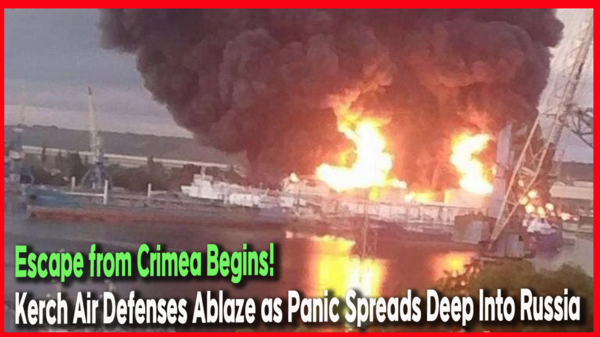
[Air Defenses Crushed, Supply Lines Severed… ‘40-Day Operation’ Shakes Crimea]
Ukraine is intensifying its multi-dimensional, coordinated pressure targeting the Crimean Peninsula. Following consecutive strikes on Russian air defense networks near Kerch, Ukraine has launched serial attacks on key supply bridges and substations connected to Crimea, rapidly crippling the logistics capabilities of Russian forces. Furthermore, rumors that families of the occupying administrative officials have already begun evacuating are spreading, deepening anxiety within the peninsula. Analysts suggest that Ukraine's "40-Day Operation" is transcending mere airstrikes and has begun to destabilize the very foundation of Russia's occupational rule.
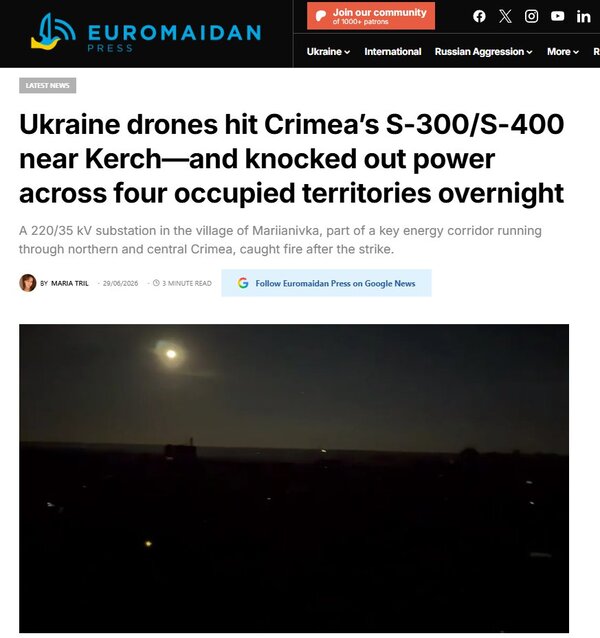
On June 30, the Ukrainian media outlet Euromaidan cited an analysis by "Exile+," an anonymous OSINT (Open Source Intelligence) group, reporting, "Ukrainian attacks appear to have struck Russian S-300 or S-400 air defense missile systems stationed in the Crimean Peninsula." The report added, "These are among Russia’s most elite air defense assets—strategically critical systems that are highly expensive and limited in availability."
Euromaidan further noted, "As the Security Service of Ukraine's (SBU) '40-Day Operation,' approved by President Zelenskyy on June 25, swings into full gear, the Crimean Peninsula is facing simultaneous, multi-directional strikes." According to the outlet, "Immediately after the launch of the operation on June 26, the SBU announced drone strikes targeting the Volga and Vyatka—Russian Navy minelayers docked at the Zaliv Shipyard in Kerch—as well as the passenger-cargo ship Petropavlovsk. Simultaneously, the radar and weapon systems of the S-400 air defense network responsible for protecting the Kerch Strait were also targeted."
The report continued, "At around 2:20 AM on June 29, anomalous heat signatures were detected at an air defense position near Kerch, and NASA’s Fire Information for Resource Management System (FIRMS) captured fires in the area. OSINT analysts are interpreting this as evidence of a strike on the air defense site."
At the same time, the OSINT group Falcon Insight and the Telegram channel 'Krimsky Veter' (Crimean Wind) reported, "A fire also broke out at the 220/35kV substation in Maryanivka, Kurmansky District, Crimea. As a consequence, large-scale power outages occurred across multiple Russian-occupied territories, including Crimea, Donetsk, and Kherson."
However, the U.S. public broadcaster NPR assessed that "this attack constitutes one of the most powerful drone strikes carried out by Ukraine," while adding that the extent of damage to the naval vessels and some of the strike outcomes could not be independently verified.
[Supply Bridges in Donetsk and Luhansk Destroyed in Succession]
The Ukrainian onslaught was not confined to air defense networks. The Kyiv Independent reported, "While squeezing Crimea's air defenses, Ukrainian forces are also accelerating efforts to sever land supply networks leading to the peninsula." The outlet added, "The General Staff of the Ukrainian Armed Forces announced that during overnight operations on June 28–29, they struck two bridges: a road bridge near Novoazovsk in Donetsk and a railway bridge in Luhansk."
The Kyiv Independent went on to say, "The General Staff explained that these bridges had served as vital logistics axes for transporting Russian troops, weapons, and ammunition." The same operation also targeted a military warehouse near Novosvitlivka in Luhansk, three drone command posts across Zaporizhzhia, Donetsk, and Kursk, and an electronic warfare command post near Velyka Novosilka in Donetsk.
Furthermore, The Kyiv Independent pointed out, "Ukraine’s 413th Separate Unmanned Systems Regiment 'Raid' struck four additional substations in the Kurmanske and Dzhankoi regions of Crimea during the night of June 29. The General Staff also announced that on June 30, they attacked a road bridge near Azovske in Zaporizhzhia and a railway bridge near Ichki in Crimea."
Militarnyi, a Ukrainian military news outlet, reported, "Following the drone strike, vehicular traffic on the Hruzkyi Yelanchyk River bridge in Novoazovsk has been restricted to a single alternating lane." It added, "This bridge is a critical piece of infrastructure that the Russian military had expanded and reinforced in 2024 for large-scale logistics transportation." The outlet evaluated such actions as an extension of the so-called "Middle Strike" strategy, which utilizes drones to continuously strike targets tens to hundreds of kilometers behind the frontlines.
The New Voice of Ukraine (NV), citing French OSINT analyst Clément Molin, noted, "In 2026, Ukrainian drones conducted over 1,000 precision strikes in areas more than 100 kilometers behind Russian lines. Of these, 35% targeted ammunition, fuel, and logistics depots, 20% targeted transport vehicles, and 7% targeted air defense systems." Western analysts estimate that approximately 125 military cargo trucks have been destroyed on the critical M-14 and N-20 land supply routes connecting Russia to Crimea alone.
[State of Emergency and Fuel Shortages: Have Officials Evacuated Their Families First?]
As the hammering of supply lines persists, signs of disruption are emerging within Crimea's administrative apparatus. The Moscow Times reported, "The occupying authorities of Crimea declared a regional state of emergency on June 26." According to the report, Mikhail Razvozhayev, the occupational governor of Sevastopol, stated that the state of emergency would remain in place until the situation stabilizes, while Sergei Aksyonov, the head of the occupying administration in Crimea, explained it as a measure to expedite property damage compensation procedures.
The Moscow Times further conveyed, "More than 2,000 vehicles swarmed the access roads to the Kerch Bridge waiting for security checkpoints, causing wait times of nearly five hours on average. Meanwhile, train operations connecting Moscow and Crimea have been slashed to half their original schedule."
Fuel shortages are also weighing heavily on residents' daily lives. Al Jazeera cited accounts from residents who could only purchase limited amounts of fuel after waiting in long lines at gas stations near Simferopol, reporting that "fuel shortages persist in some regions." Igor Girkin, a hardline pro-Russian figure, also lamented on Telegram, stating, "The gas station situation in Crimea is a true nightmare for both residents and soldiers."
Amidst this backdrop, rumors that occupation officials are evacuating their families first are spreading like wildfire. Oleg Kryuchkov, an advisor to the head of the occupation administration, acknowledged the existence of these rumors on Telegram but attempted to defuse the situation, saying, "Word is going around that we should leave because officials have snuck their families out, but our residents have endured every crisis since 2014."
In a separate announcement, the Ukrainian partisan group ATESH claimed, "We have independently detected evacuation movements among the families of occupation administrative officials and Russian Federal Security Service (FSB) personnel." However, this claim has not yet been independently verified, and the Ukrainian media outlet UNN also relayed observations that "such movements are expected to wrap up within a few days."
[The Real Goal Targeting Crimea: Shaking the 'Cost of Occupation']
Ukraine's "40-Day Operation" has not yet even reached its halfway point. However, looking at the pattern of attacks revealed so far, the objective clearly extends beyond the mere destruction of military facilities. The strategy is interpreted as an effort to sharply drive up the cost for Russia to maintain its grip on the Crimean Peninsula by degrading air defenses, severing supply bridges and railways, and simultaneously squeezing the power grid and logistics hubs.
The Crimean Peninsula serves as Russia’s core military staging ground to sustain its southern front, as well as a symbolic political achievement for Moscow. Consequently, military instability in this region crosses the line from a mere tactical loss to a direct assault on the political authority of the Putin regime. If the reports of panic and instability within the occupying administrative ranks are true, it suggests that the combination of military pressure and psychological warfare is successfully yielding results.
Granted, it is still too early to definitively predict the ultimate fate of the Crimean Peninsula. Yet, one fact remains clear: Crimea is no longer a safe rear base for Russia. Ukraine is maintaining a multi-layered, suffocating pressure campaign that simultaneously targets air defense networks, logistics lines, energy infrastructure, and the psychological stability of the occupation administration. If this trend continues, the likelihood is growing that the Crimean Peninsula—while remaining a strategic asset—will morph into Russia's single heaviest liability.

- TAG