


추부길 whytimespen1@gmail.com
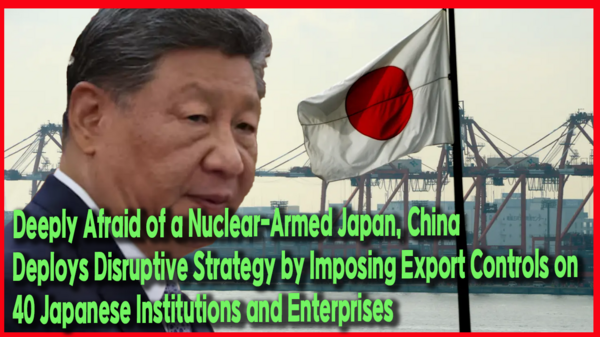
[Silence on North Korea's Nuke, Export Controls on Japan: China's 'Nuclear Double Standard']
China has launched a sweeping wave of export controls targeting 40 Japanese defense enterprises and research institutions. While Beijing's overt justification is to halt Japan's military buildup and forestall its potential nuclear armament, critics point out that its concurrent silence on North Korea’s nuclear issue underscores a glaring "nuclear double standard." Consequently, this measure is interpreted not merely as a standard trade restriction, but as a calculated strategic maneuver by Beijing regarding the nuclear order in Northeast Asia.
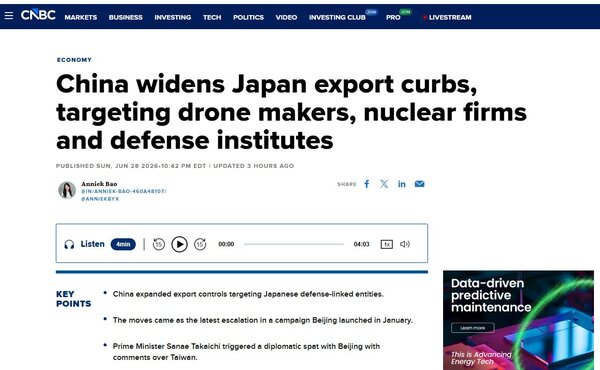
On June 29, U.S. media outlet CNBC reported that “on the 29th, China’s Ministry of Commerce added 20 entities, including Japan’s National Institute for Defense Studies and Mitsubishi Electric’s Defense & Space Systems, to its export control list, while placing another 20 enterprises, such as Mitsui E&S and drone manufacturer Terra Drone, on a cautionary watch list,” adding that “both measures took effect immediately, with companies on the watch list now subject to more stringent end-user and end-use verifications.”
CNBC further noted that “the Chinese Ministry of Commerce cited Japan’s military buildup as the rationale behind the measures,” explaining that “Beijing claims Japan is reinforcing a 'neo-militaristic' trajectory by expanding offensive weapon systems and test-firing missiles abroad, framing its own actions as necessary for national security and international non-proliferation obligations.” However, Beijing added that the measures “will not affect normal Sino-Japanese economic cooperation, and law-abiding Japanese companies have no reason for concern.”
Nonetheless, the prevailing view among observers is that this move is a strategic pressure campaign directly targeting the foundation of Japan's defense industry rather than a routine trade action.
[Anti-Japan Sanctions Underway Since January: The Core Intent is 'Containing Japan']
This is not the first time Beijing has ramped up pressure on Tokyo. Japan's The Japan Times noted that “China has been progressively expanding sanctions against Japan ever since Prime Minister Sanae Takaichi mentioned last year that Japan could intervene militarily in the event of a Taiwan contingency.”
The Japan Times pointed out that “in January, China imposed export controls on strategic minerals such as rare earths, tungsten, and molybdenum, as well as aerospace-grade carbon fiber and high-precision sensors, followed by the sanctioning of 20 entities, including Mitsubishi Shipbuilding, in February,” emphasizing that “this latest measure serves as a significant second wave of pressure following that continuum.”
The market reacted instantly. The Japan Times reported that “shares of Mitsubishi Electric and Komatsu NTC dropped by 1.4% and 4.6% respectively, whereas Mitsubishi Heavy Industries and Terra Drone actually saw gains.”
Commenting on the development, Gracelin Baskaran, a research fellow at the Center for Strategic and International Studies (CSIS) in Washington, assessed that “China is actively leveraging its dominance over rare mineral supply chains as a tool for political leverage rather than relying on military conflict.”
[What China Fears Most is Japan's 'Potential Nuclear Capability']
A noteworthy element of this measure is China’s repeated invocation of "preventing a nuclear-armed Japan" as its justification. However, verified facts indicate that the Japanese government is not pursuing nuclear armament as an official policy.
The foreign policy magazine The Diplomat explained that “during a plenary session of Japan's House of Representatives in February, Prime Minister Takaichi drew a clear line regarding a NATO-style nuclear sharing concept, stating that 'such a form of nuclear sharing is unacceptable' and reaffirming that the Three Non-Nuclear Principles remain current government policy.” The Diplomat added, however, that “discussions within Japan on the need to re-examine the Three Non-Nuclear Principles are gradually expanding in tandem with the changing security environment.”
The Carnegie Endowment for International Peace analyzed that “Prime Minister Takaichi noted in her past writings that the Three Non-Nuclear Principles could become a strategic obstacle in the future, and since taking office last year, her avoidance of clear answers to related parliamentary inquiries has ignited an internal debate within the Liberal Democratic Party (LDP).”
Recently, the Japan Innovation Party (Nippon Ishin no Kai), a member of the ruling coalition, formally proposed that the government realistically re-examine the principle of banning the entry of nuclear weapons, alongside the issue of allowing U.S. nuclear-powered submarines to port. Still, the LDP-led government remains focused on strengthening the United States' extended deterrence rather than adopting nuclear armament as official policy.
[Why China Remains Highly Sensitive]
Why, then, is China reacting so sensitively to the mere possibility of a nuclear-armed Japan? The primary reason is that Japan is evaluated as a country capable of achieving nuclear weaponization in the shortest timeframe globally if it chooses to do so. Japan possesses world-class nuclear power technology, space launch vehicle capabilities, advanced missile technology, and a massive stockpile of separated plutonium. International security experts have consistently posited that a rapid transition to a nuclear state is entirely feasible for Tokyo should a political decision be made.
From Beijing’s perspective, North Korea's nuclear capability serves as a strategic variable to check the United States. However, if Japan chooses nuclear weaponization, the paradigm shifts entirely. In the East China Sea and the Western Pacific, China would find itself directly confronting another nuclear-armed state right on its doorstep, in addition to the United States. Analysts argue this is precisely why China is concentrating its crosshairs on Japanese defense contractors and national defense research institutes.
[Silence on North Korea's Nuke: China's 'Nuclear Double Standard']
A more profound issue lies in China's asymmetric posture. During the North Korea-China summit held in Pyongyang last June, President Xi Jinping and Chairman Kim Jong Un emphasized the expansion of diplomatic and security cooperation, but any mention of North Korean denuclearization was conspicuously absent from their joint announcements.
The Associated Press (AP) evaluated this by stating that “Xi’s nuclear silence was the biggest gift to Kim Jong Un,” while Al Jazeera analyzed that “while China-North Korea cooperation has strengthened, denuclearization has effectively vanished from the agenda.”
The Institute for the Study of War (ISW) assessed that “this attitude from China could have the practical effect of tacitly condoning North Korea’s status as a nuclear-armed state,” and The Washington Post (WP) interpreted the scene as “China flaunting its strategic relationship with a nuclear-armed North Korea.”
In short, China is exhibiting a starkly contradictory stance—slabbing heavy economic sanctions on Japan over the mere possibility of nuclearization, while refraining from public pressure on North Korea, which already possesses a functional nuclear arsenal.
[The Card Played by China Could Embolden Japan’s Hawks]
Paradoxically, China’s dual approach is highly likely to fuel hawkish rhetoric within Japan. As China maintains its silence on North Korea’s nuclear arsenal while focusing its pressure solely on Tokyo, conservative factions in Japan can more forcefully argue the logic that “China condones North Korea’s nukes while attempting to bind Japan's hands.”
In reality, the current security debate in Japan is centered on how to reinforce U.S. extended deterrence rather than acquiring independent nuclear weapons. However, as Chinese military and economic pressure persists, it is difficult to rule out the possibility that discussions on radical defense alternatives will gain wider traction.
Ultimately, this export control measure is far deeper than a standard trade dispute. China seeks to preemptively suppress Japan’s latent nuclear potential, yet it maintains a self-contradictory silence on North Korea’s nuclear realities. While this "nuclear double standard" may apply short-term pressure on Japanese defense firms, over the long haul, it is highly likely to yield the paradoxical result of validating security hawks and justifying a military buildup within Japan. The security architecture of Northeast Asia is now entering a volatile new phase as China's pressure campaign intersects with Japan’s strategic response.
- TAG