


추부길 whytimespen1@gmail.com
[The Paradox of the 400-Ship Fleet — More Means More Perilous]
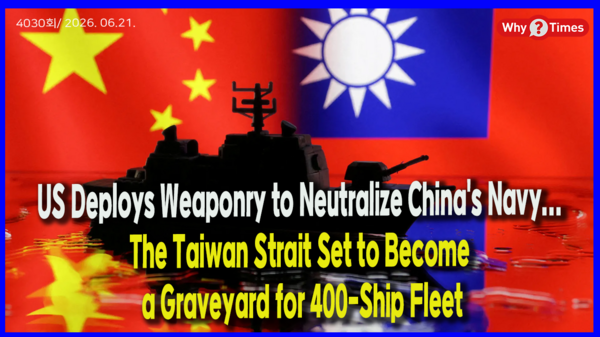
China already possesses the world's largest navy by ship count. However, an analysis gaining traction among US national security experts suggests that this massive scale could morph into a fatal vulnerability in an actual wartime scenario like a Taiwan invasion. The US military has recently demonstrated its capability to neutralize large vessels with a single strike using submarine torpedoes and precision-guided bombs. Consequently, they calculate that sinking just a few ships in the narrow Taiwan Strait could paralyze the entire invasion operation. Crucially, as the year 2027—Beijing's self-imposed deadline for invasion readiness—converges with the United States' timeline for building out its Indo-Pacific defense network, the strategic rivalry between the two powers is entering a new phase.
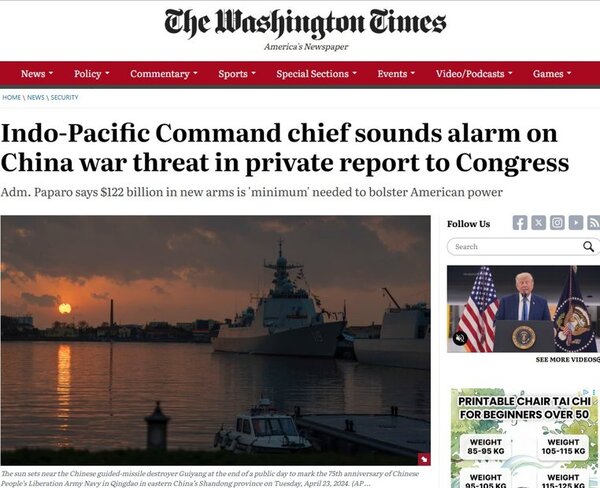
On June 17, The Washington Times reported, "In March of this year, a US Navy submarine dragged an enemy warship beneath the waves with a single torpedo, breaking a near 80-year silence during which no nation's submarine had sunk an enemy combatant with a torpedo in actual combat." The report added, "Three months later, Admiral Samuel Paparo, Commander of the US Indo-Pacific Command, requested a $122 billion FY2027 budget from Congress, presenting a list of weapon systems dead-set on the Chinese navy. This report was disclosed on the 17th by Bill Gertz, a national security correspondent for The Washington Times."
Regarding this, Admiral Paparo stated, "This amount represents the minimum investment required to maintain deterrence and, should deterrence fail, to prevail in conflict." However, the true vulnerability targeted by this report is not the Chinese navy’s firepower, but rather its heavily touted "scale" itself.
The U.S. Naval Institute (USNI) pointed out, "China has long propagated that it possesses the world’s largest navy by hull count. The People's Liberation Army Navy (PLAN) already has the world's largest fleet, numbering approximately 400 ships with a total displacement of 3.2 million tons. While the US Navy still leads in total displacement at 4.5 million tons, this overwhelming numerical advantage can instantly flip into a liability the moment the scenario narrows down to a specific Taiwan invasion."
USNI further noted, "In a Taiwan invasion scenario, China must deploy hundreds of vessels of various sizes to ferry forces across the treacherous Taiwan Strait. Because viable landing beaches are restricted to just a few locations, Chinese ships will inevitably face rapid congestion along their approach avenues. They will have to navigate through mining fields and around sister ships that are sinking or ablaze after being struck by anti-ship missiles." The institute sharpened its critique, adding, "The very 'scale' that allows them to mobilize hundreds of ships transforms into a massive bottleneck when confronted with the geographical constraints of a narrow strait and limited beachfronts. Sinking just a few vessels near the coast slows the advance of the remaining invasion fleet, leaving them more exposed to follow-on strikes from the shore or the air." This is the paradox of quantitative superiority: the more ships you have, the more targets concentrate in one place.
[No Carrier Needed — A Single Bomber Targets Enemy Vessels]
A weapon that precisely exploits this vulnerability has already proven its operational capability in the field. USNI News highlighted that "On March 4, an 80-year silence was shattered in the waters off Sri Lanka," noting that "The Moudge-class frigate IRIS Dena (of Iran) was sunk after being struck by a US Mk-48 heavyweight torpedo. This marked the first time a US submarine had sunk another surface combatant with a torpedo since World War II."
USNI News continued, "The last time a US Navy submarine sank an enemy warship was on August 14, 1945, when the USS Torsk sank a Japanese escort ship near Japan with a torpedo," adding that "The Dena was returning home after participating in MILAN 2026, a multilateral naval exercise hosted by India, and was evaluated as one of the most capable new surface combatants in their fleet."
USNI News pointed out, "The fact that a new capital ship was neutralized by a single strike during a routine voyage serves as a warning of equal weight to nations possessing navies of similar or greater scale."
In the air, an even more menacing weapon has followed a similar developmental trajectory. The Washington Times detailed, "The 'Quicksink' maritime strike capability mentioned in the report is a weapon system that outfits a Joint Direct Attack Munition (JDAM) kit with an imaging infrared seeker to strike moving targets. After navigating to the target area via GPS and inertial guidance, it switches to the seeker, matches the ship’s length against an internal database for identification, and precisely strikes the hull just below the waterline." The outlet added, "Following a proof-of-concept phase in 2022, a B-2 stealth bomber successfully sank a real maritime target in the Norwegian Sea in September 2025. In June of this year, testing was completed on a smaller 500-pound version, allowing a single bomber to carry a greater payload per sortie."
Commenting on this, the foreign policy magazine The Diplomat observed, "The true threat of this weapon lies in the fact that aircraft carrier strike groups are no longer a prerequisite." Bryan Clark of the Hudson Institute noted, "Before the advent of Quicksink, the threats the Chinese navy had to worry about were limited to nearby aircraft carriers, surface combatants, or submarines. Now, they must factor in the potential for strikes by US Air Force bombers launching from the homeland." He added, "If a single bomber flying from across the ocean can select and sink just a few exact ships among a fleet crammed into a narrow strait, the advance of the entire remaining fleet will inevitably grind to a halt."
The Diplomat emphasized, "The capability to mass-produce Quicksink bombs rapidly is viewed as a distinct advantage. This weapon, which can be deployed in large volumes precisely yet cheaply, directly targets China's traditional strategy of 'overwhelming via fleet scale'."
[2027: China’s Invasion Timeline and Completion of US Defense Net Collide Precisely]
What deserves close attention is that the infrastructure supporting this lethality is being completed at the same breakneck speed. The Washington Times reported, "As part of a $4.5 billion homeland defense strategy program for the Pacific, Admiral Paparo requested $909 million for the Defense of Guam system to counter China's ballistic, hypersonic, and cruise missiles. This system will also provide a foundation for future offensive capabilities." The Washington Times further noted, "The Guam defense architecture is an $8 billion initiative designed to establish a 360-degree, multi-layered defense shield, with initial operational capability slated for Fiscal Year 2027."
The Washington Times underscored, "This timing is uncanny," pointing out that "The same report notes that the PLA has been ordered to be ready for military action against Taiwan by 2027. The deadline for China to prepare its invasion and the deadline for the US to complete the defense network that would pin that invasion fleet down in a narrow strait are pointing to the exact same year." Within this same timeline, deployments have also been locked in for the Typhon land-based mid-range missile system, the Dark Eagle Long-Range Hypersonic Weapon (LRHW), and the low-cost 'Blackbeard' missiles, all capable of being fired toward China from Guam.
Coincidentally, US intelligence agencies and the Department of Defense assess that the Chinese military has been instructed to complete its capabilities for a Taiwan invasion by 2027. In essence, the point at which China wraps up its invasion preparations aligns perfectly with the year the United States completes the core assets designed to thwart it.
[The Paradox of a Massive Fleet—More Means More Perilous]
The Diplomat concluded, "Ultimately, the findings of this report and these real-world engagements converge on a single point: while China has grown confident in its superiority based on the absolute scale of its fleet, the US military has been systematically aiming at the exact point where that scale becomes a vulnerability in a narrow strait."
The Diplomat stated, "As peer competition intensifies with the Chinese navy, which now boasts the world's largest fleet, the US Army, Marine Corps, and Air Force are all being pushed alongside the Navy to develop independent maritime strike capabilities to contribute to sea denial operations." It added, "The Iranian warship actually sank, and the Quicksink bomb actually destroyed a target ship; neither was a hypothetical scenario, but actual combat operations."
To be sure, the Indo-Pacific Command’s budget request is an annual procedural routine, and there is an element of emphasizing threats to secure funding. However, that does not negate the geographical constraints of the Taiwan Strait or the verified performance of weapon systems already proven through tests and drills.
Ultimately, the biggest issue facing the Chinese navy is not its ship count. It is how fast that massive fleet can maneuver when a war begins, and how quickly it can be neutralized. In a cramped theater like the Taiwan Strait, the world's largest fleet could either be an overwhelming force or a massive, self-blocking bottleneck. What the United States is preparing for is a strategy precisely engineered for that exact moment.
- TAG