


추부길 whytimespen1@gmail.com
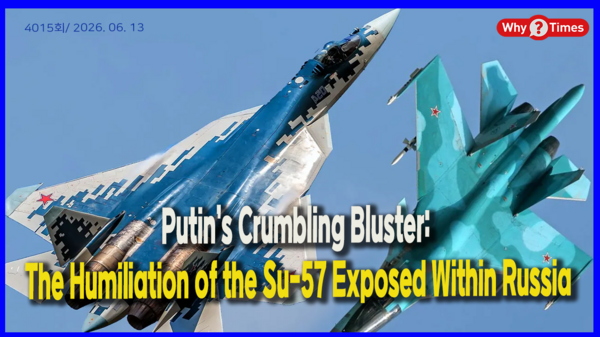
[Putin’s Bluster Shattered in Five Days: The 5th-Generation Fighter Myth Implodes]
The bravado of Vladimir Putin, who once boasted of possessing the "world's best fighter jet," has hit rock bottom. Public criticism has erupted over the fact that Russia’s self-proclaimed top-tier fifth-generation stealth fighter, the Su-57, has failed to show its face in the war in Ukraine. What makes this backlash particularly notable is that it originated from within Russia, not the West. The fact that military experts from the warring nation and the aircraft's manufacturer are publicly raising doubts carries significance far beyond a simple controversy over weaponry. It signals that the war in Ukraine, now in its fourth year, has begun to expose the reality of Russian military might, and Russians themselves are starting to acknowledge the cracks.
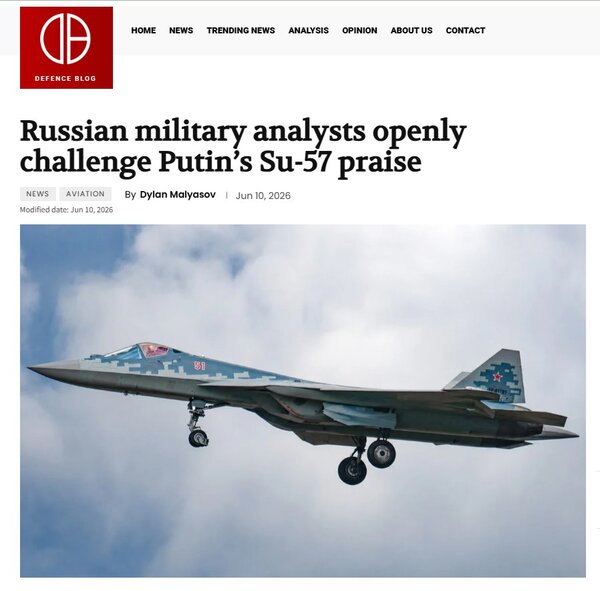
Defense News, an independent online media group specializing in global military, security, and defense industries, reported on June 11: "Russian President Vladimir Putin boasted at the St. Petersburg International Economic Forum (SPIEF) on June 5, while proposing joint production of the Su-57 to India, that 'the Su-57 is a fifth-generation aircraft and I believe it is the best aircraft to date.'" The outlet highlighted that "immediately following Putin's remarks, Russian military bloggers and analysts launched public rebuttals. They pointed out that the Su-57's highly restricted operational role—remaining confined to long-range standoff launches without ever appearing in Ukrainian airspace despite the ongoing war—serves as the most damning counterevidence to the president's claims." This pushback carries unprecedented weight, given that it comes from within the invading country and the nation that manufactures the jet, navigating a media environment where criticizing military programs carries severe personal risk.
Defense News further noted, "Leading the charge in this dissent was the prominent independent Russian defense commentator, Maxim Kalashnikov." He delivered a scathing critique, stating: "If the Su-57 is a better aviation complex than the notorious F-35, where is it in Ukraine? The Israeli Air Force's F-35s operated against Iran as if air defenses didn’t exist at all. They struck air defense systems and hit decisively important targets. Do we see similar actions from the Su-57 in Ukraine? No, only drones and missiles. Is the Su-57 even following behind those waves of attacks? What matters in life are actions, not words. We have already heard enough words."
According to Defense News, "The criticism went beyond operational deployment to target the aircraft's very status as a 'fifth-generation' jet." Domestic Russian commentary responding to Putin's remarks included statements such as: "Without the S-70 Hunter (Okhotnik), the Su-57 is merely a museum rarity. It has failed to become a true fifth-generation aircraft in terms of engines, avionics, or stealth. Everyone is witnessing the results in the Special Military Operation (the war in Ukraine). The Russian Aerospace Forces have failed to secure air superiority in contested areas and have even lost control of the airspace over Russian territory itself." This self-deprecating admission—that the air force of the 'world's second-strongest military' cannot even protect its own skies—came straight from the mouths of Russian citizens.
[The F-35 Over Iran, the Su-57 Outside the Theater]
In a related analysis, Defense.Info—an international security and defense media outlet providing deep dives into global strategic challenges, defense systems, and security environments—stated, "The combat record of the Israeli F-35, which Kalashnikov used as a benchmark, makes the absence of the Su-57 stand out even more dramatically." The outlet noted, "During a 12-day operation against Iran, the Israeli Air Force conducted over 1,400 long-range sorties, striking targets up to 1,600 kilometers away without losing a single manned aircraft. While 3,709 bombs were dropped on 2,879 targets, Iran managed to fire only two surface-to-air missiles at Israeli manned jets, neither of which came anywhere near their targets. In March of this year, an F-35I 'Adir' shot down an Iranian Air Force Yak-130 over Tehran, marking the first-ever manned air-to-air kill by an F-35."
In contrast, Defense.Info observed that "the Su-57’s track record during the same period is dismal." According to Ukrainian and Western sources, Russia has strictly limited the Su-57 to a 'standoff' role, launching long-range weapons like the Kh-69 cruise missile from within Russian or occupied airspace to avoid entering the envelope of Ukrainian air defenses. Defense.Info added, "Instead of committing the Su-57 to meaningful missions in contested airspace, the Russian Aerospace Forces have relied heavily on cruise missiles, Shahed drones, and glide bombs," concluding that "Russia has effectively abandoned the very raison d'être of a stealth aircraft: penetrating enemy air defenses."
Testimony suggests this passive deployment was an intentional act of 'concealment.' The Ukrainian outlet Euromaidan Press reported, "In an interview with Donbas.Realii in January this year, a Ukrainian MiG-29 pilot revealed that Russia abandoned its initial plan to use the Su-57's deployment over Ukraine as an export promotion campaign. Instead, they removed the aircraft from active operations and stored them near the Urals." This implies Moscow chose to hide the jets rather than risk a humiliating performance that could ruin its export market.
[Shooting Down Its Own Wingman: The Humiliation of the S-70 Incident]
Defense News pointed out an incident that Russian domestic commentary alluded to without explicitly detailing: "On October 5, 2024, a prototype of the S-70 Okhotnik drone—developed to serve as the Su-57’s 'loyal wingman'—suffered a technical failure, lost connection with ground control, and began drifting toward Ukrainian-controlled territory near Kostiantynivka in the Donetsk region. Facing the risk of Russia’s most advanced combat drone falling intact into enemy hands, the pilot of the accompanying Su-57 fired an air-to-air missile and shot down his own wingman."
The report continued, "The wreckage fell directly into Ukrainian hands as a trophy. Ukrainian forces recovered the debris roughly 16 kilometers from the front lines, and subsequent analysis by Ukrainian and Western experts cast serious doubt on Russia’s claims regarding the drone's sophistication." Defense News quoted a Ukrainian defense expert who assessed the wreckage not as the sophisticated stealth platform advertised in Russian promotional materials, but rather as "closer to a glider equipped with basic flight capabilities and radio-control systems." The outlet analyzed that "this incident, where the Su-57 had to shoot down its own partner aircraft designed to act as its command relay and wingman, accurately illustrates the networking and systems integration gaps that Russian commentators are now raising across the entire Su-57 program."
[Legacy Engines, Legacy Radar: The Exaggerated 'Fifth-Generation' Label]
"The technical reality is also far from 'world-class,'" Defense News noted. "The Su-57 models currently in mass production do not fly with the next-generation 'Product 30' engine, but rather with the AL-41F1, a derivative of the Su-35 engine." Western analytical institutions assess that "the new engine program required to guarantee supersonic cruise capability—a defining characteristic of fifth-generation aircraft—has been delayed for years. Furthermore, the intake design and exterior surface treatments fall short of the radar signature management achieved by the F-22 or F-35." This means the aircraft fails to meet both core requirements of a fifth-generation jet: stealth and supercruise.
Regarding this issue, the National Security Journal stated, "The radar disparity is even more structural." The journal explained, "While modern Western Active Electronically Scanned Array (AESA) radars have transitioned to Gallium Nitride (GaN)-based transmit-receive modules, which extend detection range by approximately 70%, Russia remains stuck with older Gallium Arsenide (GaAs) technology." It added, "In stark contrast to the widespread adoption of AESA radars across modern American and European fighters, the N036 Belka on the Su-57 is the only AESA radar Russia has managed to mass-produce. Ukrainian radar designers familiar with the inner workings of Russian industry have testified that early Russian-made transmit-receive modules suffered from extremely low efficiency."
[Drones Find Them, Even Hidden Behind the Urals]
The price of dodging combat in the skies is being paid on the ground. The Kyiv Independent reported, "The commander of Ukraine's Unmanned Systems Forces, Vadym 'Madyar' Sukharevskyi, confirmed on May 1 that a drone strike on Russia's Shagol Air Base in the Chelyabinsk region on April 25 successfully hit four combat aircraft, including two Su-57s and one Su-34." The target was located roughly 1,700 kilometers from the Ukrainian border. Satellite imagery from the analysis group Exilenova+ visually verified the strike location. This marks the second time an Su-57 has been struck, following the 2024 hit on the Akhtubinsk base in the Astrakhan region, which Russia acknowledged. Even the 'vault' behind the Ural Mountains has been breached.
[Proclaiming 'World’s Best' with a Mere 19 Aircraft]
The hard numbers paint an even grimmer picture. The International Institute for Strategic Studies (IISS) stated, "As of April 2025, the Russian Aerospace Forces possessed an inventory of just 19 Su-57s." Of these, seven were delivered over the two-year period of 2023–2024, exposing a massive gap between the Kremlin's production target of 16 aircraft per year and actual manufacturing speeds. The IISS added, "It took 15 years after its maiden flight for Algeria to become its first export customer. Algeria's schedule involves receiving 14 Su-57E jets split into six in 2025, six in 2026, and two in 2027. When compared to the United States, which has produced over 1,100 F-35s and deployed them across allied nations, the very notion of calling them 'peers' is completely untenable."
[Analysis and Outlook] What is Crumbling is Not Just a Fighter Jet, But the Myth of a 'Strong Russia'
The essence of the Su-57 controversy is not merely a performance debate over a single aircraft model. It signifies that the narrative of a "Strong Russia," which has underpinned the country's entire military projection, is facing a harsh reality check on the battlefield.
Since the Cold War, Russia has leveraged its image as an overwhelming military superpower as a strategic asset. However, the war in Ukraine is systematically dismantling these myths one by one—first with its tanks, then the Black Sea Fleet, overall airpower, and now its advanced stealth fighter.
What is most painful for Moscow is that these assessments are not Western propaganda, but are emerging from within Russia itself. The most dangerous moment for an authoritarian regime is not when it faces external criticism, but when internal cynicism begins to spread.
This fracture offers a crucial takeaway for the Korean Peninsula. Amid deepening military cooperation with Russia, the upper limit of what North Korea can hope to gain from potential aviation technology transfers is precisely the flawed reality of this Su-57. Conversely, the F-35A fleet operated by the Republic of Korea Air Force belongs to the exact same aircraft family that proved its penetration and survivability in real combat over Iran. Commentator Kalashnikov’s sharp reminder that "what matters are actions, not words" sounds the death knell for the myth of Russian weaponry, while ironically validating the qualitative superiority held by the ROK-U.S. combined air forces.

- TAG