


추부길 whytimespen1@gmail.com
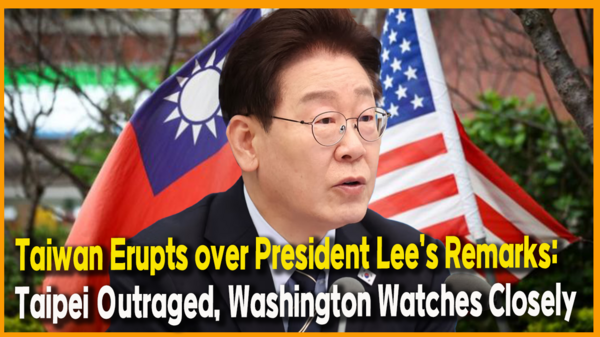
[Using Taiwan as a 'Shield' at the First-Anniversary Press Conference]
President Lee Jae-myung’s remarks during his first-anniversary press conference have triggered unexpected diplomatic ripples. In an attempt to explain the performance of the KOSPI, President Lee used Taiwan as a point of comparison—a move that drew fierce backlash from the Taiwanese media and added fuel to ongoing concerns in Washington regarding the health of the US-ROK alliance. What began as a routine commentary on domestic economics has rapidly escalated into a diplomatic headache.
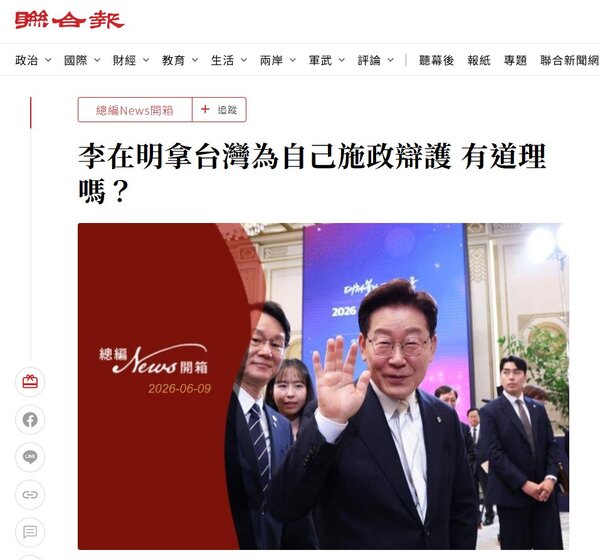
On June 9, United Daily News (聯合報), one of Taiwan’s two major daily newspapers, leveled harsh criticism at the South Korean president: "During his press conference, President Lee claimed that if geopolitical risk were the genuine culprit behind falling stock prices, it could not explain Taiwan's situation." The daily argued that President Lee effectively used Taiwan as a "shield" to defend his administration's economic policies.
The publication took particular issue with another segment of Lee's remarks. "President Lee noted that 'from a military and security perspective, the Korean Peninsula is no less stable than Taiwan—provided, of course, that we refrain from constantly provoking North Korea,'" United Daily News reported. The paper interpreted this as an offensive downplaying of the security threats in the Taiwan Strait, engineered solely to legitimize Seoul's appeasement policy toward Pyongyang.
Ultimately, the core of the issue lies less in the original intent of the statement and more in how it was perceived. While viewed in Seoul as a mere macroeconomic metaphor, the remarks touched a raw nerve in Taiwan, where Chinese military intimidation has become an everyday reality.
[Why Taiwan Reacted with High Sensitivity]
The scale of the current controversy is amplified by President Lee’s track record of controversial remarks regarding Taiwan. In March 2024, during his tenure as opposition leader, Lee famously declared at a campaign rally in Dangjin, South Chungcheong Province: "Whether Taiwan and China fight or not, what does that have to do with us?"
At the time, national security experts in both Washington and Taipei countered that viewing the Taiwan Strait issue as entirely disconnected from South Korea's national interest was detached from geopolitical reality. Should a military conflict erupt in the Taiwan Strait, the operational role of United Forces Korea (USFK) would immediately be called into question, and South Korea’s vital maritime trade routes would face direct disruptions.
The Taiwan Strait serves as one of the world's most critical maritime choke points. Any kinetic conflict in these waters would instantly deliver a severe shock to the export-dependent South Korean economy. It is precisely for this reason that both the United States and Japan explicitly link the stability of the Taiwan Strait to their own vital national security interests.
Consequently, President Lee's latest press conference remarks did not create a new controversy out of thin air; rather, they dragged a long-simmering debate over his foreign policy worldview back into the spotlight.
[Mounting Concerns in Washington Over the US-ROK Alliance]
What makes President Lee’s remarks particularly sensitive is that skepticism regarding the alliance has been structurally expanding across South Korean society. In a report titled "South Korean election campaign sparks US alliance questions," Nikkei Asia observed that "fresh security pressures and Trump-induced chaos are eroding public confidence in Washington." The outlet reported that during the local election cycle, weekly protests near the US Embassy in downtown Seoul—where hundreds chant anti-American slogans—actually grew in scale.
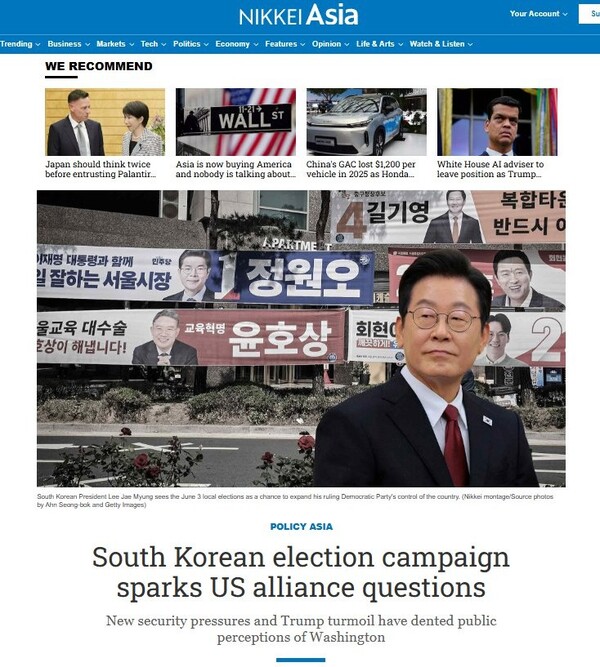
Nikkei Asia analyzed that "this shifting tide of public opinion, coupled with the Lee administration's diplomatic trajectory, is amplifying anxieties in Washington." The outlet added that with anti-American sentiments resonating within the civil society groups that back the ruling party, foreign observers are growing cold as President Lee's diplomatic language carelessly entangles itself with the Taiwan issue.
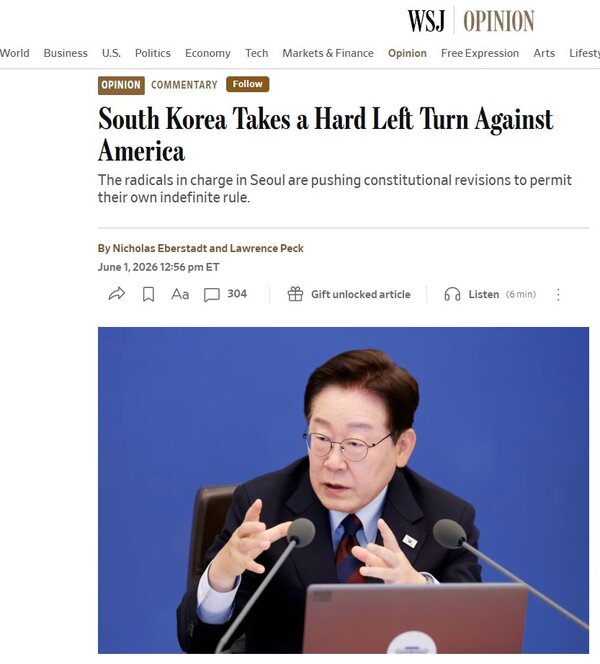
On June 2, The Wall Street Journal (WSJ) published a joint op-ed by Nicholas Eberstadt, a researcher at the American Enterprise Institute (AEI)—a prominent conservative, market-oriented think tank based in Washington, D.C.—and Lawrence Peck, an advisor to the North Korea Freedom Coalition. Titled "South Korea Takes a Hard Left Turn Against America," the op-ed explicitly categorized the Lee administration as a "hard-left" regime and warned that it could exert severe, negative long-term impacts on the US-ROK alliance.
Choi Sung-ah, the Presidential Secretary for Foreign Media, quickly hit back with a counter-op-ed in the WSJ, stating that the piece failed to reflect the realities of modern South Korea and risked undermining trust in one of America's closest allies, calling it a "grave distortion."
While such assessments can be viewed as strictly reflecting the perspectives of the American conservative establishment, the broader takeaway is undeniable: South Korea’s diplomatic alignment has turned into an object of open debate within Washington’s political elite—a phenomenon rarely seen under previous South Korean administrations. Ironically, the Blue House's highly publicized pushback merely underscores the reality that South Korea has become a contentious topic inside the Beltway.
[Rubio: "Seoul’s Treatment of US Firms Hampering Trade Negotiations"]
Simultaneously, the American news agency UPI reported that "US Secretary of State Marco Rubio, testifying before the House Foreign Affairs Committee, explicitly noted that South Korea’s treatment of American companies has impacted Washington's ability to finalize trade agreements." Rubio reportedly added that while the United States respects the domestic choices of democratic nations, it has no choice but to intervene when core American commercial interests are compromised. During the same hearing, Republican Representative Darrell Issa blasted South Korean democracy as having taken a "sharp leftward tilt," arguing that Seoul is opening more pathways for Chinese influence.
Secretary Rubio’s public linkage of trade negotiations to the treatment of US firms is far more than mere political rhetoric. The friction traces back to a controversy surrounding a Starbucks tumbler promotional event, where President Lee personally took to social media to state that "moral, administrative, legal, and political accountability must rightfully be imposed." Washington interpreted this executive intervention as a signal that American corporations were being treated as political targets. Combined with ongoing regulatory investigations into Coupang, the perception in Washington has evolved from an ideological disagreement into a concrete conflict of commercial and trade interests.
[US Assistant Secretary Meets Officially with Critic of Lee Government]
Rifts in the alliance are manifesting across other diplomatic channels as well. Riley Barnes, the US Assistant Secretary of State for the Bureau of Democracy, Human Rights, and Labor (DRL), visited the Saegwero Church in Busan during an official trip to South Korea to meet with representatives of Pastor Son Hyun-bo. Pastor Son is a prominent conservative religious figure who spearheaded rallies opposing the impeachment of former President Yoon Suk-yeol. Notably, Assistant Secretary Barnes was appointed by Secretary Rubio and concurrently serves as the Special Coordinator for Tibetan Issues and Acting Envoy for International Religious Freedom.
Barnes was accompanied by Julie Turner, Acting Deputy Assistant Secretary for DRL, and Belsis Romero, the White House Faith-Based Communities liaison. The meeting’s agenda reportedly covered highly sensitive domestic issues, including legislation regarding the dissolution of religious corporations, the push for a comprehensive anti-discrimination law, insurrection charges levied against Pastor Son, and targeted regulations on Christian alternative education. Given that Assistant Secretary Barnes held high-level meetings with South Korea’s Ministry of Foreign Affairs the following day, the visit to Saegwero Church was an official diplomatic maneuver, signaling Washington's close monitoring of South Korea’s internal political fractures.
[Ambassador Kang Co-Hosts "End-of-War" Event with Anti-Trump Lawmaker]
Against this backdrop, diplomatic observers are closely watching the upcoming attendance of South Korean Ambassador to the US Kang Kyung-wha and former Democratic Party leader Song Young-gil at a Korean Peninsula End-of-War Declaration and Peace Agreement event. The event is spearheaded by Representative Brad Sherman, a prominent House Democrat. Representative Sherman re-introduced the Peace on the Korean Peninsula Act (H.R. 1841) for the 2025–2026 congressional session, calling for a binding peace agreement to formally conclude the Korean War and the establishment of liaison offices between Washington and Pyongyang. Crucially, Sherman is also known as a staunchly anti-Trump progressive Democrat who previously led efforts to impeach Donald Trump.
With the Trump administration already raising public alarms over the leftward tilt of the South Korean government, the decision by the Lee administration's ambassador to join an event led by a leading anti-Trump lawmaker sends an incredibly counterproductive signal to the current Washington establishment. An end-of-war declaration is fundamentally entangled with the legal status of USFK and calls for the dissolution of the United Nations Command (UNC). The formal participation of the South Korean ambassador in such a forum underscores just how far the Lee administration’s North Korea and US policies have drifted from the mainstream Washington consensus.
[Overlapping Fault Lines: Washington and Taipei Cool Simultaneously]
On its own, pushback from the Taiwanese press may not inflict a fatal blow to South Korean diplomacy. The real peril lies not in Taipei's irritation, but in how Washington interprets the underlying mindset. While the immediate uproar in Taiwan could blow over as a short-lived media episode, the Lee administration’s framing of the Taiwan issue acts as an important indicator for a Trump administration that prioritizes countering China above all else.
In an environment where Washington views the containment of Beijing as its premier foreign policy directive, any messaging from Seoul that downplays the strategic importance of the Taiwan Strait—or treats cross-strait stability as a matter completely foreign to South Korean interests—carries weight far beyond mere rhetoric. Indeed, policy circles in Washington are already keeping a watchful eye on the Lee government's stance toward Beijing.
Ultimately, the essence of this controversy is not about Taiwan itself. It centers on where South Korea intends to position itself amidst the escalating US-China strategic rivalry. While Taipei’s indignation is an isolated event, how Washington chooses to decode that signal will dictate the future trajectory of the US-ROK alliance and South Korea’s strategic standing to a degree far greater than Seoul may anticipate.
- TAG