


추부길 whytimespen1@gmail.com
[From Canada to the South China Sea… Simultaneous and Multi-Pronged Pressure on Beijing]
In May 2026, a distinct shift materialized in the international environment surrounding China, spanning from the Taiwan Strait and the South China Sea to Singapore and Europe. A Canadian warship transited the Taiwan Strait to coincide with Chinese Foreign Minister Wang Yi’s visit to Ottawa, while the Dutch Navy engaged in an electronic warfare-level standoff with the Chinese military in the South China Sea. At the Shangri-La Dialogue—Asia’s premier security summit—the absence of China’s Defense Minister drew intense international scrutiny, and the United States continues to bolster its First Island Chain deterrence network, spearheaded by the "Typhon" mid-range missile system. Viewed in isolation, these appear to be disparate incidents; however, when connected as a single narrative, a far clearer picture emerges. The hardline diplomacy and power politics that China has pursued over the past decade are now backfiring, working in reverse to constrict Beijing's own strategic environment.
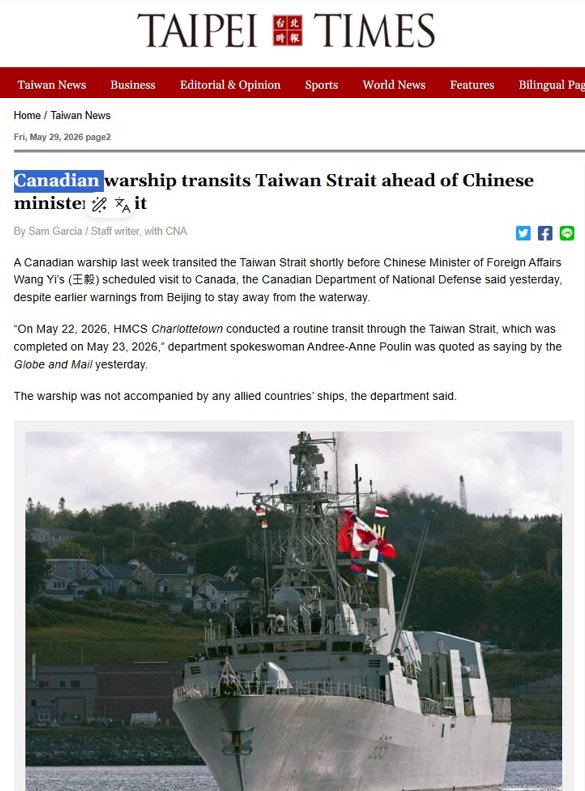
Taiwan’s Taipei Times recently reported, “During the final week of May, at the exact moment Chinese Foreign Minister Wang Yi arrived in Ottawa for his first visit to Canada in ten years, the Canadian Navy frigate HMCS Charlottetown executed a solo transit through the Taiwan Strait.”
Commenting on this, Canada’s The Globe & Mail noted, “This voyage, conducted independently without the escort of allied warships, was highly unusual and provoked an immediate backlash from Beijing.” The publication further highlighted, “More notably, this was not a random decision by Canada; this transit marks Canada's eighth passage through the Taiwan Strait since announcing its Indo-Pacific Strategy in November 2022, and its first of this year.”
[The South China Sea: Electronic Warfare Clash with a Dutch Vessel]
In a related report, Hong Kong’s South China Morning Post (SCMP) stated, “During the same period, a more direct confrontation was unfolding in the South China Sea.” It revealed that “on May 27, when the Dutch Navy frigate HNLMS De Ruyter (F804) and its shipborne helicopter appeared in the airspace over the Paracel Islands, the Southern Theater Command of the Chinese People’s Liberation Army (PLA) launched an immediate response.”
Furthermore, Bloomberg explained, “The Chinese Navy and Air Force took 'necessary measures,' including verbal warnings and electronic interference, to expel the vessel.” It added, “Footage released by the Chinese military showed at least two warships and fighter jets intercepting the Dutch frigate, whereas the Netherlands maintained its stance that its vessel was operating in international waters.”
Additionally, Newsweek reported, “The De Ruyter entered the South China Sea after conducting joint exercises with nations including India and Indonesia, and the Dutch government described the operation as an expression of its commitment to freedom of navigation and regional security.”
While the South China Sea issue was previously perceived as a bilateral showdown between the United States and China, it has now transformed into a matter of direct intervention by European nations. This demonstrates that China’s maritime expansion strategy is no longer viewed merely as a regional grievance, but as an object of global concern.
[The Empty Chair at the Shangri-La Dialogue… Why China’s Presence Has Diminished]
The 23rd Shangri-La Dialogue, held in Singapore at the end of May, put another reality facing China on full display. For the second consecutive year, China withheld its Defense Minister from attending, opting instead to send a delegation composed primarily of research institutes and military experts.
CNBC reported, “U.S. Defense Secretary Pete Hegseth remarked, ‘I wish our counterpart were here,’ while representatives from Japan, Germany, and the Philippines also publicly expressed regret and criticism over China’s absence.”
In particular, the assessment by Philippine Defense Secretary Gilberto Teodoro that “in terms of value proposition, China's presence has shrunk to a minimum level” carries deep symbolic weight. China has long advocated for a new international order to challenge the U.S.-led system, yet it effectively forfeited its chance to speak at Asia’s largest security forum.
[The Shock of the Typhon Missile: A New Strategic Pressure Beyond THAAD]
What worries China even more than diplomatic friction is the changing military landscape. The military affairs publication 19FortyFive summarized, “At the core of this military encirclement lies the U.S. 'Typhon' land-based, mid-range missile system.” It added, “As of 2026, U.S. military Typhon Mid-Range Capability (MRC) batteries deployed along the First Island Chain project a lethal strike radius of approximately 1,930 kilometers, fundamentally reshaping the landscape of Indo-Pacific deterrence.”
The Typhon is a ground-launched system capable of firing Tomahawk cruise missiles and SM-6 missiles. While THAAD is a purely defensive weapon, Typhon represents an offensive capability tailored to directly strike an enemy's core military infrastructure in the opening stages of a conflict.
Beijing views this as a grave threat, particularly because it is designed to directly counter China’s long-established Anti-Access/Area Denial (A2/AD) strategy.
Compounded by the strengthening trilateral security cooperation among the U.S., Japan, and the Philippines, the First Island Chain is transitioning from a simple line of defense into a strategic choke point designed to restrict China's maritime power projection.
[The U.S.-Japan-Philippines Trilateral Alignment and the Completion of the First Island Chain]
The deployment of the Typhon system effectively turns the First Island Chain into a strategic bottleneck. By leveraging the anti-ship capabilities of the SM-6 missile, the U.S.-Japan alliance has secured its own A2/AD capability—a modern military strategy designed to prevent hostile forces from entering a specific operational theater (Anti-Access; A2) or to limit their freedom of maneuver once inside (Area Denial; AD). Simultaneously, the deepening trilateral security cooperation among the United States, Japan, and the Philippines is delivering a decisive blow along this containment line.
In May, during Philippine President Marcos’s visit to Japan, South China Sea security cooperation was discussed in depth. The U.S.-Japan-Philippines trilateral alignment is evaluated as making the defense of the First Island Chain more ironclad while applying direct pressure on China's expansionist strategy. Even Indonesian military officials are now openly discussing scenarios where a Chinese blockade of Taiwan could trigger a U.S.-led counter-blockade of the Strait of Malacca.
[How Russia Shattered China’s Image as a ‘Neutral Actor’]
Paradoxically, it was Russia—China’s closest strategic partner—that further exacerbated Beijing’s diplomatic burden. The foreign policy magazine Foreign Policy pointed out, “The most paradoxical aspect of this diplomatic encirclement is the fact that China’s closest partner, Russia, has single-handedly dismantled Beijing’s claims of 'neutrality.'” It noted that “in the first quarter of 2026, Russia's oil exports to China increased by 35%, and NATO has officially designated China as a 'decisive enabler' of the war in Ukraine.” The basis for this designation is that Chinese companies are supplying dual-use goods used to replenish Russian weapons production.
Elaborating on this, Ukrainska Pravda pointed out, “More decisively, China trained a group of Russian soldiers in late 2025, who subsequently went on to fight against Ukraine.” It added, “This covert training, heavily focused on drones and electronic warfare, has dealt an irreparable blow to the 'neutral state' image that Beijing has painstakingly tried to maintain.” EU Commission President Ursula von der Leyen has signaled that she will use this as justification to further tighten sanctions on subsidized Chinese products.
[The World Pivots Toward Taiwan… Cracks in the ‘One China’ Diplomatic Wall]
The shift is equally stark regarding the Taiwan issue. Throughout the month of May, a succession of high-profile delegations—including Israeli lawmakers, the President of Paraguay, German and French parliamentary delegations, and top executives from the U.S. defense industry—visited Taiwan in rapid succession.
Notably, French political figures publicly referring to Taiwan as a “de facto state” is a scene that would have been unimaginable in the past.
While Beijing continues to emphasize its “One China” principle, the international community is increasingly moving to expand political and security contacts with Taiwan. In effect, the diplomatic defensive wall that China spent decades building is beginning to crack.
[The Invoice for Wolf Warrior Diplomacy… What China is Losing is its ‘Strategic Space’]
The most significant shift revealed by the international political landscape in May 2026 is not the mere fact that China is being militarily encircled. The more fundamental issue is that the strategic buffer zones China painstakingly spent the last two decades building are rapidly evaporating.
In the past, a significant number of nations maintained economic cooperation with China while remaining neutral on security matters. Today, however, even nations with vastly different interests—such as Canada, the Netherlands, Germany, France, Japan, and the Philippines—are moving in alignment on the Taiwan Strait and South China Sea issues.
The adversary China must face has also changed; it is no longer a specific, single nation. Instead, a new strategic coalition, forged out of a pervasive wariness toward China’s behavior across the international community, has materialized before Beijing.
"Wolf Warrior" diplomacy has transformed neutral nations into a distinct containment bloc, and coercive behavior in the South China Sea has pushed the Philippines to the front lines of the U.S. alliance network. Meanwhile, China's "no-limits partnership" with Russia has structurally damaged its relationship with Europe. While each individual choice may have looked like a display of strength at the time, the aggregate result has engineered the exact type of international coalition that China dreaded most.
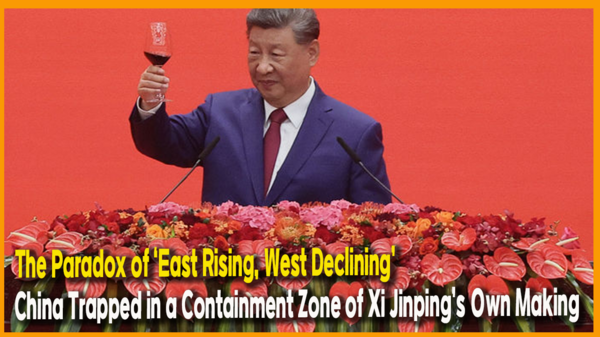
Xi Jinping has long asserted that "the East is rising and the West is declining (東升西降)." Yet, the world in May 2026 painted a completely different picture. The West has not fractured; instead, it is coalescing around the Taiwan Strait and the South China Sea. China may have risen to superpower status, but it has simultaneously become the most strategically contained nation in the world.
Ultimately, what is pressing down on Beijing right now is not a handful of warships or a few missile batteries. It may well be the very strategic space that China has constricted for itself—the direct consequence of the hardline diplomacy and power politics Beijing has consistently chosen over the past decade.

- TAG