


추부길 whytimespen1@gmail.com
[From 'Partner' to 'Systemic Rival' — Europe’s Inverted Perspective on China]
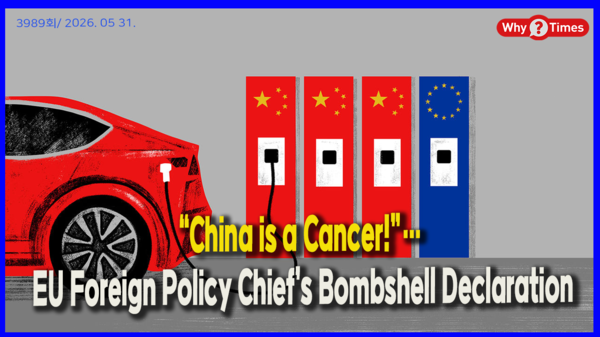
The European Union (EU) has effectively admitted the failure of its decades-long economic strategy toward China. Kaja Kallas, the EU’s foreign policy chief, compared the issue of China dependency to "cancer treatment," warning that a painful structural overhaul is inevitable. With China cannibalizing Europe’s core industries—ranging from solar energy and batteries to industrial robotics—the phrase "panic attack" has surfaced within Brussels. Europe has now entered a phase where it is forced to choose between the benefits of cheap Chinese goods and industrial survival.
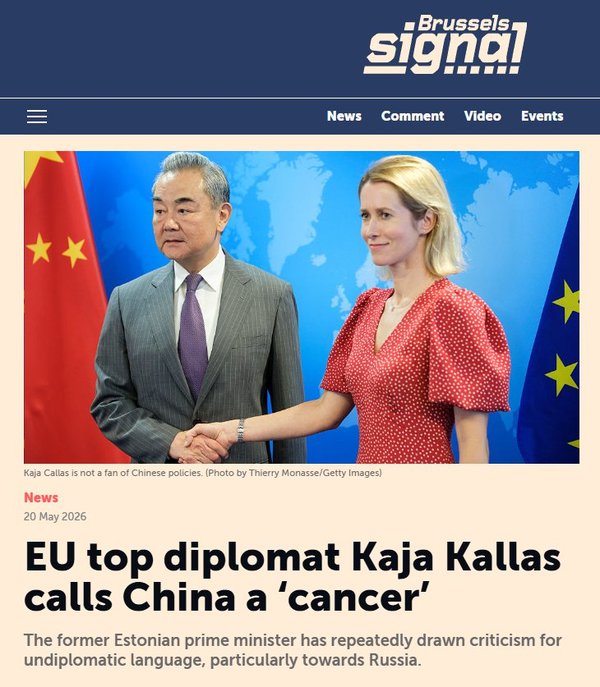
The Brussels Signal, a news and analysis platform focusing on EU politics, policy, and cultural issues, recently drew attention by reporting that "the EU’s top diplomat targeted China using unprecedentedly harsh language."
According to the Brussels Signal, High Representative Kallas stated at the annual Lennart Meri Conference in Tallinn, Estonia, on May 17: "The diagnosis on China—its coercive economic practices, unfair competition, and dominance in key sectors such as batteries, chemicals, shipbuilding, and raw materials—is already clearly laid out by Europe." She then added, "If you have a very serious illness, a cancer, you have only two choices: you either increase the dose of morphine, or you start chemotherapy." Kallas further noted, "Increasing morphine is not painful, but chemotherapy is painful," directly criticizing that "subsidizing European companies to help them compete with Chinese imports is merely a temporary fix that fails to resolve the underlying issue."
Kallas’ remarks spread like wildfire, immediately sparking intense debate over their interpretation. Some media outlets, including the Brussels Signal, reported that "Kallas called China a 'cancer,'" and screenshots of the statement garnered millions of views on social media. However, Euronews clarified that "a closer look at Kallas’ remarks reveals that she did not literally label China itself as a 'cancer,' but rather used a medical metaphor while discussing how Europe should respond to China’s trade pressure and economic competition." In this metaphor, 'morphine' represents subsidy policies aimed at helping European firms against Chinese imports, while 'chemotherapy' signifies tough EU trade countermeasures that could trigger retaliation from Beijing.
What makes Kallas’ metaphor so compelling, however, is not its mere rhetoric. It resonates because Europe’s core industries have become so deeply dependent on Chinese supply chains that they are losing their own capacity for substitution.
Euronews pointed out that "as of 2024, China supplied 98% of the solar panels imported into Europe, a vertical surge from 68% a decade ago." It added, "China’s share in lithium-ion battery imports for electric vehicles (EVs) also jumped from 75% in 2019 to 88%, while its dependency on inverter imports rose from 45% in 2018 to 61%." This creates a structural paradox: the more Europe accelerates its green transition, the deeper its reliance on China becomes.
Euronews further reported that "the figures in the industrial robotics sector are even more shocking: between early 2025 and early 2026, EU imports of Chinese industrial robots surged by 315%, while their average price dropped by 29%." This is the direct result of Beijing’s 'Made in China 2025' strategy, which mobilized state subsidies, low-interest loans, and tax incentives to expand advanced robotics companies more than threefold compared to 2020. Consequently, another paradox emerges: as Europe expands automation to restore its manufacturing competitiveness, Chinese companies are capturing a greater market share in the automation equipment market itself.
"The collapse of Europe's solar manufacturing base has already happened, and the EV sector is highly likely to be the next victim," Euronews warned. "Over the two years of 2024 and 2025, the European EV industry lost 104,000 jobs, and the wind industry is rapidly losing global market share to Chinese competitors—yet there is no evidence whatsoever that Beijing intends to change course."
[Why 'Morphine' is Not the Answer — The Structural Limits of Subsidies]
The Brussels Signal noted, "Kallas’ characterization of subsidies as 'morphine' is not just rhetoric; economics proves that subsidies cannot serve as a sustainable solution."
Alicia García-Herrero, a renowned economist and senior fellow, observed that "the competitiveness of Chinese EVs does not stem from a superior industrial model, but is rather the result of concentrating subsidies into relatively competitive sectors to compensate for structural distortions within its state capitalism." She warned, "If Europe enters a subsidy race in the same manner, it will only alleviate the symptoms of the problem without addressing its root causes."
The Brussels Signal added that "European Parliament research supports the same conclusion." The research indicates that "if investment is attracted solely through subsidies, projects are highly likely to merely shift from one EU country to another rather than enhancing the overall industrial capacity of Europe." In essence, it merely reallocates internal resources instead of fostering global competitiveness. As Kallas warned, "Eventually, even wealthy nations will run out of subsidy funds, and the fundamental problem will remain."
"The more fundamental issue is that China’s strategy is evolving at a speed that short-term subsidies cannot catch up with," the Brussels Signal explained. "The blueprint for China’s 15th Five-Year Plan (2026–2030) explicitly identifies new energy, new materials, hydrogen, and nuclear fusion as core growth engines, clearly demonstrating its resolve to further deepen its dominance in strategic manufacturing sectors." In other words, while Europe uses subsidies to close current gaps, China is already racing toward next-generation industries.
[Why Kallas’ Prescription is Right — The Efficacy of 'Chemotherapy' Tools]
The 'chemotherapy' tools proposed by Kallas—foreign investment screening, public procurement regulations, export controls, and supply chain diversification—have already begun to yield partial results. The EU’s Foreign Subsidies Regulation (FSR) is a tool designed to directly counter how Chinese subsidies distort the EU internal market. Paradoxically, the fact that Beijing is reacting so sensitively to this regulation proves that these measures are working.
EU Perspective reported, "In the solar inverter sector, the prescription has already been administered." It noted, "Approximately 70% of solar inverters in the EU are manufactured by Chinese companies, with Huawei alone accounting for 29% of global solar inverter capacity as of 2024. After officially designating solar inverters as a high-risk dependency in December 2025, the EU took measures to restrict EU funding for projects using products from high-risk suppliers." This marks the first step toward breaking the vicious cycle where subsidies were being used to purchase Chinese products.
Euronews also reported on May 29 that "the EU's in-depth investigation into JD.com’s acquisition of Germany’s Ceconomy is a concrete execution of the prescription Kallas spoke of." It added, "European industry is already heavily pressuring the European Commission to deploy trade defense instruments 'more flexibly, faster, and proactively.'" Kallas’ remarks provide the political momentum for those demands.
[Inside the EU: Admissions of a "Panic Attack" — A Belated but Necessary Awakening]
Euronews noted, "Even those who find Kallas’ remarks uncomfortable cannot refute their substance." A senior EU official, speaking on the condition of anonymity, admitted, "In recent weeks, we have been experiencing a panic attack regarding the China issue. The China problem has been swept under the rug for far too long." Jeromin Zettelmeyer, director of the Bruegel think tank, also diagnosed, "The tone in Brussels right now is panic. There is a pervasive fear that industrial collapse is imminent and that danger is staring us in the face." Euronews pointed out the contradiction of "giving the side-eye to the person who spoke the truth most directly, calling it 'diplomatically inappropriate,' while internally acknowledging the crisis."
In response, the Global Times, an English-language edition of China's state-run Global Times, countered that "the EU is using the 'wrong prescription' of trade barriers." Ironically, however, the outlet introduced a quote from the Director of the Finnish Security and Intelligence Service, who compared Europe’s simultaneous over-reliance on US software and Chinese hardware to "a body infiltrated by two types of cancer." Paradoxically, even an adversary's state-run media has acknowledged how accurately the cancer metaphor describes the reality.
[A Divided Europe is the Real Danger — "United We Stand, Divided We Break"]
Kallas’ diagnosis extends beyond the China issue. She warned that "the US, China, and Russia all want a divided EU," emphasizing, "We must understand why they dislike the EU. If we are united, we become an equal superpower." She particularly cautioned that individual member states seeking unilateral deals with Washington play right into the Trump administration's 'divide and conquer' strategy, warning that if countries act separately, "we will be broken like a bundle of twigs."
In this context, Kallas’ 'chemotherapy' remarks take on a more multi-dimensional meaning. Her argument is that for Europe to survive economic pressure from China, the EU as a whole must transcend the short-term calculations of individual nations, share the pain, and commit to a fundamental structural transition. As long as France supports a hardline stance while Germany adheres to a moderate approach out of fear of losing access to the Chinese market, Europe’s chemotherapy cannot even begin.
[Conclusion — Why We Need Those Who Speak Uncomfortable Truths]
The problem Europe faces is not merely a trade conflict with China. It is a situation where Europe must admit that the supply chain model it built over the past two decades for efficiency and cost reduction has transformed into a geopolitical risk. Reducing dependency on China will undoubtedly entail pain, including rising costs and industrial restructuring. However, if Europe relies solely on subsidies and temporary fixes to avoid that pain, it is highly likely to lose leadership even in future industries.
Ultimately, Kallas’ remarks are significant not because she criticized China, but because Europe is finally beginning to recognize 'excessive dependence on China' itself—rather than 'cheap China'—as the core problem. Depending on how aggressively the EU pushes forward with supply chain restructuring and industrial protection measures in the future, not only the future of the European economy but also the global economic order is highly likely to enter a new phase.
- TAG