


추부길 whytimespen1@gmail.com
[“Agreed, but Not Approved”: Trump’s Final Calculus]
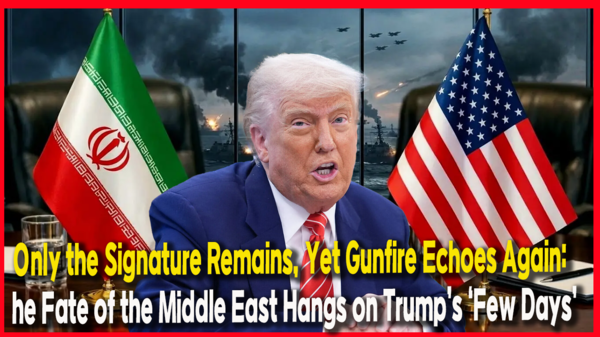
While the United States and Iran have reached a de facto working-level agreement on a Memorandum of Understanding (MOU) centered on a 60-day ceasefire extension and the initiation of nuclear talks, U.S. President Donald Trump has withheld his final signature, plunging the Middle East back into a state of deep uncertainty. Even in the final stages of negotiations, U.S. airstrikes and Iranian retaliatory attacks persisted in the Strait of Hormuz, and the two sides continue to offer conflicting interpretations regarding the nuclear issue and control over the strait. With President Trump stating that he "needs a few more days to think," intense attention is focused on whether this agreement will serve as the starting point for a historic end to the conflict or merely stop at another "temporary ceasefire to buy time."
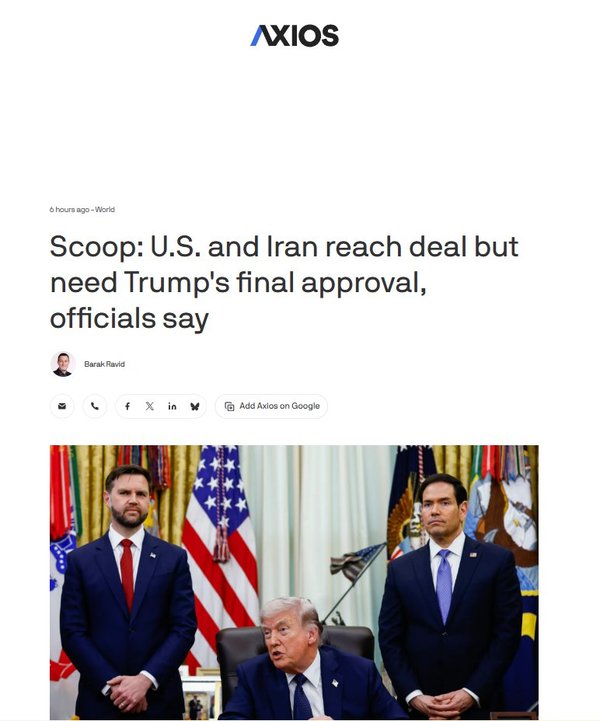
On May 29, the U.S. political news outlet Axios reported, citing multiple U.S. government officials and regional sources involved in the mediation process, that "U.S. and Iranian negotiating teams have agreed on a 60-day MOU." According to Axios, the core of this MOU lies in opening the Strait of Hormuz "without restriction" and requiring Iran to remove all naval mines within the strait within 30 days.
In return, the U.S. is reportedly prepared to lift the maritime blockade on Iranian ports and invoke partial sanctions waivers to allow Iranian crude oil exports. Furthermore, the U.S. is understood to have agreed to release a portion of Iran's frozen assets and discuss humanitarian aid mechanisms. Axios further explained that the scope of the agreement also encompasses ending the clashes between Israel and Hezbollah on the Lebanese front.
The nuclear issue was also integrated into this MOU. Axios reported that "the agreement includes a commitment from Iran not to pursue nuclear weapons, and the handling of highly enriched uranium (HEU) and uranium enrichment will be top-priority agenda items during the upcoming 60-day negotiation period." However, the U.S. side maintains a cautious stance, noting that Iran's nuclear concessions currently remain at the level of 'verbal commitments' and that actual compliance must be verified at the negotiating table.
Nevertheless, the most critical final step remains. Axios noted that "President Trump did not immediately approve the final proposal after being briefed on its details, but instead asked mediators for a few days to think." Iran has also not yet announced its official acceptance.
[Trump Postpones Approval: ‘Brinkmanship’ Shaking the Negotiation Table]
Analysts suggest that a strategic calculus extending far beyond simple caution underlies President Trump's decision to delay the final signature. The move is viewed as an attempt to manage backlash from Republican hardliners and Israel, while simultaneously ramping up pressure until the final moment to extract further concessions from Iran on the nuclear front.
In fact, throughout the negotiation period, President Trump consistently alternated between hawkish messages and diplomatic signals. Over the weekend, via media interviews and social media, he raised the sense of urgency by stating that the chances of "a deal versus a resumption of airstrikes are 50-50," only to remark a few hours later that an announcement would be made "very shortly."
During a White House cabinet meeting on May 28, Trump publicly invoked the military option once again, stating, "If we don't get a deal, we're just going to have to finish the job." On the same day, the U.S. Department of the Treasury’s Office of Foreign Assets Control (OFAC) intensified the pressure by designating the Persian Gulf Strait Authority (PGSA) of Iran, along with affiliated entities and individuals, to the Specially Designated Nationals (SDN) list.
This is evaluated as a quintessential 'Trump-style maximum pressure negotiation' strategy, concurrently running negotiations alongside military and economic coercion. Notably, as hardliners within the Republican Party pushed back, labeling the 60-day ceasefire "a disaster," President Trump focused on preempting concerns over a rushed deal, emphasizing that "this will be a proper deal, unlike the Obama era."
[Same MOU, Entirely Different Interpretations Rendered by the U.S. and Iran]
The underlying issue is that the United States and Iran are interpreting the exact same MOU in diametric opposition.
CNBC reported that "the gap in perception between the two sides surrounding the agreement is substantial." Iran's Fars News Agency countered that "the Strait of Hormuz will remain under Iranian management," arguing that the phrase "completely open" claimed by President Trump does not align with reality.
Reuters similarly noted that "Iran has not agreed to the disposal of its highly enriched uranium stockpiles, maintaining the position that the nuclear issue is not a core provision of this preliminary agreement."
Conversely, the U.S. side asserts that Iran has already communicated its willingness to make nuclear-related concessions. U.S. officials signaled that future negotiations will proceed on a strict quid pro quo basis, stating, "The more Iran concedes, the more it stands to gain."
Iran, on the other hand, is placing its emphasis on security guarantees. Fars News Agency claimed that "the agreement includes provisions stating that the U.S. and its allies will not attack Iran or its allied forces," adding that "in return, Iran also agreed not to launch preemptive strikes against the U.S. and its allies."
Ultimately, while the U.S. reads the document focusing on 'nuclear restrictions and the opening of the strait,' Iran is interpreting it through the lens of 'security guarantees and sanctions relief.'
[Gunfire Echoes in Hormuz on the Very Eve of the Agreement]
A more perilous factor is that military clashes have persisted even as negotiations are underway.
CNN reported that on May 25, the U.S. military conducted airstrikes against missile launch sites and mine-laying vessels in southern Iran near the Strait of Hormuz. U.S. Central Command (CENTCOM) described the operation as "self-defense measures taken to eliminate threats to U.S. forces and commercial vessels."
However, Iran's Ministry of Foreign Affairs strongly reacted, stating, "The U.S. launched an attack at a time when diplomatic negotiations were underway through Pakistani mediation," and called it "clear evidence of U.S. deception and betrayal."
The clashes did not stop there. On May 27, the U.S. military struck additional Iranian military facilities and intercepted multiple Iranian drones near Hormuz. Subsequently, the Islamic Revolutionary Guard Corps (IRGC) launched retaliatory strikes targeting a U.S. military base in Kuwait, as reported by the Associated Press (AP).
The Kuwaiti military also officially confirmed that its "air defense networks are responding to hostile missile and drone attacks." U.S. Central Command defined the IRGC’s actions as an "egregious ceasefire violation," while the IRGC countered that it was "retaliation for the U.S. airstrikes."
In short, a bizarre dynamic persists where the battlefield remains active while negotiations continue.
[A 60-Day Peace, or a ‘Dangerous Reprieve’ Before a Larger Conflict?]
Experts point out that even if this MOU is executed, the genuine hurdles are only just beginning. This is because variables such as the nuclear issue, the IRGC factor, and Israel's hardline stance remain entirely unresolved.
In particular, many analysts evaluate that this agreement resembles a temporary safety pin to avert an all-out war, rather than a 'peace treaty' to end the conflict. Indeed, a scenario is being raised where both sides might continually extend the negotiation period under mutual agreement as the 60-day deadline approaches, thereby sustaining a de facto 'long-term provisional truce.'
Citing a U.S. official, Axios reported that "there is an opportunity to normalize the Iranian economy, and factions exist within Iran that believe they need to move in a different direction," but added, "we will find out through the 60-day negotiation whether that is genuine."
Ultimately, even if President Trump presses the final approval button, the instability in the Middle East will not dissipate overnight. Rather, the current MOU is highly likely to be a temporary truce built upon a precarious equilibrium to prevent a larger collision, rather than an end to the war. And the final key to that volatile balance remains firmly held in the hands of President Trump.

- TAG